India-Mali Forum for Export Promotion and Trade Relations
#GS-1 #Geography #Physical Geography #GS-3 #Economy #Current Events #International #Bilateral Trade #Mali
Why in News
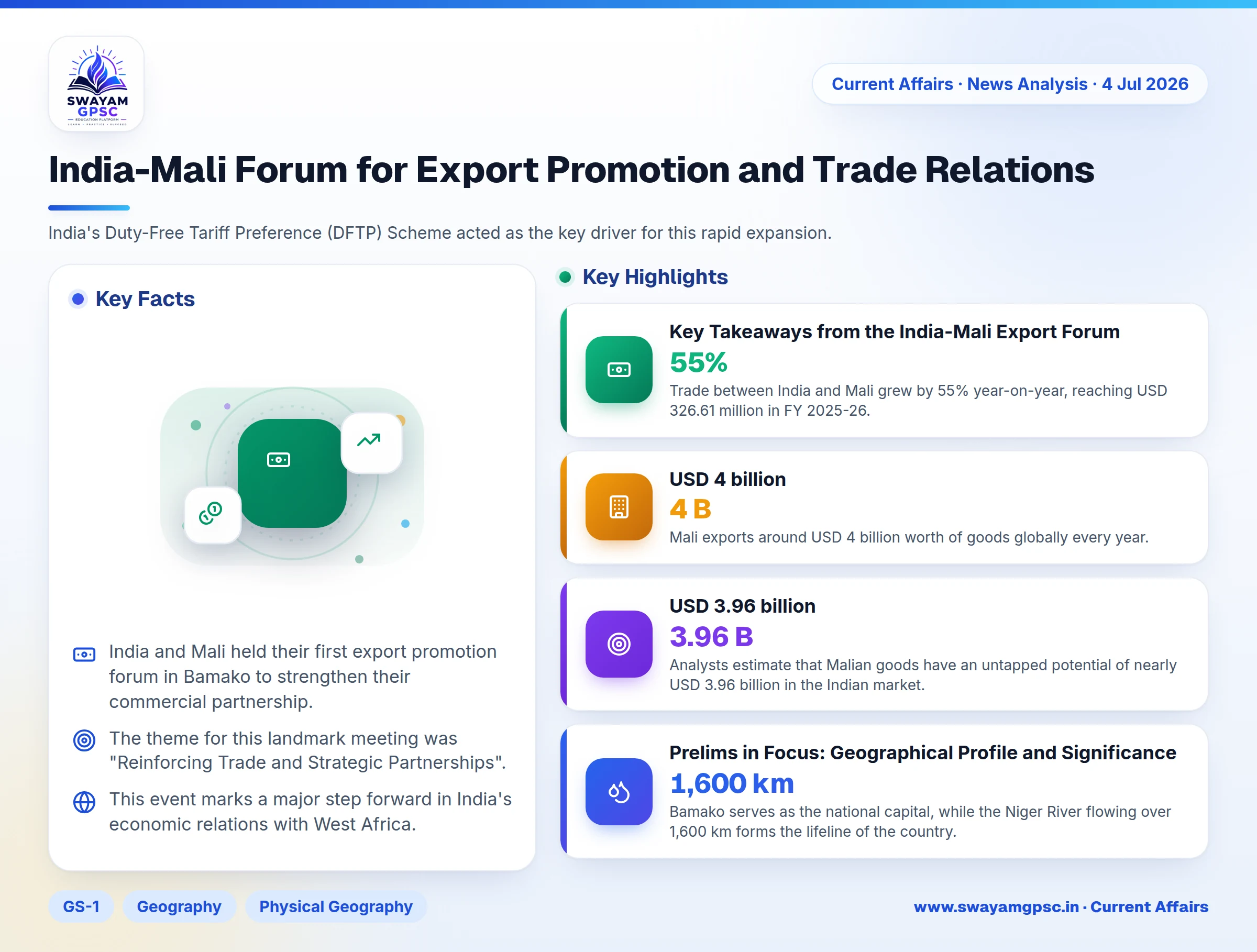
- India and Mali held their first export promotion forum in Bamako to strengthen their commercial partnership.
- The theme for this landmark meeting was "Reinforcing Trade and Strategic Partnerships".
- This event marks a major step forward in India's economic relations with West Africa.
Key Takeaways from the India-Mali Export Forum
- Trade between India and Mali grew by 55% year-on-year, reaching USD 326.61 million in FY 2025-26.
- India's Duty-Free Tariff Preference (DFTP) Scheme acted as the key driver for this rapid expansion.
- Mali exports around USD 4 billion worth of goods globally every year.
- Analysts estimate that Malian goods have an untapped potential of nearly USD 3.96 billion in the Indian market.
Key Trade Commodities and Priority Sectors
- Mali mainly exports raw cotton, finished leather, cashews, lead, gum arabic, and sesame to India.
- India primarily sends pharmaceuticals, cotton fabrics, two-wheelers, three-wheelers, and bicycles to Mali.
- Both countries identified textiles, mining, energy, and agro-processing as key areas for joint investments.
- They also decided to collaborate in healthcare and education infrastructure.
Mutual Requests and Future Investment Roadmap
- Mali requested Indian assistance to digitize its Certificate of Origin system and speed up medicine approvals.
- India asked Mali to review its ban on shea-nut exports and protect Indian citizens and assets.
- Mali promoted itself as a regional business center under its Vision Mali 2063 strategic plan.
- Mali announced an Investment Forum in December 2026 to invite global funding for bankable projects.
Prelims in Focus: Geographical Profile and Significance of Mali
- Mali is a landlocked nation in West Africa located within the Sahara and Sahel regions.
- It shares land borders with seven nations including Algeria, Niger, Burkina Faso, Côte d'Ivoire, Guinea, Senegal, and Mauritania.
- Bamako serves as the national capital, while the Niger River flowing over 1,600 km forms the lifeline of the country.
- The Sénégal River is formed by the confluence of the Bakoye and Bafing rivers at Bafoulabé.
- Mali's highest peak is Mount Hombori at 1,155 meters, located near the Dogon Plateau and Bandiagara Escarpment.
- Northern Mali features the Iforas Massif, a rugged sandstone plateau connected to the Saharan mountain system.
- The economy relies heavily on agriculture, with gold being its primary export along with cotton, livestock, and fishing.
- Historical cities like Timbuktu and Djenné were major centers of ancient trade and learning across the Saharan desert.