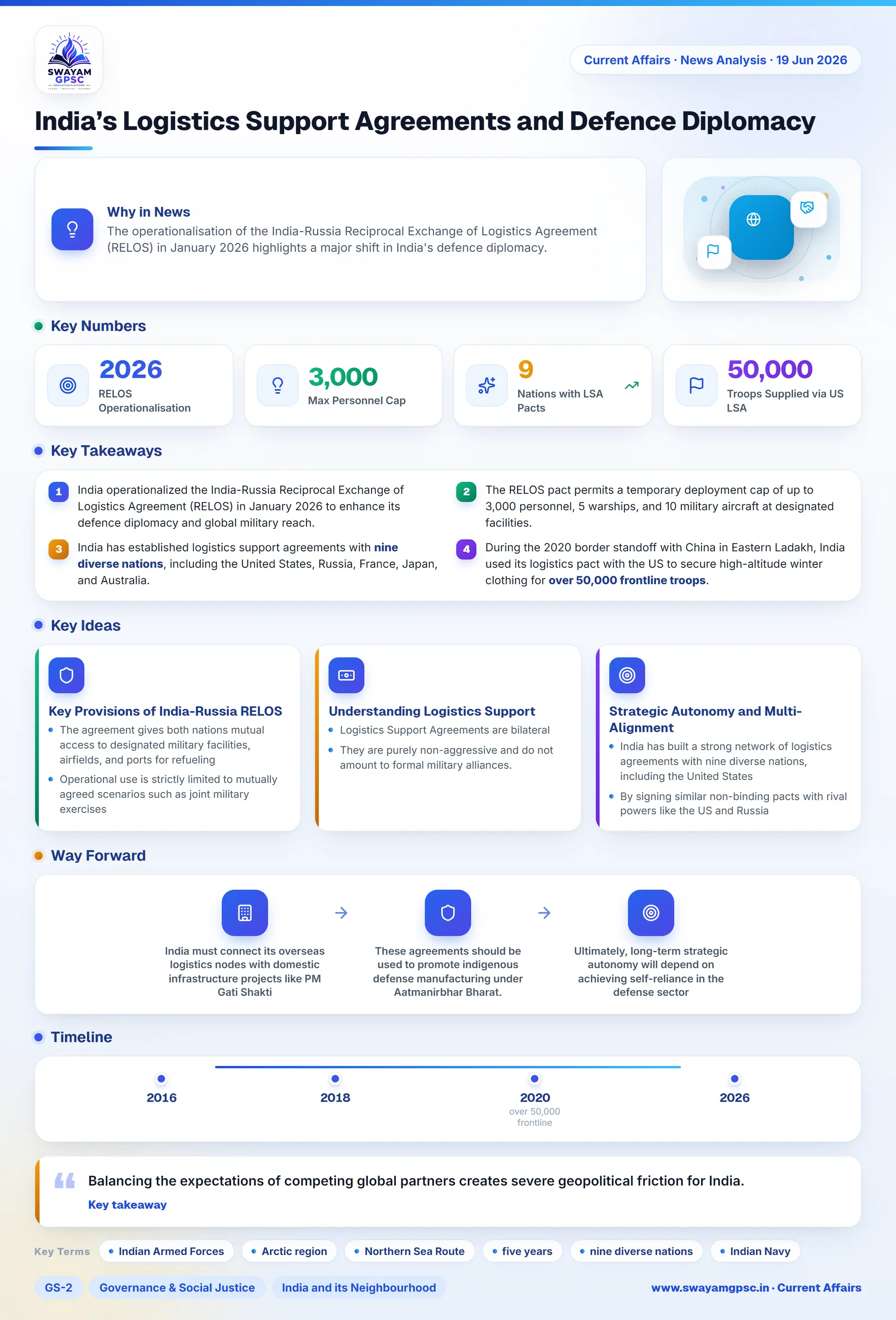
India’s Logistics Support Agreements and Defence Diplomacy
#GS-2 #Governance & Social Justice #India and its Neighbourhood #Bilateral Groupings & Agreements #Regional Groupings #Effect of Policies & Politics of Countries on India's Interests #Current Events #National #International #Economy #Infrastructure
Key takeaways
- India operationalized the India-Russia Reciprocal Exchange of Logistics Agreement (RELOS) in January 2026 to enhance its defence diplomacy and global military reach.
- The RELOS pact permits a temporary deployment cap of up to 3,000 personnel, 5 warships, and 10 military aircraft at designated facilities.
- India has established logistics support agreements with nine diverse nations, including the United States, Russia, France, Japan, and Australia.
- During the 2020 border standoff with China in Eastern Ladakh, India used its logistics pact with the US to secure high-altitude winter clothing for over 50,000 frontline troops.
Why in News
- The operationalisation of the India-Russia Reciprocal Exchange of Logistics Agreement (RELOS) in January 2026 highlights a major shift in India's defence diplomacy.
- Logistics Support Agreements act as vital force multipliers because they expand the global reach of the Indian Armed Forces while protecting India's strategic autonomy in a multipolar world.
Key Provisions of India-Russia RELOS
- The agreement gives both nations mutual access to designated military facilities, airfields, and ports for refueling, replenishment, and maintenance of warships and aircraft.
- Operational use is strictly limited to mutually agreed scenarios such as joint military exercises, bilateral training operations, routine port calls, and Humanitarian Assistance and Disaster Relief (HADR) missions.
- A temporary limit allows up to 3,000 personnel, 5 warships, and 10 military aircraft to be positioned at partner facilities at any given time.
- Officials clarify that this is only a transient cap for visiting troops rather than an agreement for permanent foreign military bases.
- Permissible services cover food, water, accommodation, transportation, petroleum, oils, lubricants, medical support, clothing, storage, spare parts, and navigation services.
- A unique aspect of RELOS is that it extends India's operational footprint into the Arctic region.
- This gives Indian forces access to Russia's northern infrastructure as climate change opens up new Northern Sea Route shipping lanes.
- The initial validity of the agreement is five years, with provisions for automatic extensions based on changing strategic needs.
Understanding Logistics Support Agreements
- Logistics Support Agreements are bilateral, non-binding military arrangements created to remove administrative and financial hurdles during joint operations.
- They are purely non-aggressive and do not amount to formal military alliances.
- They grant partner militaries mutual access to designated bases for routine maintenance, repairs, and refueling.
- The scope of engagement is strictly defined and cannot be invoked arbitrarily.
- Eligible activities include joint military drills, transit visits, and Humanitarian Assistance and Disaster Relief (HADR) operations.
- These agreements simplify pricing and use cashless accounting mechanisms to cut down the paperwork normally required for foreign military visits.
Strategic Autonomy and Multi-Alignment
- India has built a strong network of logistics agreements with nine diverse nations, including the United States, Russia, the United Kingdom, France, Japan, Australia, Vietnam, and Singapore, alongside a defense agreement with Oman.
- By signing similar non-binding pacts with rival powers like the US and Russia, India successfully practices its policy of multi-alignment without joining any single bloc.
- These agreements extend the endurance of the Indian Navy during long-range patrols and anti-piracy missions in key areas like the Gulf of Aden.
- Indian vessels can use partner facilities for rapid operational turnarounds without needing to sail back to domestic ports.
- In contrast to China's physical military bases in places like Djibouti or commercial ports like Hambantota, India relies on an invisible network of logistics nodes.
- This network covers strategic maritime choke points like the Mozambique Channel, the Strait of Malacca, and the Sunda Straits.
- Combined with real-time maritime domain awareness, this allows India to track Chinese PLA Navy movements from the Southern Indian Ocean to the Arctic.
- India is currently reorganizing its military into Integrated Theater Commands, and these logistics pacts provide ready-made external infrastructure for power projection.
- During the 2020 border standoff with China in Eastern Ladakh, India used its logistics pact with the US to urgently import specialized winter clothing for over 50,000 frontline troops.
- These agreements are reciprocal, allowing foreign navies like the United Kingdom's Royal Navy to repair their ships in Indian shipyards.
- Sourcing local spare parts helps establish India as a reliable defense manufacturing hub in the Indian Ocean Region.
Challenges With India's LSA Network
- Balancing the expectations of competing global partners creates severe geopolitical friction for India.
- Implementing RELOS with Russia while deepening ties with the US via LEMOA (2016) and COMCASA (2018) forces India to walk a diplomatic tightrope.
- Western nations view these pacts as a way to contain China, while Russia views them through an anti-NATO lens.
- Managing relations without running afoul of American sanctions under CAATSA requires complicated non-dollar trade mechanisms like Rupee-Ruble arrangements.
- LSAs lack mutual defense obligations, meaning foreign partners can request logistical help during active conflicts.
- Refusing these requests to protect India's neutrality can strain diplomatic ties.
- Russia's growing dependence on Beijing poses a threat to the reliability of RELOS during a potential border conflict between India and China.
Way Forward
- India must connect its overseas logistics nodes with domestic infrastructure projects like PM Gati Shakti and the Integrated Theatre Commands.
- These agreements should be used to promote indigenous defense manufacturing under Aatmanirbhar Bharat.
- Ultimately, long-term strategic autonomy will depend on achieving self-reliance in the defense sector and building world-class domestic infrastructure.