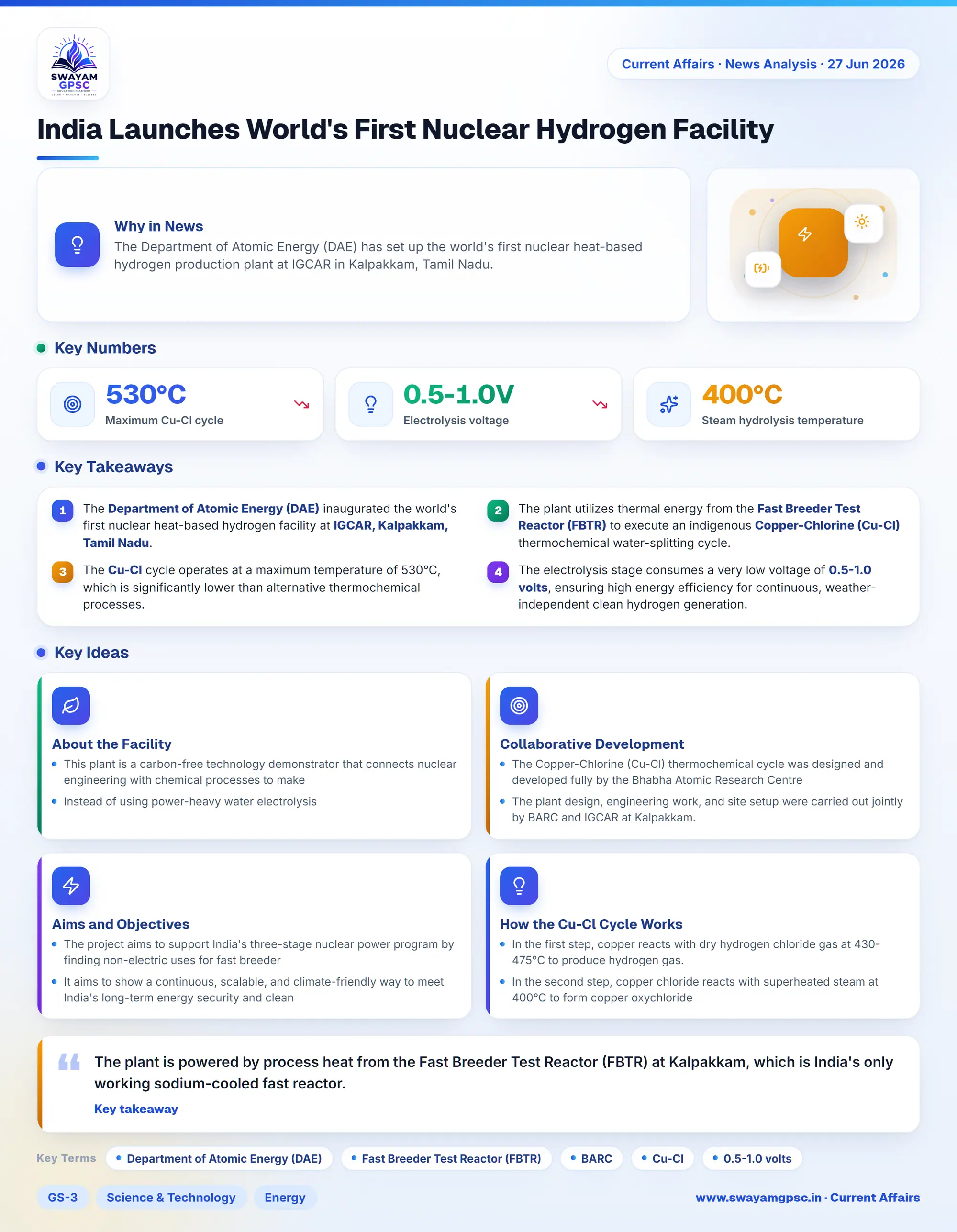
India Launches World's First Nuclear Hydrogen Facility
#GS-3 #Science & Technology #Energy #Economy #Infrastructure #Current Events #National
Key takeaways
- The Department of Atomic Energy (DAE) inaugurated the world's first nuclear heat-based hydrogen facility at IGCAR, Kalpakkam, Tamil Nadu.
- The plant utilizes thermal energy from the Fast Breeder Test Reactor (FBTR) to execute an indigenous Copper-Chlorine (Cu-Cl) thermochemical water-splitting cycle.
- The Cu-Cl cycle operates at a maximum temperature of 530°C, which is significantly lower than alternative thermochemical processes.
- The electrolysis stage consumes a very low voltage of 0.5-1.0 volts, ensuring high energy efficiency for continuous, weather-independent clean hydrogen generation.
Why in News
- The Department of Atomic Energy (DAE) has set up the world's first nuclear heat-based hydrogen production plant at IGCAR in Kalpakkam, Tamil Nadu.
- It uses thermal energy from the Fast Breeder Test Reactor (FBTR) to produce hydrogen through a domestic Copper-Chlorine (Cu-Cl) thermochemical water-splitting method.
About the Facility
- This plant is a carbon-free technology demonstrator that connects nuclear engineering with chemical processes to make clean hydrogen.
- Instead of using power-heavy water electrolysis, it uses high-temperature heat directly from a nuclear core to split water into hydrogen and oxygen.
Collaborative Development
- The Copper-Chlorine (Cu-Cl) thermochemical cycle was designed and developed fully by the Bhabha Atomic Research Centre (BARC) in Mumbai.
- The plant design, engineering work, and site setup were carried out jointly by BARC and IGCAR at Kalpakkam.
Aims and Objectives
- The project aims to support India's three-stage nuclear power program by finding non-electric uses for fast breeder reactors.
- It aims to show a continuous, scalable, and climate-friendly way to meet India's long-term energy security and clean hydrogen goals.
How the Cu-Cl Cycle Works
- In the first step, copper reacts with dry hydrogen chloride gas at 430-475°C to produce hydrogen gas.
- In the second step, copper chloride reacts with superheated steam at 400°C to form copper oxychloride while regenerating hydrogen chloride gas.
- In the third step, copper oxychloride is heated to about 500°C using reactor heat to release oxygen gas and produce cuprous chloride.
- In the final step, cuprous chloride goes through low-voltage electrolysis to regenerate copper and copper chloride, which completes the closed loop.
Key Features of the Kalpakkam Facility
- The plant is powered by process heat from the Fast Breeder Test Reactor (FBTR) at Kalpakkam, which is India's only working sodium-cooled fast reactor.
- The Cu-Cl cycle needs a maximum temperature of only 530°C, which is much lower than the 850°C required for the Sulfur-Iodine cycle.
- The electrolysis stage uses only 0.5-1.0 volts, which is much lower than traditional water electrolysis that needs 1.23 volts or more.
- Unlike solar or wind energy, this nuclear-powered system runs continuously without depending on the weather.
Key Applications
- Clean hydrogen can replace fossil-fuel gray hydrogen in steel, oil refining, and chemical plants to cut carbon emissions.
- It provides carbon-free hydrogen to make green ammonia, which helps India's fertilizer production and food security.
- It supplies fuel for fuel-cell vehicles, shipping, aviation, and large-scale renewable energy storage.