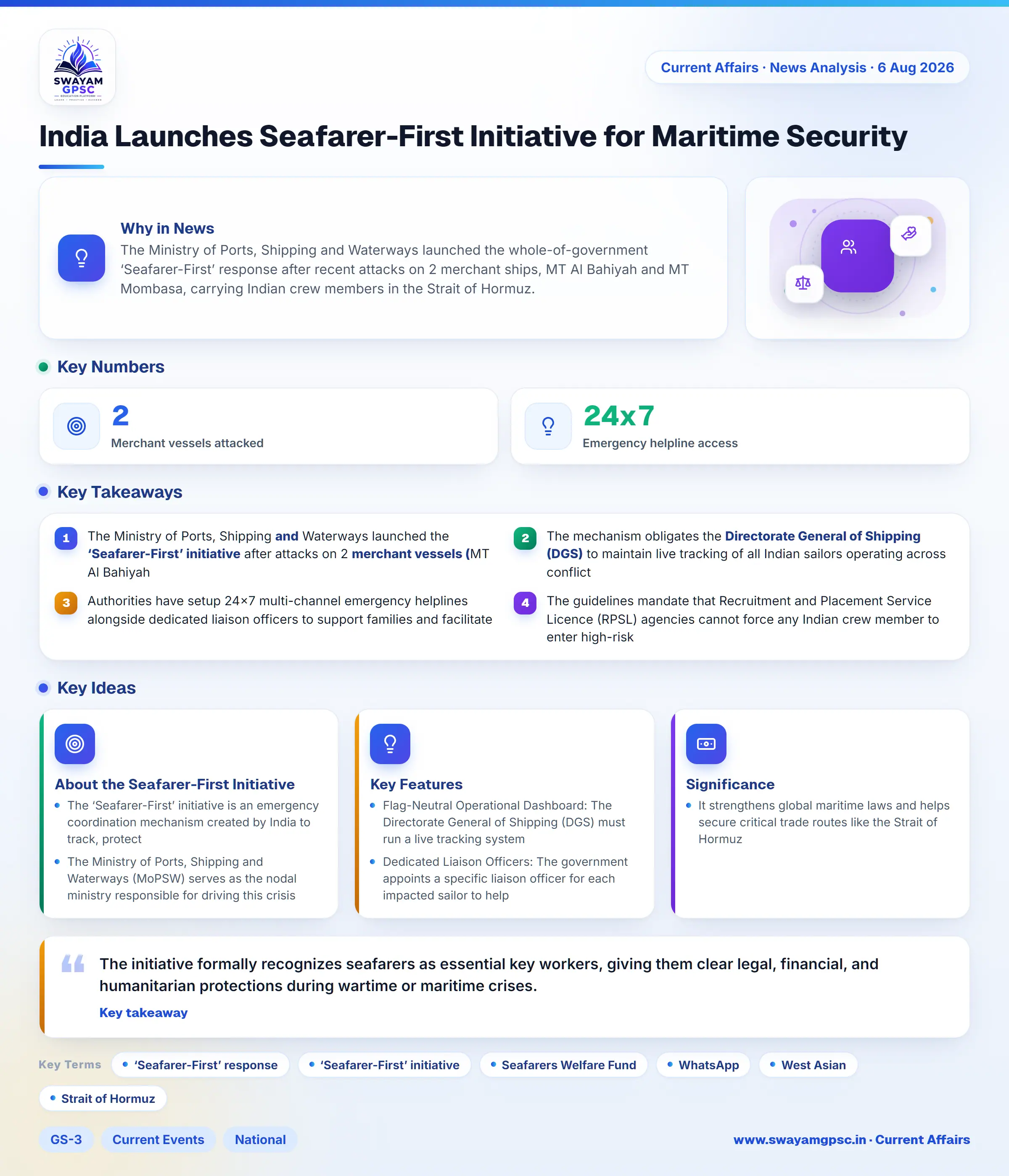
India Launches Seafarer-First Initiative for Maritime Security
#GS-3 #Current Events #National #International #GS-2 #Governance & Social Justice #Vulnerable Sections #Economy #Infrastructure
Key takeaways
- The Ministry of Ports, Shipping and Waterways launched the ‘Seafarer-First’ initiative after attacks on 2 merchant vessels (MT Al Bahiyah and MT Mombasa) carrying Indian crew in the Strait of Hormuz.
- The mechanism obligates the Directorate General of Shipping (DGS) to maintain live tracking of all Indian sailors operating across conflict zones in West Asia regardless of foreign flag registrations.
- Authorities have setup 24x7 multi-channel emergency helplines alongside dedicated liaison officers to support families and facilitate medical care, repatriation, and funds from the Seafarers Welfare Fund.
- The guidelines mandate that Recruitment and Placement Service Licence (RPSL) agencies cannot force any Indian crew member to enter high-risk maritime zones without informed consent.
Why in News
- The Ministry of Ports, Shipping and Waterways launched the whole-of-government ‘Seafarer-First’ response after recent attacks on 2 merchant ships, MT Al Bahiyah and MT Mombasa, carrying Indian crew members in the Strait of Hormuz.
About the Seafarer-First Initiative
- The ‘Seafarer-First’ initiative is an emergency coordination mechanism created by India to track, protect, and assist Indian sailors working in high-risk maritime zones across West Asia, including the Persian Gulf, Strait of Hormuz, and Gulf of Oman, regardless of which country's flag their ship flies.
- The Ministry of Ports, Shipping and Waterways (MoPSW) serves as the nodal ministry responsible for driving this crisis response framework.
- This mechanism aims to maintain a clear record of every Indian sailor in conflict zones, safeguard their legal and working rights, deliver 24x7 medical and emergency support, and stop employers from forcing sailors into dangerous waters without explicit consent.
Key Features
- Flag-Neutral Operational Dashboard: The Directorate General of Shipping (DGS) must run a live tracking system that monitors the exact location, crew details, cargo type, and risk status of every Indian sailor, no matter which nation owns or registers the ship.
- Dedicated Liaison Officers: The government appoints a specific liaison officer for each impacted sailor to help their family, coordinate medical treatment, manage bring-back efforts, handle wage payments, and process aid from the Seafarers Welfare Fund.
- 24x7 Multi-Channel Support System: Authorities activated round-the-clock emergency assistance lines through a domestic toll-free number, an international helpline, WhatsApp, and email.
- Strict Employer and RPSL Compliance: The policy directs vessel owners and Recruitment and Placement Service Licence (RPSL) agencies to ensure that no Indian sailor is forced to navigate through high-risk zones against their will.
- Fresh Threat-Based Voyage Approvals: Before sailing through high-risk West Asian waters, ships must complete mandatory pre-trip risk assessments, receive professional approval from the ship's Master, and coordinate closely with naval and coastal defense authorities.
Significance
- The initiative formally recognizes seafarers as essential key workers, giving them clear legal, financial, and humanitarian protections during wartime or maritime crises.
- It strengthens global maritime laws and helps secure critical trade routes like the Strait of Hormuz, which is essential for worldwide energy supplies.