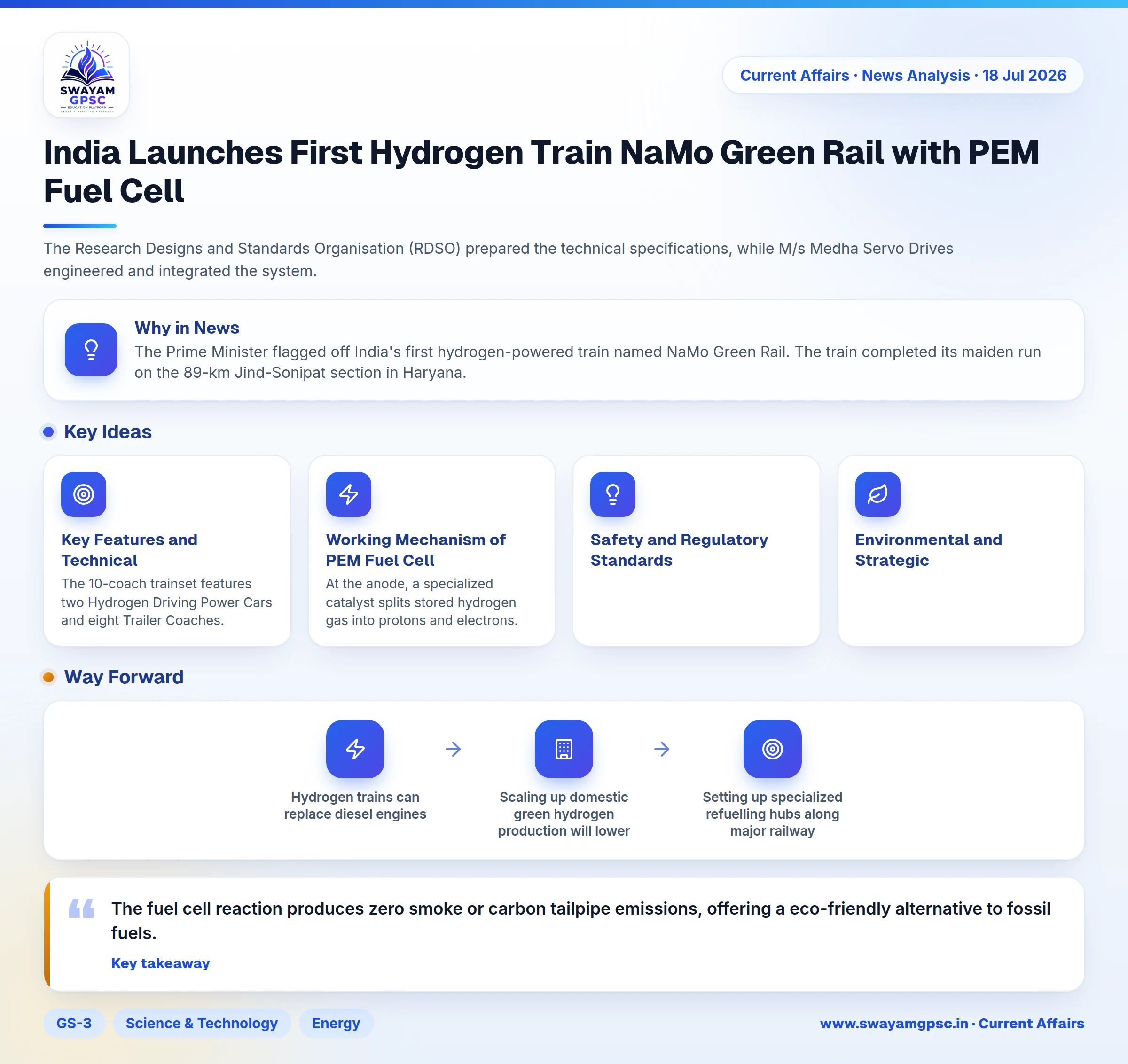
India Launches First Hydrogen Train NaMo Green Rail with PEM Fuel Cell
#GS-3 #Science & Technology #Energy #Environment #Sustainable Development #Economy #Infrastructure #Current Events #National #Prelims
Why in News
- The Prime Minister flagged off India's first hydrogen-powered train named NaMo Green Rail.
- The train completed its maiden run on the 89-km Jind-Sonipat section in Haryana.
- This technology demonstration project validates hydrogen propulsion, refuelling systems, and operating procedures for future rail operations.
Key Features and Technical Specifications
- The Research Designs and Standards Organisation (RDSO) prepared the technical specifications, while M/s Medha Servo Drives engineered and integrated the system.
- The 10-coach trainset features two Hydrogen Driving Power Cars and eight Trailer Coaches.
- Each power car generates 1,200 kW, giving the train a total propulsion capacity of 2,400 kW.
- The train operates at a service speed of 75 kmph with a maximum design speed of 110 kmph.
- The energy storage system pairs fuel cells with Lithium Iron Phosphate (LFP) batteries to manage acceleration and fluctuating track loads.
Working Mechanism of PEM Fuel Cell
- The train carries an onboard Proton Exchange Membrane (PEM) fuel cell that acts as a clean electricity generator.
- At the anode, a specialized catalyst splits stored hydrogen gas into protons and electrons.
- A polymer membrane allows positively charged protons to cross to the cathode while blocking electrons.
- Blocked electrons flow through an external electrical circuit, generating electricity to run the traction motors.
- At the cathode, protons and electrons recombine with atmospheric oxygen to release harmless water vapour and heat.
Safety and Regulatory Standards
- Onboard cylinders store hydrogen refuled at 350 bar pressure from a 500-bar compression facility located in Jind.
- Automated sensors continuously track gas leaks, flames, and heat to trigger an immediate emergency shut-off without manual input.
- Active canopy ventilation loops continuously dilute any escaping hydrogen gas and vent it safely into the open atmosphere.
- The storage system earned approval from the Petroleum and Explosives Safety Organisation (PESO) and received independent validation from TÜV SÜD, Germany.
Environmental and Strategic Significance
- The fuel cell reaction produces zero smoke or carbon tailpipe emissions, offering a eco-friendly alternative to fossil fuels.
- With this deployment, India joins advanced nations like Germany, Japan, China, and the United States in operating hydrogen rail technology.
- The initiative aligns with the National Green Hydrogen Mission and accelerates India's progress toward Net Zero targets.
- Deploying hydrogen trains creates reliable demand for green hydrogen and stimulates investments in clean energy infrastructure.
Challenges
- Producing green hydrogen remains significantly more expensive than procuring traditional diesel fuel.
- High-pressure storage and specialized transport requirements demand capital-intensive infrastructure.
- The limited availability of green hydrogen across the country restricts rapid large-scale adoption.
Way Forward
- Hydrogen trains can replace diesel engines on non-electrified routes, heritage tracks, and difficult terrains like the Kalka-Shimla line.
- Scaling up domestic green hydrogen production will lower fuel costs and ensure steady supply for transport applications.
- Setting up specialized refuelling hubs along major railway corridors will enable broader deployment across the national train network.