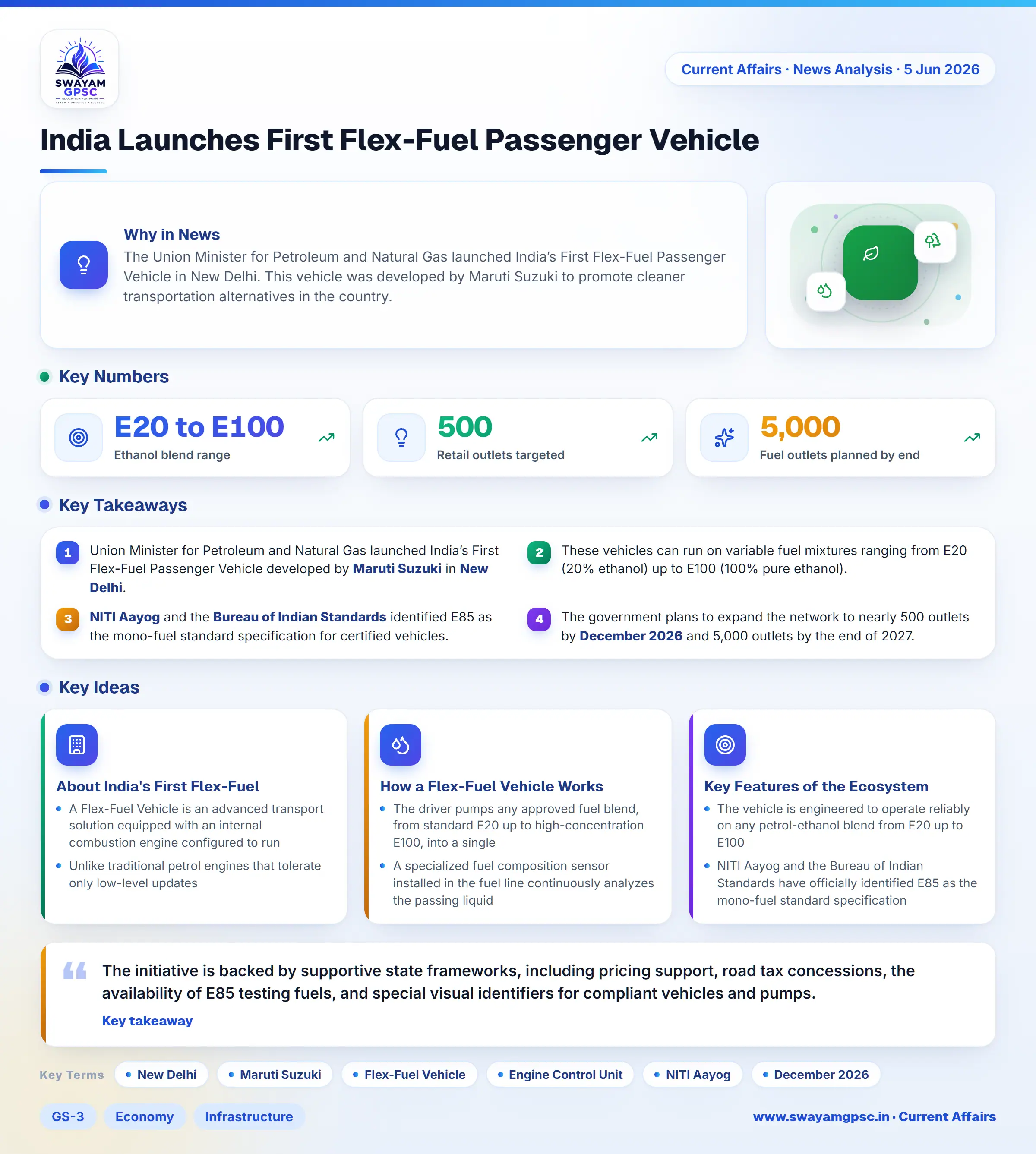
India Launches First Flex-Fuel Passenger Vehicle
#GS-3 #Economy #Infrastructure #Environment #Science & Technology #Energy
Key takeaways
- Union Minister for Petroleum and Natural Gas launched India’s First Flex-Fuel Passenger Vehicle developed by Maruti Suzuki in New Delhi.
- These vehicles can run on variable fuel mixtures ranging from E20 (20% ethanol) up to E100 (100% pure ethanol).
- NITI Aayog and the Bureau of Indian Standards identified E85 as the mono-fuel standard specification for certified vehicles.
- The government plans to expand the network to nearly 500 outlets by December 2026 and 5,000 outlets by the end of 2027.
Why in News
- The Union Minister for Petroleum and Natural Gas launched India’s First Flex-Fuel Passenger Vehicle in New Delhi.
- This vehicle was developed by Maruti Suzuki to promote cleaner transportation alternatives in the country.
About India's First Flex-Fuel Passenger Vehicle
- A Flex-Fuel Vehicle is an advanced transport solution equipped with an internal combustion engine configured to run seamlessly on a wide range of fuel combinations.
- Unlike traditional petrol engines that tolerate only low-level updates, these vehicles can adapt dynamically to varying mixtures of petrol and ethanol, ranging from E20 to E100.
How a Flex-Fuel Vehicle Works
- The driver pumps any approved fuel blend, from standard E20 up to high-concentration E100, into a single, unified fuel tank.
- A specialized fuel composition sensor installed in the fuel line continuously analyzes the passing liquid, instantly detecting the exact alcohol-to-gasoline ratio.
- The sensor transmits this composition data to the vehicle’s Engine Control Unit.
- Because ethanol has a lower energy density but a higher octane rating than standard petrol, the Engine Control Unit automatically adapts the engine settings.
- The Engine Control Unit instantly adjusts the timing and volume of the fuel injectors and advances or retards the spark plug ignition, ensuring smooth combustion without any engine knocking.
Key Features of the Ecosystem and Vehicle
- The vehicle is engineered to operate reliably on any petrol-ethanol blend from E20 up to E100, providing flexible fueling options based on local availability.
- NITI Aayog and the Bureau of Indian Standards have officially identified E85 as the mono-fuel standard specification for certified Flex-Fuel Vehicles.
- NITI Aayog officially classifies ethanol-based Flex-Fuel Vehicles, including those running on high-blend E85, as Zero-Emission Vehicles due to their minimal environmental footprint.
- The government roadmap plans an initial launch of 50 to 100 Flex-Fuel Vehicle-ready retail stations in the Delhi-NCR and Mumbai-Pune-Nagpur corridors.
- This network is set to expand to nearly 500 outlets by December 2026 and roughly 5,000 across major cities by the end of 2027.
- The initiative is backed by supportive state frameworks, including pricing support, road tax concessions, the availability of E85 testing fuels, and special visual identifiers for compliant vehicles and pumps.
- The vehicle utilizes ethanol produced entirely within India from a variety of raw materials, including broken grains, agricultural waste, bamboo, and seaweed.