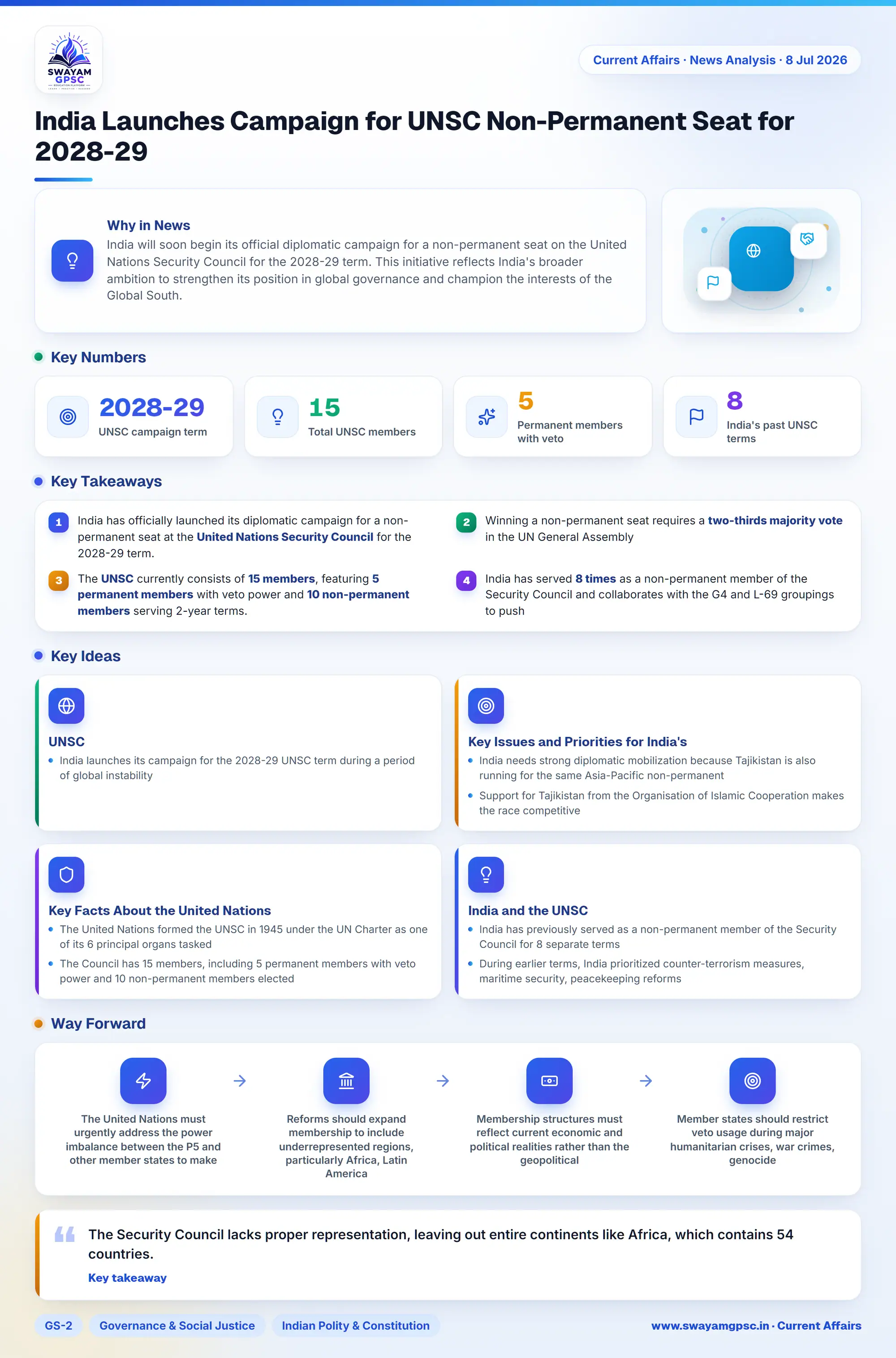
India Launches Campaign for UNSC Non-Permanent Seat for 2028-29
#GS-2 #Governance & Social Justice #Indian Polity & Constitution #Current Events #International #Important International Institutions #India and its Neighbourhood #International Relations #UNSC Reforms
Key takeaways
- India has officially launched its diplomatic campaign for a non-permanent seat at the United Nations Security Council for the 2028-29 term.
- Winning a non-permanent seat requires a two-thirds majority vote in the UN General Assembly, where India faces competition from Tajikistan for the Asia-Pacific slot.
- The UNSC currently consists of 15 members, featuring 5 permanent members with veto power and 10 non-permanent members serving 2-year terms.
- India has served 8 times as a non-permanent member of the Security Council and collaborates with the G4 and L-69 groupings to push for institutional reforms.
Why in News
- India will soon begin its official diplomatic campaign for a non-permanent seat on the United Nations Security Council for the 2028-29 term.
- This initiative reflects India's broader ambition to strengthen its position in global governance and champion the interests of the Global South.
Summary
- India launches its campaign for the 2028-29 UNSC term during a period of global instability, marked by the Ukraine conflict and West Asia tensions.
- This bid will require extensive diplomatic efforts across various regions, including African nations, island states, OIC members, SCO partners, and Western allies.
- Securing this seat will also reinforce India's ongoing diplomatic push for permanent membership in a restructured United Nations Security Council.
Key Issues and Priorities for India's 2028-29 UNSC Bid
- India needs strong diplomatic mobilization because Tajikistan is also running for the same Asia-Pacific non-permanent seat at the UNSC.
- Support for Tajikistan from the Organisation of Islamic Cooperation makes the race competitive, requiring India to gather support beyond allies like the United States, Fiji, Austria, and Sri Lanka.
- India aims to lead the Global South by focusing on critical issues like energy security, fertilizer supply, economic development, and international governance.
- India will continue advocating for structural reforms in the United Nations Security Council to reflect current global political realities.
- The External Affairs Minister has started diplomatic outreach in the Gulf and Caribbean regions to build early backing for the upcoming UNSC election.
- The recent victory of Kyrgyzstan over the Philippines demonstrates that elections for UNSC seats are becoming increasingly competitive.
- This election victory was a historic milestone for Kyrgyzstan, marking its first Security Council seat since joining the United Nations in 1992.
Key Facts About the United Nations Security Council
- The United Nations formed the UNSC in 1945 under the UN Charter as one of its 6 principal organs tasked with maintaining global peace and security.
- The Council has 15 members, including 5 permanent members with veto power and 10 non-permanent members elected for 2-year terms by the UN General Assembly.
- Regional distribution allocates 5 non-permanent seats to Africa and Asia, 1 to Eastern Europe, 2 to Latin America and the Caribbean, and 2 to Western Europe and other states.
- The UN General Assembly conducts annual secret ballots where candidates must secure a two-thirds majority vote to win a seat.
- The UNSC is the only United Nations body whose decisions carry legally binding authority over all member nations under the UN Charter.
India and the UNSC
- India has previously served as a non-permanent member of the Security Council for 8 separate terms, most recently in 2021-22.
- During earlier terms, India prioritized counter-terrorism measures, maritime security, peacekeeping reforms, and global institutional restructuring.
- India collaborates with Brazil, Germany, and Japan in the G4 grouping to advocate for expanding both permanent and non-permanent seats in the UNSC.
Key Challenges Regarding the UNSC
- The Security Council lacks proper representation, leaving out entire continents like Africa, which contains 54 countries.
- Modern global issues are interconnected, yet the council excludes crucial geopolitical voices from shaping high-level security decisions.
- Major emerging economies such as India, Germany, Brazil, and South Africa remain excluded from permanent membership.
- Critics view the veto power as an undemocratic privilege that allows individual P5 members to block essential international action.
- An elite decision-making structure from the past cannot effectively manage the complex security challenges of the modern world.
- Deep geopolitical rivalries among permanent members often paralyze the UNSC and prevent swift resolution of global crises.
- Competing interests among the United States, Russia, and China create severe friction in major conflicts such as Taiwan and the Ukraine war.
- Decisions made by the Security Council carry binding legal authority, unlike resolutions passed by the UN General Assembly.
- Enforcement tools like international sanctions can restrict member states' national sovereignty when the council decides to act.
Way Forward
- The United Nations must urgently address the power imbalance between the P5 and other member states to make the Security Council more democratic.
- Reforms should expand membership to include underrepresented regions, particularly Africa, Latin America, and the Global South.
- Membership structures must reflect current economic and political realities rather than the geopolitical balance established after 1945.
- Member states should restrict veto usage during major humanitarian crises, war crimes, genocide, and mass atrocities.
- The Security Council should increase transparency by conducting open debates and consulting non-member nations affected by its policies.
- The Council must enforce its resolutions consistently so that peacekeeping and sanction measures do not appear selective.
- In September 2022, India hosted a joint meeting of the G4 and L-69 groupings in New York to accelerate multilateral reform efforts.
- India should strengthen ties with its traditional allies in the Global South by addressing their primary security and developmental concerns.
Conclusion
- India's campaign for the 2028-29 UNSC seat offers a key strategic opportunity to project itself as a responsible leader of the Global South.
- India must leverage this platform to champion broader institutional reforms, equitable representation, and accountable global governance.