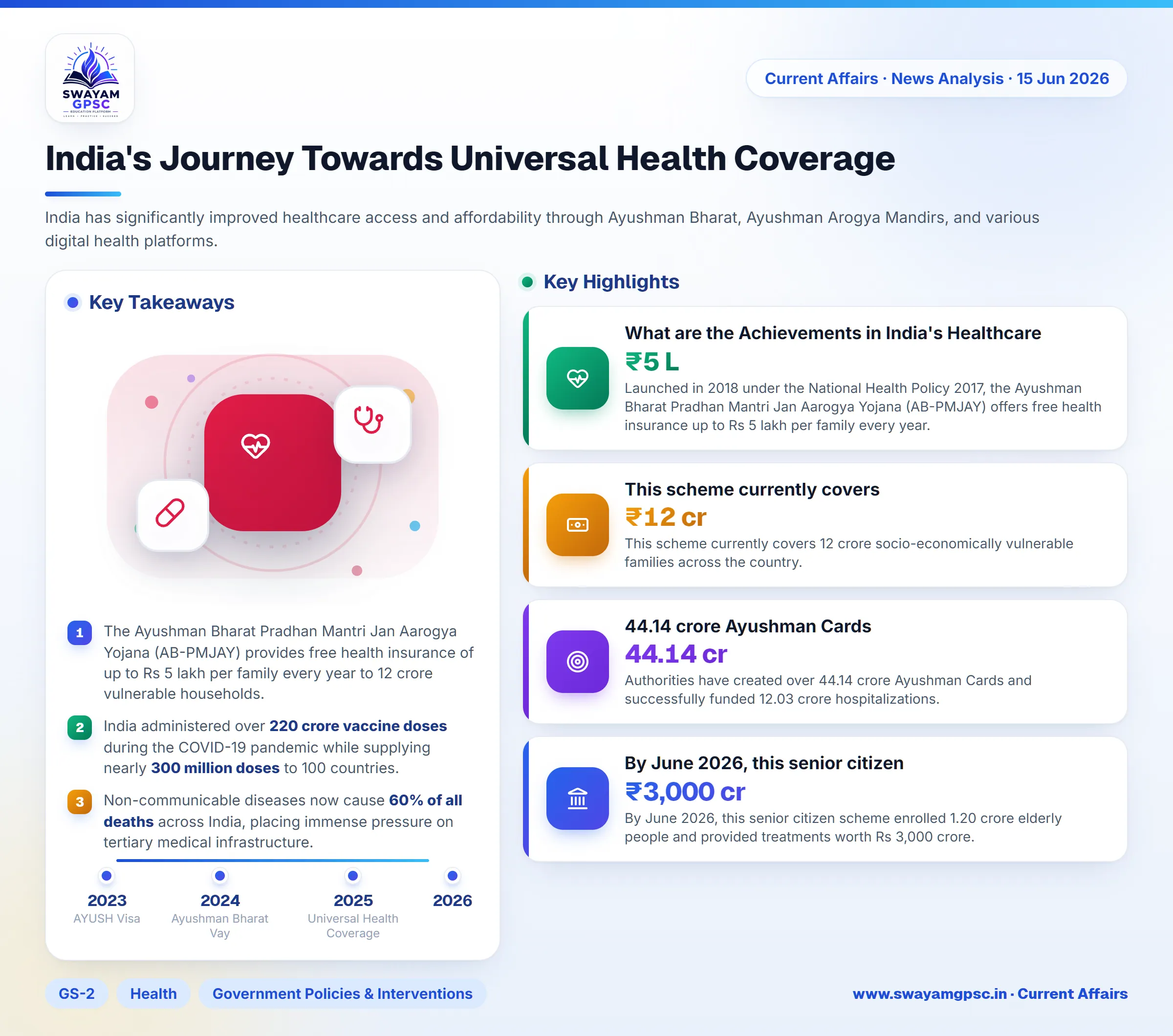
India's Journey Towards Universal Health Coverage
#GS-2 #Health #Government Policies & Interventions #Governance & Social Justice #Economy
Key takeaways
- The Ayushman Bharat Pradhan Mantri Jan Aarogya Yojana (AB-PMJAY) provides free health insurance of up to Rs 5 lakh per family every year to 12 crore vulnerable households.
- India administered over 220 crore vaccine doses during the COVID-19 pandemic while supplying nearly 300 million doses to 100 countries.
- Non-communicable diseases now cause 60% of all deaths across India, placing immense pressure on tertiary medical infrastructure.
- Union government health spending dropped from 0.37% of GDP in 2020 to 0.29% of GDP in 2025.
- Over 18,000 Jan Aushadhi Kendras provide generic medicines at 50 to 90 percent lower prices to save citizens money.
Why in News
- India is making strong progress toward Universal Health Coverage based on findings from the National Statistical Office 2025 survey.
- People now use public healthcare more often because of major programs like Ayushman Bharat and the National Health Mission.
- Families also spend less money out of their own pockets for medical care compared to before.
Summary
- India has significantly improved healthcare access and affordability through Ayushman Bharat, Ayushman Arogya Mandirs, and various digital health platforms.
- Despite this progress, low public health spending and rising non-communicable diseases remain major hurdles that require urgent policy action.
What are the Achievements in India's Healthcare
- Launched in 2018 under the National Health Policy 2017, the Ayushman Bharat Pradhan Mantri Jan Aarogya Yojana (AB-PMJAY) offers free health insurance up to Rs 5 lakh per family every year.
- This scheme currently covers 12 crore socio-economically vulnerable families across the country.
- Authorities have created over 44.14 crore Ayushman Cards and successfully funded 12.03 crore hospitalizations.
- The Ayushman App helps citizens access services easily and is available in 19 languages.
- The government launched Ayushman Bharat Vay Vandana in October 2024 to cover all senior citizens above 70 years of age.
- By June 2026, this senior citizen scheme enrolled 1.20 crore elderly people and provided treatments worth Rs 3,000 crore.
- A patient named Soni Khatoon from Bihar received a completely free heart valve replacement surgery in Lucknow under the AB-PMJAY scheme.
- The government has upgraded over 1.86 lakh facilities into Ayushman Arogya Mandirs (AAMs) to deliver 12 free comprehensive health services.
- These transformed primary health centers have recorded a massive 540 crore cumulative footfall of patients.
- The *Lalmati sub-centre in Assam became an Ayushman Arogya Mandir and successfully introduced screening for Non-communicable diseases (NCDs) alongside mental health support.
- Staffed by Community Health Officers, this local center achieved zero maternal and child deaths from preventable causes starting in 2024.
- The Pradhan Mantri Ayushman Bharat Health Infrastructure Mission (PM-ABHIM) builds strong medical facilities, including 744 public health labs and 631 critical care hospital blocks.
- India administered over 220 crore doses during the COVID-19 pandemic in the world's largest vaccination drive.
- Hospitals expanded their capacity by raising ICU beds from 2,168 to 1.45 lakh during the health crisis.
- Under Vaccine Maitri, India supplied nearly 300 million vaccine doses to 100 countries worldwide.
- The Pradhan Mantri Surakshit Matritva Abhiyan (PMSMA) examined 7.47 crore pregnant women to ensure safe deliveries.
- The Janani Shishu Suraksha Karyakram (JSSK) provides completely free childbirth services so mothers pay nothing out of pocket.
- Dedicated ASHA workers actively track pregnancies to guarantee safe institutional deliveries everywhere.
- Mission Indradhanush successfully vaccinated 5.46 crore children who missed their regular shots.
- The population of children receiving zero doses dropped to just 0.06% by April 2026.
- The Pradhan Mantri TB Mukt Bharat Abhiyaan screened 20 crore people for tuberculosis.
- Around 3.78 lakh Nik-shay Mitras distributed food kits to 20 lakh tuberculosis patients.
- Malaria deaths fell by 78% and mother-to-child HIV transmission dropped by 74.5% since 2010.
- Ayushman Arogya Mandirs screened 41.5 crore people for hypertension and 41.3 crore for diabetes.
- These centers also conducted over 60 crore combined screenings for oral, breast, and cervical cancers.
- The Pradhan Mantri National Dialysis Programme (PMNDP) delivered 4 crore free hemodialysis sessions to kidney patients.
- All 22 new AIIMS hospitals received formal approval to build dedicated cancer care facilities.
- The Eat Right India and Fit India Movement work to prevent chronic lifestyle diseases.
- India won the 2025 Bloomberg Philanthropies Award for lowering tobacco use by 17.3% and running an effective quitline.
- Citizens have created over 20.49 crore unique Ayushman Bharat Health Accounts (ABHAs).
- The U-WIN platform digitally tracks vaccination records for 11.87 crore children and 3.96 crore pregnant women.
- The eSanjeevani portal delivered over 47 crore teleconsultations to patients in remote areas.
- Tele-MANAS provides professional mental health counseling through 53 centers in 20 languages.
- The ICMR i-DRONE project delivered 22,000 medicines across 7,700 km of difficult geographical terrain using drones.
- Clinical Decision Support Systems use artificial intelligence to improve medical diagnoses.
- The Cough Against TB tool helped detect 12 to 16 percent more hidden tuberculosis cases.
- MadhuNetrAI automates screening for diabetic retinopathy to catch eye damage early.
- Over 18,000 Jan Aushadhi Kendras sell generic medicines at 50 to 90 percent lower prices.
- A total of 255 AMRIT Pharmacies saved patients ₹8,400 crore on essential drugs.
- The Free Diagnostics Initiative provides up to 57 medical tests at district hospitals following the model of Andhra Pradesh's NTR Vaidya Pariksha.
- The number of medical colleges in the country has doubled, and 157 new nursing colleges are under construction.
- The Ministry of AYUSH integrated traditional medicine into 13,093 facilities.
- India launched a special AYUSH Visa in July 2023 to promote global medical tourism.
Challenges
- The National Health Policy (NHP) 2017 target to raise public health spending to 2.5% of the GDP by 2025 remains unfulfilled.
- Union government health spending dropped heavily from 0.37% of GDP in 2020 to 0.29% of GDP in the 2025-26 fiscal year.
- Federal grants to states for Centrally Sponsored Schemes crashed from 75.9% in 2014 to 43% in 2024.
- India's per capita public health spending remains among the lowest in the world.
- Bhutan spends 2.5 times more per person on health than India, while Sri Lanka spends 3 times more.
- Peer BRICS nations spend 14 to 15 times more per capita on public health than India does.
- ASEAN countries like Thailand and Malaysia outspend India on public healthcare by 10 times.
- Key health drivers like sanitation, clean water, and air quality are managed by separate ministries with isolated budgets.
- This institutional division prevents effective resource pooling and leaves health systems dealing with preventable illnesses.
- Public health and hospitals fall under Entry 6 of the State List, which stops the center from enforcing uniform national standards.
- A study commissioned by NITI Aayog showed that 65% of patients still pay out of pocket at private hospitals under the PMJAY scheme.
- Only 35% of beneficiaries received completely free hospital care, pointing to weak regulatory oversight.
- India lacks a centralized and legally binding Right to Health Act to make healthcare a legal entitlement.
- Non-communicable diseases like heart disease and diabetes now cause 60% of all deaths in India.
- Reaching remote and hilly regions with doctors and medical supplies remains a tough logistical barrier.
- Mental healthcare suffers from deep social stigma and a shortage of rural psychiatric facilities.
- Traditional primary health centers previously lacked advanced diagnostic tools to catch complex diseases early.
Way Forward
- The government must create a legal roadmap to push public health spending up to 2.5% to 3% of GDP.
- Authorities should deploy AI diagnostic tools like MadhuNetrAI and Cough Against TB across all rural health centers.
- The i-DRONE network should expand nationwide to transport medical supplies safely over difficult terrain.
- Community programs like Nik-shay Mitras and Eat Right India must continue to drive positive behavioral changes.
- The AYUSH Grid should connect all traditional medicine laboratories digitally to boost medical tourism.
- Hospitals must adopt the 14-digit ABHA ID and the U-WIN platform completely to build a paperless health system.
- Parliament should pass a comprehensive Right to Health Act to make healthcare a justiciable right for all citizens.