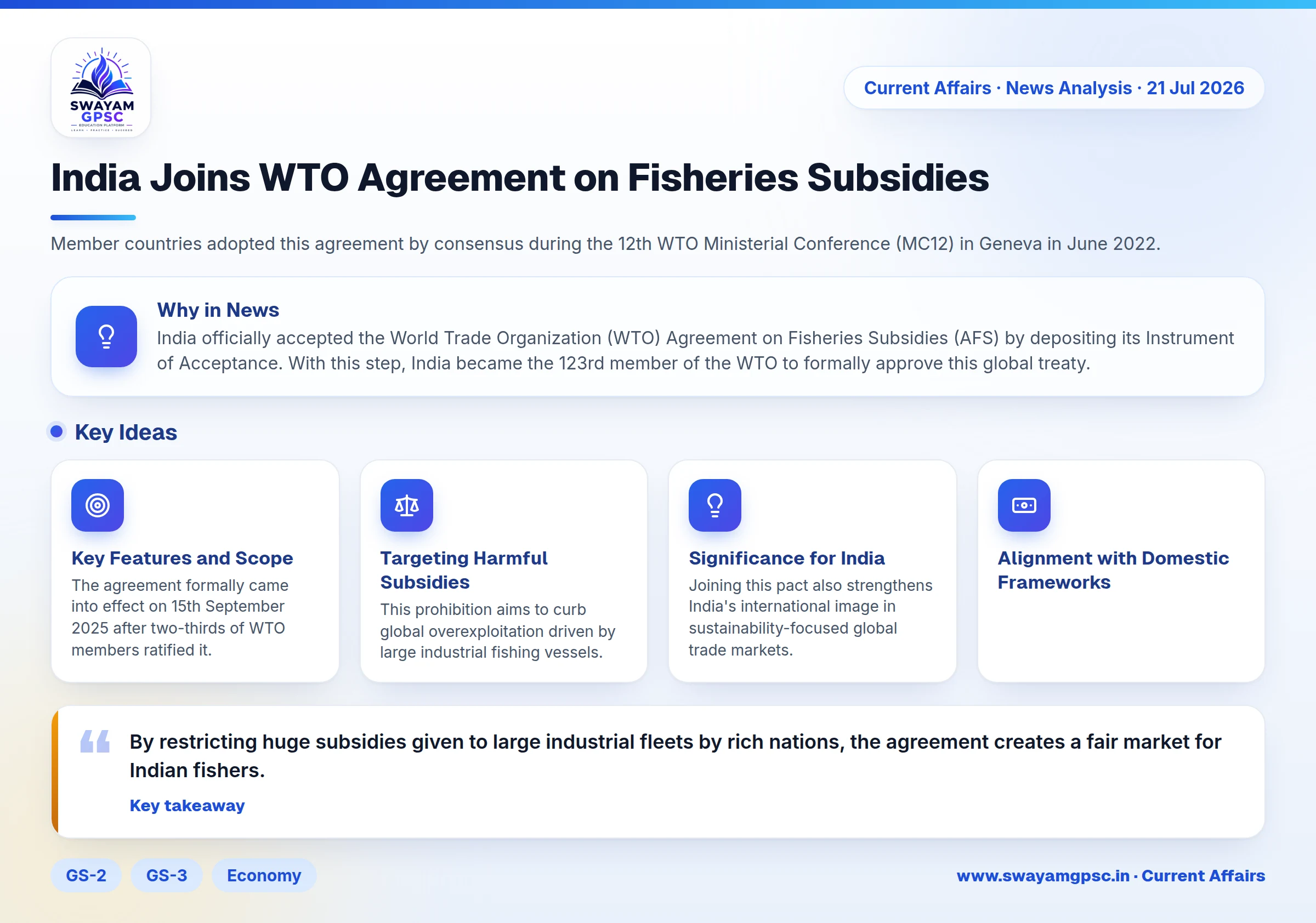
India Joins WTO Agreement on Fisheries Subsidies
#GS-2 #GS-3 #Economy #Agriculture #Food Security #Environment #Sustainable Development #Current Events #International #WTO #Fisheries Subsidies
Why in News
- India officially accepted the World Trade Organization (WTO) Agreement on Fisheries Subsidies (AFS) by depositing its Instrument of Acceptance.
- With this step, India became the 123rd member of the WTO to formally approve this global treaty.
Key Features and Scope of the Agreement
- Member countries adopted this agreement by consensus during the 12th WTO Ministerial Conference (MC12) in Geneva in June 2022.
- This pact is the first multilateral agreement under the WTO that focuses directly on environmental sustainability.
- The agreement formally came into effect on 15th September 2025 after two-thirds of WTO members ratified it.
- It applies strictly to marine wild capture fishing and related activities out at sea.
- The treaty completely excludes aquaculture and inland fisheries from its regulatory scope.
Targeting Harmful Subsidies
- The pact prohibits government subsidies linked to Illegal, Unreported and Unregulated (IUU) fishing and the targeting of overfished stocks.
- This prohibition aims to curb global overexploitation driven by large industrial fishing vessels.
- Data from the WTO shows that 37.7% of global marine stocks are overfished today, compared to 10% in 1974.
- Governments spend about USD 35 billion annually on global fishing subsidies, which fuels unsustainable industrial operations.
Significance for India
- By restricting huge subsidies given to large industrial fleets by rich nations, the agreement creates a fair market for Indian fishers.
- This protection directly safeguards the food security, jobs, and livelihoods of India's traditional and small-scale coastal fishing communities.
- Since aquaculture is excluded, India's main seafood export of aquaculture-based shrimp remains completely safe and untouched.
- Joining this pact also strengthens India's international image in sustainability-focused global trade markets.
Alignment with Domestic Frameworks
- India prepared its domestic regulatory framework by introducing the Sustainable Harnessing of Fisheries in the Exclusive Economic Zone (EEZ) Rules, 2025.
- The government issued the Guidelines for Sustainable Harnessing of Fisheries in the High Seas by Indian-Flagged Fishing Vessels, 2025.
- India continues supporting fisher welfare and capacity building through various schemes under the Pradhan Mantri Matsya Sampada Yojana (PMMSY).