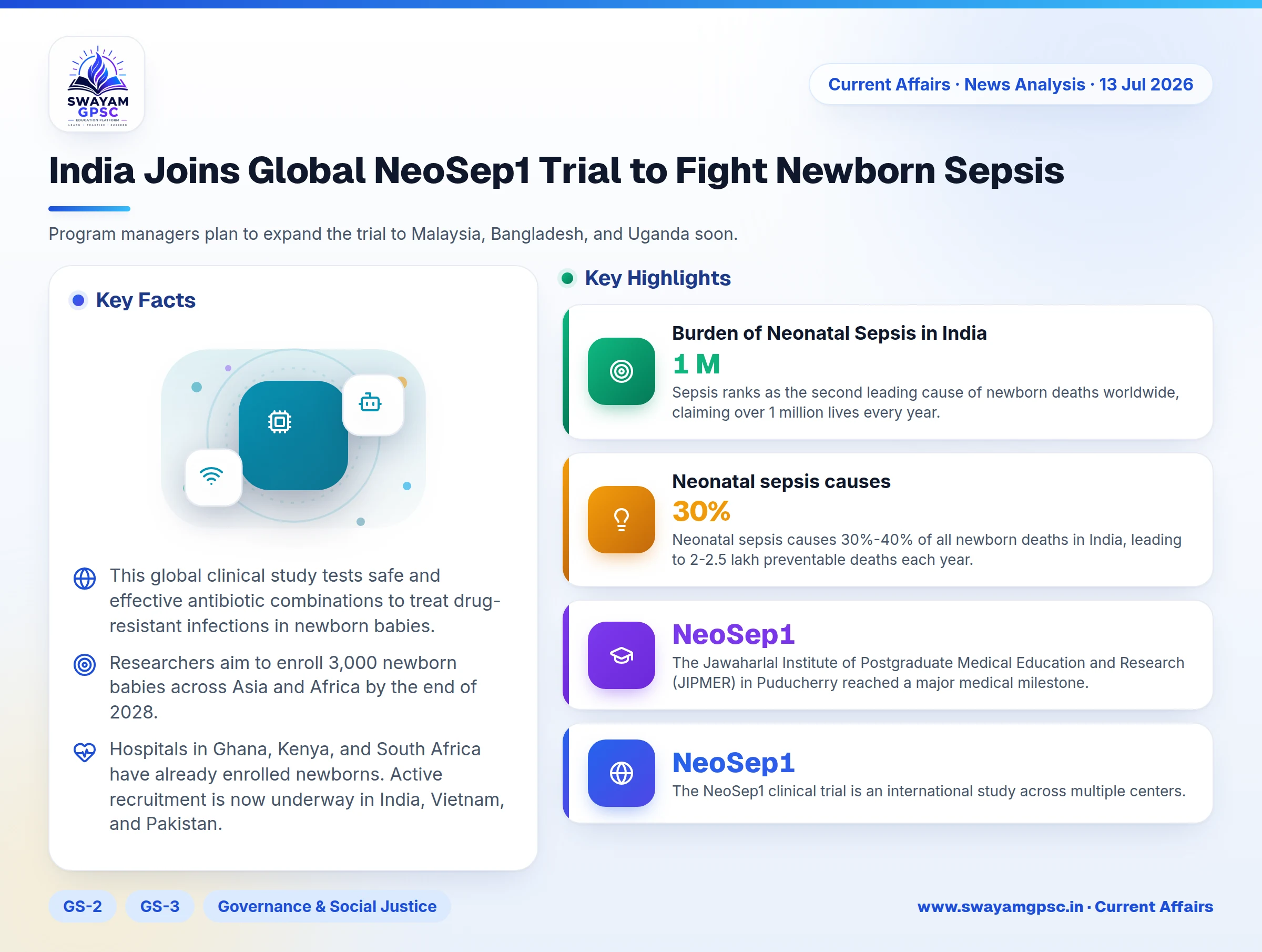
India Joins Global NeoSep1 Trial to Fight Newborn Sepsis
#GS-2 #GS-3 #Governance & Social Justice #Science & Technology #Current Events #Health #Biotechnology #National #Antimicrobial Resistance #NeoSep1 Trial
Why in News?
- The Jawaharlal Institute of Postgraduate Medical Education and Research (JIPMER) in Puducherry reached a major medical milestone. It became the first Indian medical center to enroll a newborn baby in the NeoSep1 trial.
- This global clinical study tests safe and effective antibiotic combinations to treat drug-resistant infections in newborn babies.
What is the NeoSep1 Clinical Trial?
- The NeoSep1 clinical trial is an international study across multiple centers. The Global Antibiotic Research and Development Partnership (GARDP), a non-profit group fighting drug-resistant infections, sponsors this project.
- Researchers aim to enroll 3,000 newborn babies across Asia and Africa by the end of 2028.
- Hospitals in Ghana, Kenya, and South Africa have already enrolled newborns. Active recruitment is now underway in India, Vietnam, and Pakistan.
- Program managers plan to expand the trial to Malaysia, Bangladesh, and Uganda soon.
- The main goal is to find the best antibiotic combinations for babies with sepsis. It also aims to create proven treatment methods suited for Low- and Middle-Income Countries.
- The trial uses an innovative structure called the PRACTical design, short for Personalised Randomised Controlled Trial.
- Under this design, doctors select suitable antibiotic treatments for each baby before random assignment. This step makes the treatment practical for real-world hospitals and encourages careful antibiotic use.
- India's involvement is vital because bacteria causing newborn sepsis in Indian hospitals differ greatly from those in rich countries. Therefore, India needs its own local research data.
What is Neonatal Sepsis?
- Neonatal sepsis is a dangerous, life-threatening infection of the bloodstream in infants under 90 days old.
- Newborns have weak immune systems that cannot stop local infections. As a result, bacteria spread quickly through the body, causing septic shock, organ failure, and death.
- The disease manifests through severe systemic conditions such as septicaemia, pneumonia, and meningitis.
- Early-onset Sepsis starts within the first 72 hours of life. Mothers usually pass these bacteria to their babies before or during birth.
- Late-onset Sepsis appears between 72 hours and 90 days of age. Babies usually catch these infections from hospital rooms or community surroundings.
- Globally, Group B Streptococcus (GBS) and E. coli cause most newborn sepsis cases in rich nations.
- In India, Gram-negative bacteria cause most newborn sepsis cases. Common species include Klebsiella pneumoniae, E. coli, Acinetobacter, and Pseudomonas aeruginosa.
- These bacterial strains are often resistant to multiple drugs, making medical treatment very difficult.
- Major risk factors include early breaking of water bags, mother's infections, unhygienic delivery, and dirty amniotic fluid.
- Premature delivery and Low Birth Weight increase risk because babies lack mature immune defenses and maternal antibodies.
- Long hospital stays and medical equipment like ventilators or catheters also expose babies to dangerous hospital infections.
- Common symptoms include unstable body temperature, rapid breathing, extreme tiredness, seizures, poor feeding, and vomiting.
- Doctors must act immediately because symptoms are non-specific and a baby's health can decline rapidly.
- Doctors treat neonatal sepsis using broad-spectrum antibiotics right after taking blood sample cultures. They adjust the medication once laboratory culture tests identify the exact bacteria.
Burden of Neonatal Sepsis in India
- Sepsis ranks as the second leading cause of newborn deaths worldwide, claiming over 1 million lives every year.
- Neonatal sepsis causes 30%-40% of all newborn deaths in India, leading to 2-2.5 lakh preventable deaths each year.
- Unlike Western nations, drug-resistant Gram-negative bacteria drive most newborn sepsis cases across Indian hospital wards.
- Growing resistance to basic antibiotics reduces the power of cheap medicines and forces reliance on costly emergency drugs.
- Current diagnostic blood cultures require 48-72 hours to show results and often miss bacteria when sample volumes are tiny.
- India needs local evidence from trials like NeoSep1 to create safe, reliable, and affordable treatment routines for newborns.