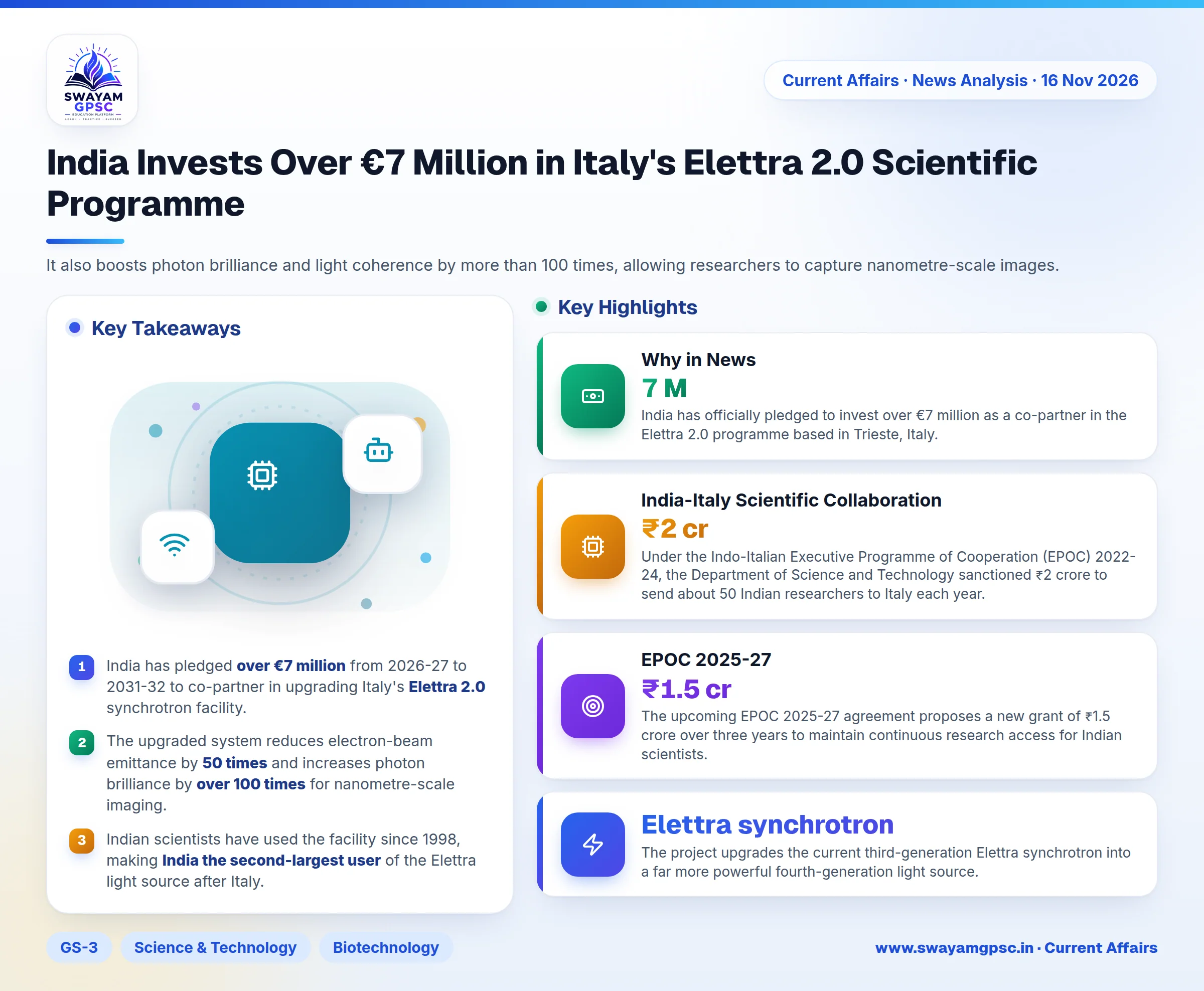
India Invests Over €7 Million in Italy's Elettra 2.0 Scientific Programme
#GS-3 #Science & Technology #Biotechnology #Space #Rapid Fire CA #Quick Facts For Prelims #Achievements of Indians in Science & Technology
Key takeaways
- India has pledged over €7 million from 2026-27 to 2031-32 to co-partner in upgrading Italy's Elettra 2.0 synchrotron facility.
- The upgraded system reduces electron-beam emittance by 50 times and increases photon brilliance by over 100 times for nanometre-scale imaging.
- Indian scientists have used the facility since 1998, making India the second-largest user of the Elettra light source after Italy.
- The Department of Science and Technology (DST) sanctioned ₹2 crore under EPOC 2022-24 and proposed ₹1.5 crore under EPOC 2025-27 to support researcher exchanges.
- The project replaces two older setups with new Micro-XRD (μXRD) and Xpress Superbend (Xpress-SB) beamlines for macromolecular and high-pressure physics research.
Why in News
- India has officially pledged to invest over €7 million as a co-partner in the Elettra 2.0 programme based in Trieste, Italy.
- This funding commitment will span a five-year period starting in 2026-27 to help build next-generation synchrotron beamlines for advanced scientific research.
About the Elettra 2.0 Programme
- The project upgrades the current third-generation Elettra synchrotron into a far more powerful fourth-generation light source.
- This upgraded facility produces brighter and more focused radiation, which helps scientists conduct precise experiments in physics, chemistry, structural biology, and advanced materials.
- The upgraded storage ring reduces electron-beam emittance by about 50 times.
- It also boosts photon brilliance and light coherence by more than 100 times, allowing researchers to capture nanometre-scale images.
New Advanced Beamlines
- The upgrade will replace two older India-supported beamlines, XRD2 and XPRESS, with modern equipment.
- The new Micro-XRD (μXRD) is a microfocus beamline designed for macromolecular crystallography, helping scientists study complex biological proteins.
- (Xpress-SB) is a dedicated high-pressure diffraction beamline built to analyze material structures under extreme pressure.
India-Italy Scientific Collaboration
- Indian researchers have actively used the Elettra facility since 1998, making India the second-largest user after Italy.
- Under the Indo-Italian Executive Programme of Cooperation (EPOC) 2022-24, the Department of Science and Technology sanctioned ₹2 crore to send about 50 Indian researchers to Italy each year.
- The upcoming EPOC 2025-27 agreement proposes a new grant of ₹1.5 crore over three years to maintain continuous research access for Indian scientists.
Key Concepts: Synchrotron Radiation and Beamlines
- Synchrotron radiation is high-intensity light produced when charged particles, like electrons traveling near the speed of light, are bent by magnetic fields.
- Beamlines are specialized scientific setups made of optical lenses and instruments that guide and focus this intense light onto target material samples.
- Scientists use beamlines for drug discovery, protein mapping, nanotechnology, quantum material studies, semiconductor design, solar cells, and high-pressure physics.
Facilities at Elettra Sincrotrone Trieste
- The main Elettra facility operates as a synchrotron light source that generates radiation using high-speed electrons moving inside a circular storage ring.
- The FERMI facility functions as a free-electron laser, creating ultrashort and intense light pulses to study ultrafast chemical and physical events.