India's Insurance Sector as a Pillar of Sovereign Fiscal Stability
#GS-3 #Economy #Mobilization of Resources #Capital Market #Infrastructure #Current Events #National
Key takeaways
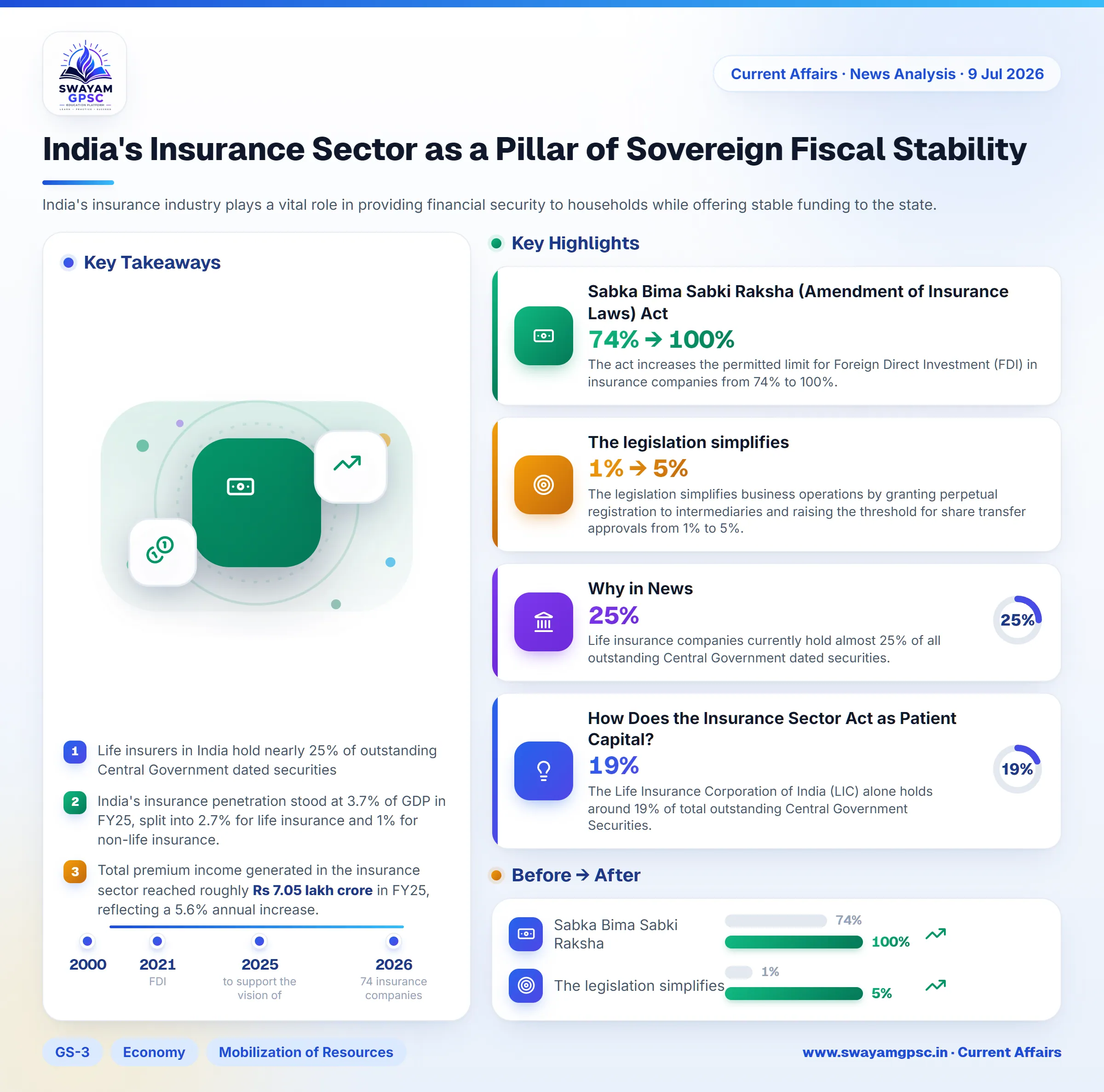
- Life insurers in India hold nearly 25% of outstanding Central Government dated securities, with LIC alone accounting for 19% of central debt.
- India's insurance penetration stood at 3.7% of GDP in FY25, split into 2.7% for life insurance and 1% for non-life insurance.
- Total premium income generated in the insurance sector reached roughly Rs 7.05 lakh crore in FY25, reflecting a 5.6% annual increase.
- The Sabka Bima Sabki Raksha Act, 2025 reformed the sector by increasing the Foreign Direct Investment limit from 74% to 100%.
- Over 40 crore citizens belong to the missing middle population who lack social safety nets while finding private coverage unaffordable.
Why in News
- India's life insurance industry has become a major source of long-term funding for the government.
- Life insurance companies currently hold almost 25% of all outstanding Central Government dated securities.
- Insurers convert regular household premium payments into long-term patient capital.
- This investment mechanism simultaneously protects families financially and strengthens the country's fiscal stability.
Executive Summary
- India's insurance industry plays a vital role in providing financial security to households while offering stable funding to the state.
- Life insurance firms hold nearly 25% of central government bonds and supply essential long-term capital for national projects.
- Challenges such as low coverage, the missing middle class, high costs, climate risks, and unfair sales practices persist despite recent policy reforms.
- Overcoming these obstacles remains essential to achieve the national goal of Insurance for All by 2047.
How Does the Insurance Sector Act as Patient Capital?
- Life insurers issue policies with long commitments extending across 20 to 40 years.
- Government securities (G-Secs) carry sovereign guarantees with minimal default risk and offer predictable investment returns.
- These bonds fit long insurer liabilities perfectly without causing market distortion.
- Insurers pool premium contributions from millions of citizens to purchase government debt securities.
- Citizens buying life insurance for family protection end up funding national infrastructure projects like railways, highways, and defense.
- Insurers serve as steady buy-and-hold investors unlike Foreign Portfolio Investors (FPIs) who quickly pull capital during global crises.
- Reinvesting funds during market downturns lowers the government's debt rollover risk and keeps borrowing costs steady across maturities.
- Insurers buy long-dated 30 to 40 year government bonds, which helps the Reserve Bank of India (RBI) maintain a stable sovereign yield curve.
- The Life Insurance Corporation of India (LIC) alone holds around 19% of total outstanding Central Government Securities.
- The Insurance Regulatory and Development Authority of India (IRDAI) designates LIC as a Domestic Systemically Important Insurer (D-SII) due to its massive financial influence.
- Any severe financial crisis in LIC would disrupt the government's entire sovereign borrowing program.
- Private insurers hold smaller amounts of government bonds because they focus heavily on shorter-term Unit-Linked Insurance Plans (ULIPs) tied to equity markets.
- India follows international models seen in Japan, the United Kingdom, and South Korea where insurers hold long-term public debt to match their liability profiles.
Insurance Sector in India
- The Indian Constitution places the insurance sector in Entry 47 of the Union List within the 7th Schedule, giving exclusive legislative power to the Central Government.
- In the landmark 1995 case of LIC of India v. Consumer Education & Research Centre, the Supreme Court declared LIC an instrumentality of the State under Article 12.
- The Supreme Court ruled that LIC's investment decisions must serve public welfare and advance social justice.
- India's modern insurance history began with the Oriental Life Insurance Company in 1818 and Triton Insurance in 1850.
- The statutory regulation of insurance began comprehensively with the passage of the Insurance Act of 1938.
- The government nationalized life insurance through the Life Insurance Corporation Act, 1956, creating LIC to protect policyholders and stop corporate fraud.
- General insurance was later nationalized through the General Insurance Business (Nationalisation) Act, 1972, leading to the creation of the General Insurance Corporation of India (GIC).
- Historical laws like the Insurance Act of 1938, the LIC Act of 1956, and the IRDA Act of 1999 shaped the legal structure of Indian insurance.
- The Malhotra Committee recommended opening the insurance market to private players in 1993.
- Based on committee proposals, Parliament established IRDAI in 1999 as an independent statutory regulator to safeguard policyholders.
- India allowed private firms into the insurance market in 2000 to encourage competition.
- Foreign Direct Investment (FDI) limits were expanded progressively from 26% initially up to 74% in 2021 to bring in foreign capital and technical skills.
Sabka Bima Sabki Raksha (Amendment of Insurance Laws) Act, 2025
- Parliament passed the Sabka Bima Sabki Raksha (Amendment of Insurance Laws) Act, 2025 to support the vision of Insurance for All by 2047.
- The legislation amends three key historical statutes: the Insurance Act of 1938, the LIC Act of 1956, and the IRDAI Act of 1999.
- The act increases the permitted limit for Foreign Direct Investment (FDI) in insurance companies from 74% to 100%.
- The legislation simplifies business operations by granting perpetual registration to intermediaries and raising the threshold for share transfer approvals from 1% to 5%.
- A new Policyholders' Education and Protection Fund was created to safeguard consumer interests.
- The statute expands IRDAI's regulatory authority, enhancing its power to supervise, investigate, and take corrective actions against non-compliant entities.
- The act grants LIC operational freedom to set up zonal offices without seeking prior approval from the central government.
Government Initiatives Supporting Insurance Expansion
- Pradhan Mantri Jeevan Jyoti Bima Yojana (PMJJBY) provides affordable life cover to low-income households.
- Pradhan Mantri Suraksha Bima Yojana (PMSBY) offers low-cost accidental death and disability coverage.
- Ayushman Bharat-Pradhan Mantri Jan Arogya Yojana (AB-PMJAY) supplies health coverage to economically vulnerable families across the nation.
- Bima Sugam acts as an integrated digital platform designed to streamline insurance sales, service requests, and claim processing.
Current Status of India's Insurance Sector
- India holds the position of the 10th largest insurance market in the world based on premium collections according to Swiss Re reports.
- As of April 2026, India has 74 insurance companies, including 26 life insurers and 35 non-life insurers, alongside specialized insurance entities.
- India ranks as the fifth-largest life insurance market among emerging market economies worldwide.
- The insurance industry generated a total premium income of roughly Rs 7.05 lakh crore in FY25, recording a 5.6% annual growth rate.
- Overall insurance penetration in India stood at 3.7% of GDP in FY25, split into 2.7% for life insurance and 1% for non-life insurance.
- Insurance density, which measures average premium per person, rose from USD 95 in FY24 to USD 97 in FY25.
- Health insurance became the largest segment among non-life policies in FY25, generating 41% of gross domestic premiums and overtaking motor insurance.
- High healthcare inflation, growing health awareness, and demand for private medical insurance drove this strong growth in health policies.
- Rising middle-class incomes and the broader shift toward financial savings have increased general demand for insurance products.
- Insurance and pension funds increased their share of household financial assets from 28.6% in FY19 to 29.6% in FY25.
- Smaller cities and Tier-III towns generated 62% of all new insurance premiums in FY25.
- Insurance premiums for small businesses grew by 112%, while life policies grew over 60% and motor insurance increased by 25.6%.
- Policy measures like 100% FDI, the Use-and-File framework, and the target of Insurance for All by 2047 have spurred investments and product innovation.
- Government decisions offering tax exemptions on life and individual health insurance policies have made coverage more affordable.
- Bancassurance has become a major distribution channel by allowing banks to sell insurance products alongside regular banking services.
- Introduced in 2000 under the Banking Regulation Act of 1949, bancassurance allows banks to earn fee income while helping insurers reach new customers.
- Insurers use extensive banking networks built through schemes like Pradhan Mantri Jan Dhan Yojana (PMJDY) to sell micro-insurance products to underserved populations.
- Technology integration through Bima Sugam, artificial intelligence, machine learning, and process automation is lowering distribution costs and speeding up claims.
- Heightened awareness after the pandemic and rising healthcare costs have shifted consumer preferences toward risk protection products.
- Health insurance expanded to claim 41% of all non-life insurance premiums in FY25, surpassing motor coverage as the leading non-life segment.
- Following LIC's stock market debut, nine insurers submitted IPO documents to IRDAI in 2025 to raise capital.
Challenges
- India's insurance penetration rate of 3.7% remains well below the global average of 7.3%.
- Non-life insurance coverage stays critically low at 1% of GDP, leaving large gaps in property, health, and vehicle protection.
- Over 40 crore people belong to the missing middle, including gig workers and small business staff, who lack government benefits but cannot afford private insurance.
- High insurance premiums and growing healthcare expenses make adequate protection unaffordable for poor families and elderly citizens.
- Banks pushing for fee income often force customers into buying unsuitable complex products like ULIPs through bancassurance partnerships.
- Hidden contract terms, unexpected policy exclusions, and sudden claim rejections harm consumer trust in insurance firms.
- Insurers pay nearly Rs 1 lakh crore in annual claims, yet widespread mistrust and low financial literacy hinder market expansion.
- Frequent natural disasters highlight India's low coverage against crop losses, property destruction, and extreme weather damage.
- Rapid digital transition increases vulnerability to data theft, cyber fraud, and confidential medical data breaches.
- Unpredictable regulatory changes generate uncertainty, making it difficult for insurance executive teams to plan long-term business strategy.
Way Forward
- The government should reduce taxes on basic life and health policies and offer dedicated tax benefits to make coverage affordable.
- Lowering taxes on policy premiums and developing GIFT City into an international reinsurance center will build strong economic support for a Viksit Bharat.
- Authorities must fully implement Bima Sugam to provide a single digital platform for buying policies and resolving consumer complaints.
- Integrating insurance platforms with the Account Aggregator framework and Ayushman Bharat Digital Mission (ABDM) will enable paperless customer onboarding.
- Companies should launch parametric climate insurance and create low-cost insurance products tailored for gig workers, small business employees, and rural families.
- Policymakers should use regulatory sandboxes and tax incentives in GIFT City to attract foreign reinsurance firms and retain premium capital inside India.
- Regulators should use 100% FDI to bring in foreign capital, advanced underwriting technology, and specialized products like cyber insurance.
- Regulatory bodies must use artificial intelligence to stop mis-selling, simplify policy contracts, and boost insurance awareness using the Bima Vahak initiative.
Conclusion
- The insurance industry needs to transition from aggressive sales tactics to a customer-focused protection approach.
- Achieving long-term success requires going beyond basic regulatory compliance to foster a strong culture of household financial security.
- Building a deeply expanded, well-capitalized, and tech-driven insurance sector will be crucial for maintaining macroeconomic stability as India aims for developed nation status by 2047.