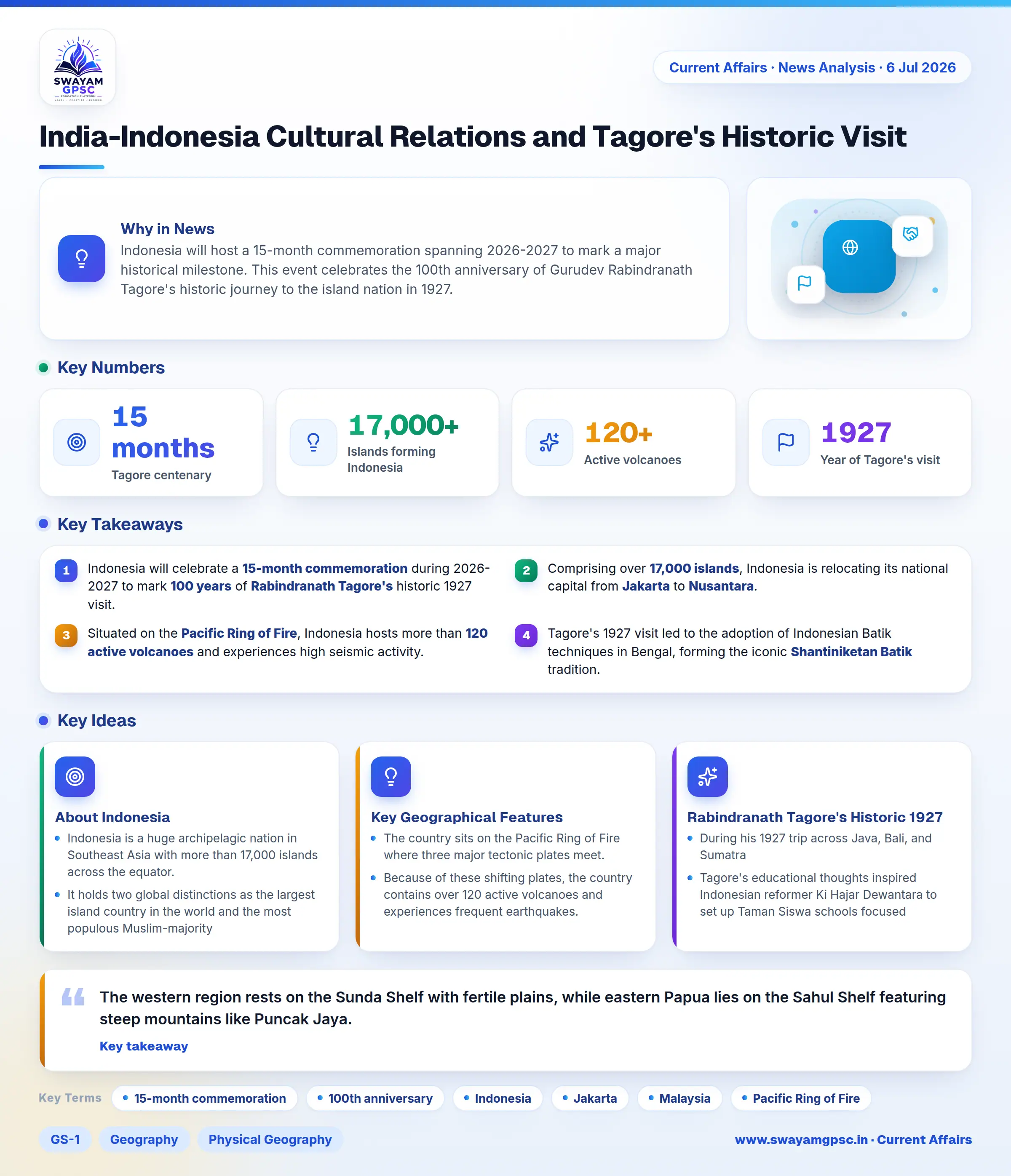
India-Indonesia Cultural Relations and Tagore's Historic Visit
#GS-1 #Geography #Physical Geography #Culture #Heritage #GS-3 #Current Events #International #India-Indonesia Relations #Rabindranath Tagore
Why in News
- Indonesia will host a **15-month commemoration** spanning **2026-2027** to mark a major historical milestone.
- This event celebrates the **100th anniversary** of **Gurudev Rabindranath Tagore's** historic journey to the island nation in **1927**.
About Indonesia
- **Indonesia** is a huge archipelagic nation in Southeast Asia with more than **17,000 islands** across the equator.
- It holds two global distinctions as the largest island country in the world and the most populous Muslim-majority nation.
- Geographically, the country sits between the Indian and Pacific Oceans to connect Asia with Oceania.
- This strategic position creates an important maritime link between the South China Sea and the southern ocean waters.
- The national capital is **Jakarta**, but the government is currently shifting its capital to **Nusantara**.
- On land, the country shares direct national borders with three neighbors: **Malaysia**, **Papua New Guinea**, and **East Timor**.
Key Geographical Features
- The country sits on the **Pacific Ring of Fire** where three major tectonic plates meet.
- Because of these shifting plates, the country contains over **120 active volcanoes** and experiences frequent earthquakes.
- The western region rests on the **Sunda Shelf** with fertile plains, while eastern Papua lies on the **Sahul Shelf** featuring steep mountains like **Puncak Jaya**.
- A deep ocean boundary known as the **Wallace Line** separates Asian wildlife in the west from Australian-type species in the east.
- This geographical separation makes the region one of the richest biodiversity zones on Earth.
- Two vital ocean channels, the **Sunda Strait** and **Lombok Strait**, serve as essential global routes for shipping, energy transport, and naval movement.
Rabindranath Tagore's Historic 1927 Visit
- During his **1927** trip across **Java**, **Bali**, and **Sumatra**, Tagore explored how local performing arts preserved stories from the **Ramayana** and **Mahabharata**.
- Tagore's educational thoughts inspired Indonesian reformer **Ki Hajar Dewantara** to set up **Taman Siswa** schools focused on student freedom and nature.
- Tagore brought traditional Javanese Batik printing methods back to Bengal, which created the famous **Shantiniketan Batik** style.