India-Indonesia Comprehensive Strategic Partnership and Bilateral Relations
#GS-2 #GS-3 #Current Events #International #Defence #Infrastructure #Bilateral Groupings & Agreements
Key takeaways
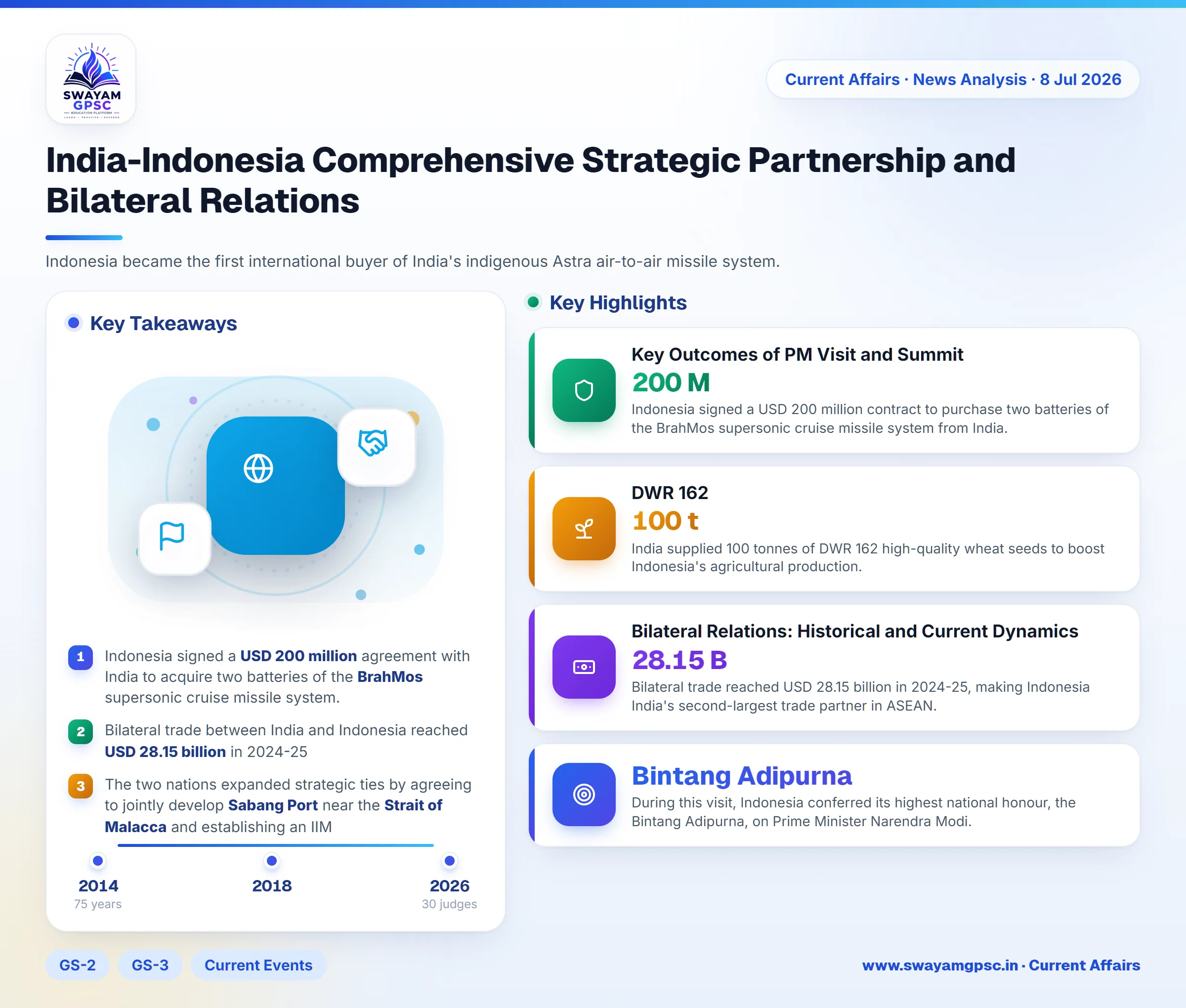
- Indonesia signed a USD 200 million agreement with India to acquire two batteries of the BrahMos supersonic cruise missile system.
- Bilateral trade between India and Indonesia reached USD 28.15 billion in 2024-25, positioning Indonesia as India's second-largest trading partner in ASEAN.
- The two nations expanded strategic ties by agreeing to jointly develop Sabang Port near the Strait of Malacca and establishing an IIM Bangalore campus in East Java.
- India supplied 100 tonnes of DWR 162 wheat seeds and agreed to provide technical support to restore the UNESCO-listed Prambanan Temple Complex.
Why in News
- The Prime Minister of India completed an official visit to Indonesia to deepen the Comprehensive Strategic Partnership established in 2018.
- During this visit, Indonesia conferred its highest national honour, the Bintang Adipurna, on Prime Minister Narendra Modi.
- Prime Minister Modi became only the second Indian leader to receive this award after Jawaharlal Nehru.
- Both nations issued a joint statement covering defence, maritime security, trade, technology, digital infrastructure, and global cooperation.
Key Outcomes of PM Visit and Summit
- Indonesia signed a USD 200 million contract to purchase two batteries of the BrahMos supersonic cruise missile system from India.
- Indonesia became the first international buyer of India's indigenous Astra air-to-air missile system.
- Both nations renewed their agreement on maritime safety and decided to jointly develop Sabang Port in Indonesia.
- Sabang Port sits at the northern tip of Sumatra near the Strait of Malacca, giving India key strategic access to vital shipping lanes.
- The leaders welcomed plans for the 3rd India-Indonesia Security Dialogue to address regional security issues systematically.
- Steel Authority of India Limited (SAIL) partnered with PT Krakatau Steel to set up a stainless-steel slab factory in Indonesia.
- India and Indonesia signed agreements to develop Rare Earth Magnets and collaborate on steel supply chains.
- Both countries extended their space exploration framework agreement, supporting India's Gaganyaan Mission through the Biak tracking facility.
- India's CDSCO and Indonesian health authorities signed agreements to align medical regulations and support healthcare workers.
- National Disaster Management Authority (NDMA) of India linked with Indonesia's disaster agency to improve emergency response efforts.
- India supplied 100 tonnes of DWR 162 high-quality wheat seeds to boost Indonesia's agricultural production.
- Indonesia launched the Indonesia Open Network (ION), which adopts the design of India's Open Network for Digital Commerce (ONDC).
- Indonesia deployed a liaison officer to the Information Fusion Centre for the Indian Ocean Region (IFC-IOR) in Gurugram to share real-time maritime intelligence.
- India agreed to provide technical assistance to restore the Prambanan Temple Complex, a famous UNESCO world heritage site in Java.
- Both nations announced the Tagore-Dewantara Year (2026-27) to mark 100 years since Rabindranath Tagore visited Indonesia.
- The Election Commission of India signed an agreement with Indonesia's election body to share best practices for large elections.
- The Indian Institute of Management (IIM) Bangalore agreed to establish an offshore branch campus at the Singhasari Special Economic Zone in Java.
- Both countries pledged zero tolerance for terrorism, agreeing to combat terror funding, online radicalization, and cyber threats through CERT cooperation.
- Both nations established a Joint Economic and Financial Dialogue and promoted local currency settlement to reduce reliance on foreign currencies.
Bilateral Relations: Historical and Current Dynamics
- Maritime and cultural links connect both countries, with Hindu, Buddhist, and Islamic traditions moving from Indian coasts to Indonesia.
- Post-colonial cooperation led both nations to organize the Bandung Conference in 1955 and create the Non-Aligned Movement in 1961.
- Formal diplomatic ties began 75 years ago in 1949, evolving through India's Look East Policy in 1991 and Act East Policy in 2014.
- Bilateral trade reached USD 28.15 billion in 2024-25, making Indonesia India's second-largest trade partner in ASEAN.
- India buys large quantities of crude palm oil and coal from Indonesia, while exporting petroleum products, vehicles, steel, and farm goods.
- India ranks as the fifth-largest source of tourists visiting Indonesia, supported by direct flights between major cities.
- Defence collaboration includes joint exercises like IND-INDO CORPAT, Garuda Shakti, Samudra Shakti, and naval drills like Milan and Komodo.
- India transferred a replica of the 9th-century Nalanda Copper Plate to Indonesia to highlight shared historical connections.
- The Indian Technical and Economic Cooperation (ITEC) program trains Indonesian professionals, including a delegation of 30 judges trained in Bhopal in 2026.
- Over 135,000 people of Indian origin and non-resident Indians live in Indonesia, strengthening commercial and cultural ties.
Strategic Significance of Ties
- Indonesia serves as an anchor for India's Act East Policy and the SAGAR vision in Southeast Asia.
- Developing Sabang Port improves logistics for the Indian Navy near the Strait of Malacca, maintaining open sea routes.
- Supplying BrahMos missiles and securing critical minerals helps build balanced regional supply chains away from single-country reliance.
- Partnering with Indonesia strengthens India's connection with ASEAN, as Indonesia represents the largest economy in the group.
- Securing Indonesian nickel and rare earths ensures a steady supply of raw materials for India's electric vehicle manufacturing.
Challenges in Bilateral Relations
- Indonesia follows an independent foreign policy known as Bebas-Aktif and remains cautious about alliances like the Quad.
- Strategic alignment remains limited because Indonesia avoids actions that could be seen as opposing China directly.
- China holds strong economic influence in Indonesia through heavy investments in infrastructure and nickel refining projects.
- Trade remains heavily skewed in favor of Indonesia due to massive Indian imports of palm oil.
- Potential shifts in Indonesian palm oil export policies for local biofuels could create food price spikes in India.
- High non-tariff barriers and slow progress under the ASEAN-India Trade in Goods Agreement (AITIGA) hinder Indian exports like pharmaceuticals.
- Domestic producers in India worry about cheap imports of products like Viscose Staple Fibre from Indonesian suppliers.
- Administrative delays and strict regulations often slow down joint projects such as the development of Sabang Port.
Way Forward
- Both nations must complete the review of AITIGA quickly and consider a bilateral trade agreement to lower non-tariff barriers.
- India and Indonesia should establish joint ventures in nickel and rare earth processing to secure critical mineral supply chains.
- The two countries need a dedicated project framework and clear funding model to complete construction work at Sabang Port.
- India should align its SAGAR policy with Indonesia's Global Maritime Fulcrum while respecting ASEAN Centrality.
- Expanding cross-border digital payments and financial technology links will make bilateral business faster and cheaper.
Prelims in Focus: Geomorphology of Indonesian Archipelago
- The Indonesian archipelago formed as a Volcanic Island Arc along the active Pacific Ring of Fire.
- The region sits at a triple tectonic junction where the Eurasian, Indo-Australian, and Pacific plates interact.
- Heavy oceanic crust of the Indo-Australian plate slides beneath the Eurasian plate at subduction zones like the Sunda Trench.
- Tremendous friction and extreme heat melt subducted rock, creating pressurized magma that rises to erupt on the ocean floor.
- Continuous volcanic activity over millions of years built underwater mountains that eventually breached the surface as islands like Sumatra, Java, and Bali.