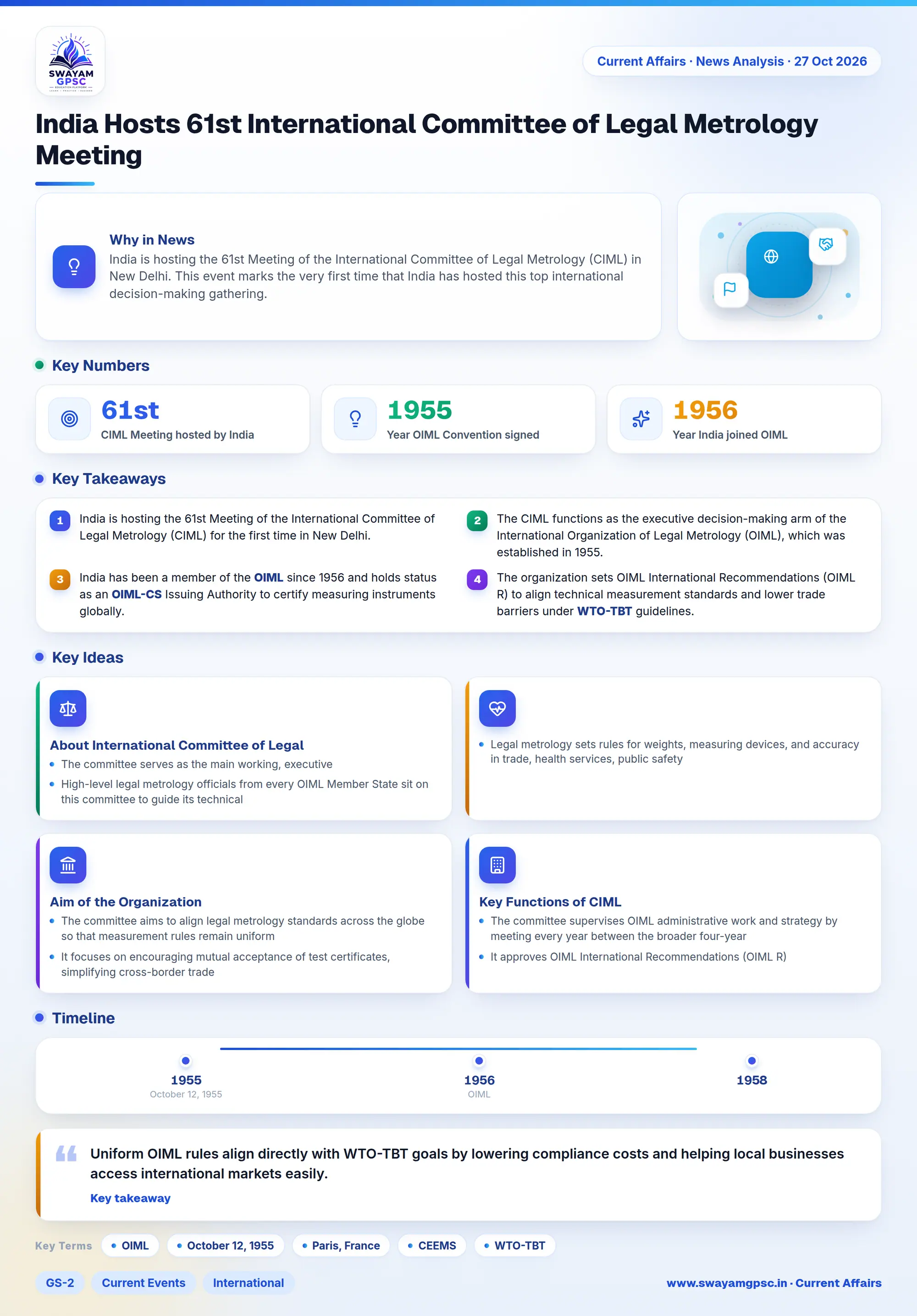
India Hosts 61st International Committee of Legal Metrology Meeting
#GS-2 #Current Events #International #International Organizations #Legal Metrology
Key takeaways
- India is hosting the 61st Meeting of the International Committee of Legal Metrology (CIML) for the first time in New Delhi.
- The CIML functions as the executive decision-making arm of the International Organization of Legal Metrology (OIML), which was established in 1955.
- India has been a member of the OIML since 1956 and holds status as an OIML-CS Issuing Authority to certify measuring instruments globally.
- The organization sets OIML International Recommendations (OIML R) to align technical measurement standards and lower trade barriers under WTO-TBT guidelines.
Why in News
- India is hosting the 61st Meeting of the International Committee of Legal Metrology (CIML) in New Delhi.
- This event marks the very first time that India has hosted this top international decision-making gathering.
About International Committee of Legal Metrology
- The committee serves as the main working, executive, and decision-making body of the International Organization of Legal Metrology (OIML).
- High-level legal metrology officials from every OIML Member State sit on this committee to guide its technical, administrative, and strategic work.
- Governments established this body under an international convention signed in Paris on October 12, 1955, which came into effect in May 1958.
- The International Bureau of Legal Metrology (BIML) handles the operational secretariat duties for the committee from Paris, France.
Background
- Legal metrology sets rules for weights, measuring devices, and accuracy in trade, health services, public safety, and environmental tracking to ensure fair dealings.
- In the past, differing measurement rules between nations created trade obstacles because manufacturers had to retest and recertify products in every country.
- India joined the OIML back in 1956 and later became an OIML-CS Issuing Authority, which allows the country to issue globally recognized certificates for measuring devices.
Aim of the Organization
- The committee aims to align legal metrology standards across the globe so that measurement rules remain uniform everywhere.
- It focuses on encouraging mutual acceptance of test certificates, simplifying cross-border trade, and protecting consumers.
Key Functions of CIML
- The committee supervises OIML administrative work and strategy by meeting every year between the broader four-year conference sessions.
- It approves OIML International Recommendations (OIML R), setting shared technical standards and performance requirements for measuring tools.
- Members manage the OIML Certification System (OIML-CS) to help countries accept test reports mutually, cutting down redundant testing expenses for businesses.
- The body advances digital measurement methods, including machine-readable standards, EV charger checks, and AI-driven validation systems.
- Through the CEEMS program, it offers technical training and guidance to help developing countries build stronger national measurement rules.
Significance
- Uniform OIML rules align directly with WTO-TBT goals by lowering compliance costs and helping local businesses access international markets easily.
- Fair and legally verified measurements build trust in everyday retail transactions, industrial sales, and public services.