India at the G7 Summit 2026
#GS-2 #Governance & Social Justice #Current Events #International #Global Groupings #Bilateral Groupings & Agreements #Important International Institutions #Economy #Infrastructure
Key takeaways
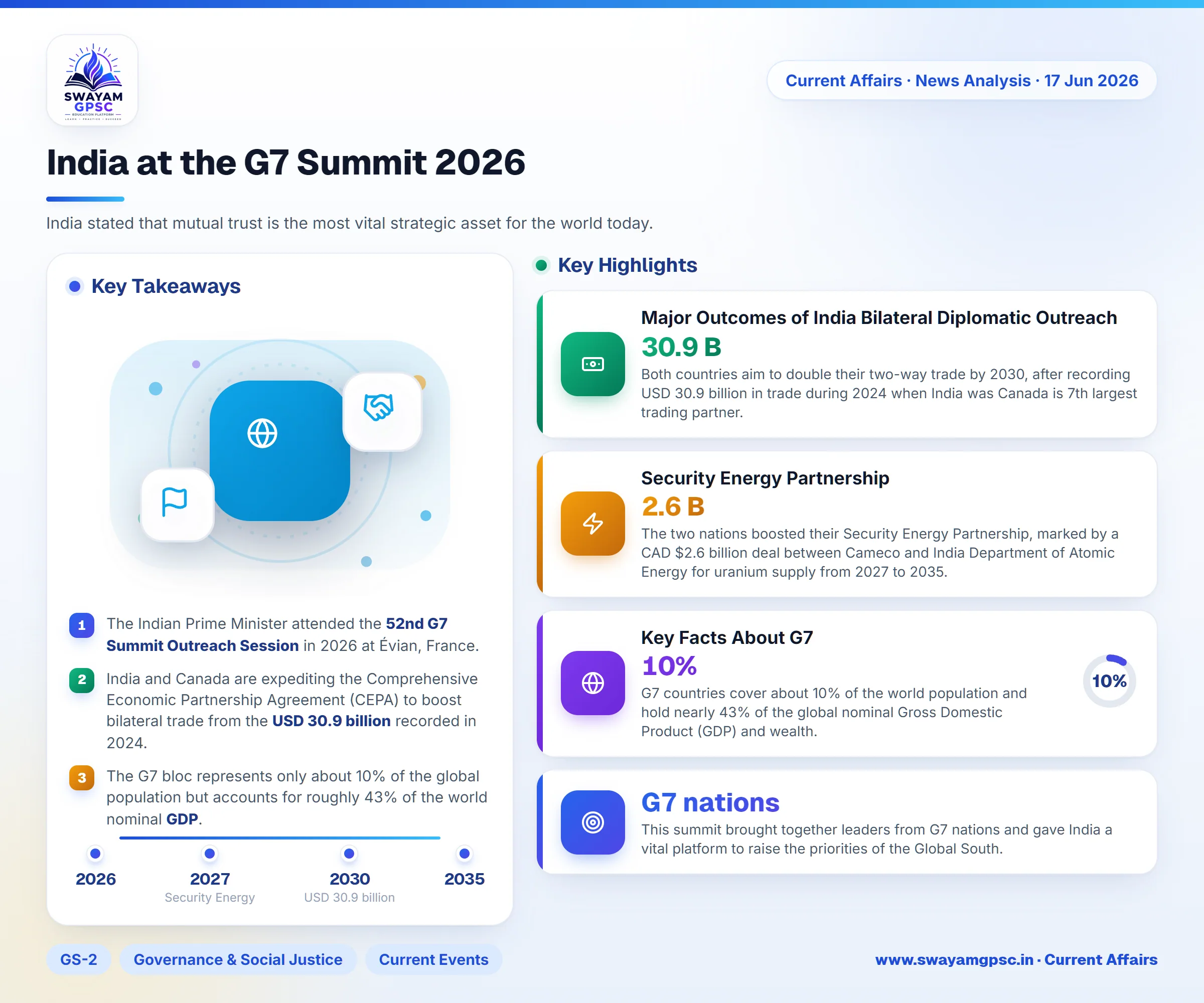
- The Indian Prime Minister attended the 52nd G7 Summit Outreach Session in 2026 at Évian, France.
- India and Canada are expediting the Comprehensive Economic Partnership Agreement (CEPA) to boost bilateral trade from the USD 30.9 billion recorded in 2024.
- The G7 bloc represents only about 10% of the global population but accounts for roughly 43% of the world nominal GDP.
- India and Canada agreed on a CAD $2.6 billion uranium supply deal between Cameco and the Department of Atomic Energy for 2027-2035.
Why in News
- The Prime Minister of India attended the 52nd G7 Summit Outreach Session in 2026 at Évian, France.
- The event took place under the theme Forging New Partnerships and Rebuilding International Solidarity.
- This summit brought together leaders from G7 nations and gave India a vital platform to raise the priorities of the Global South.
- India also worked to bridge the global trust deficit and held important meetings with leaders from Canada, the United Kingdom, and the United Arab Emirates (UAE).
What was India Core Message at the G7 Outreach Session
- India stated that mutual trust is the most vital strategic asset for the world today.
- The nation argued that current global problems happen because of a shortage of trust rather than a lack of resources.
- India asked the world to move away from the old donor and recipient model and build partnerships based on equality and shared responsibility.
- Developing and middle income countries want fair participation in global governance rather than simple financial help.
- India showcased its strong development partnership with Africa based on South-South cooperation.
Major Outcomes of India Bilateral Diplomatic Outreach
- India and Canada are speeding up talks to finish the Comprehensive Economic Partnership Agreement (CEPA) by the end of 2026.
- Both countries aim to double their two-way trade by 2030, after recording USD 30.9 billion in trade during 2024 when India was Canada is 7th largest trading partner.
- The two nations agreed to start talks on a General Security of Information Agreement (GSOIA) to improve defence and intelligence ties.
- India and Canada announced a new geopolitical platform named Raisina Americas following the model of the Raisina Dialogue.
- India officially supported Canada to become a Dialogue Partner in the Indian Ocean Rim Association (IORA).
- The two nations boosted their Security Energy Partnership, marked by a CAD $2.6 billion deal between Cameco and India Department of Atomic Energy for uranium supply from 2027 to 2035.
- India and the UK reviewed their relations under the India-UK Vision 2035 framework and reaffirmed their focus on the Comprehensive Economic and Trade Agreement (CETA).
- India and the UAE expressed worry over trade disruptions and called for free navigation through the Strait of Hormuz amid conflicts in West Asia.
- The Indian Prime Minister invited the UAE President to the 18th BRICS Summit which India will host in 2026.
Key Facts About G7
- The group started in 1975 as the G6 with six industrialised democracies after the 1973 oil crisis.
- Canada joined in 1976 to make it the G7, and Russia joined in 1998 to create the G8 before leaving in 2014 after the annexation of Crimea.
- The European Union (EU) takes part as a non-enumerated member through the heads of the European Council and the European Commission.
- The group focuses on global economic governance, trade, energy, and security based on shared democratic values.
- Unlike the UN or NATO, the G7 is informal, has no treaty, and runs without a permanent headquarters or secretariat.
- The presidency rotates annually among member states, allowing the host country to set the agenda and organize meetings.
- G7 countries cover about 10% of the world population and hold nearly 43% of the global nominal Gross Domestic Product (GDP) and wealth.
- Host nations invite guest countries like India, Brazil, and South Africa to special outreach sessions to talk about major global issues.