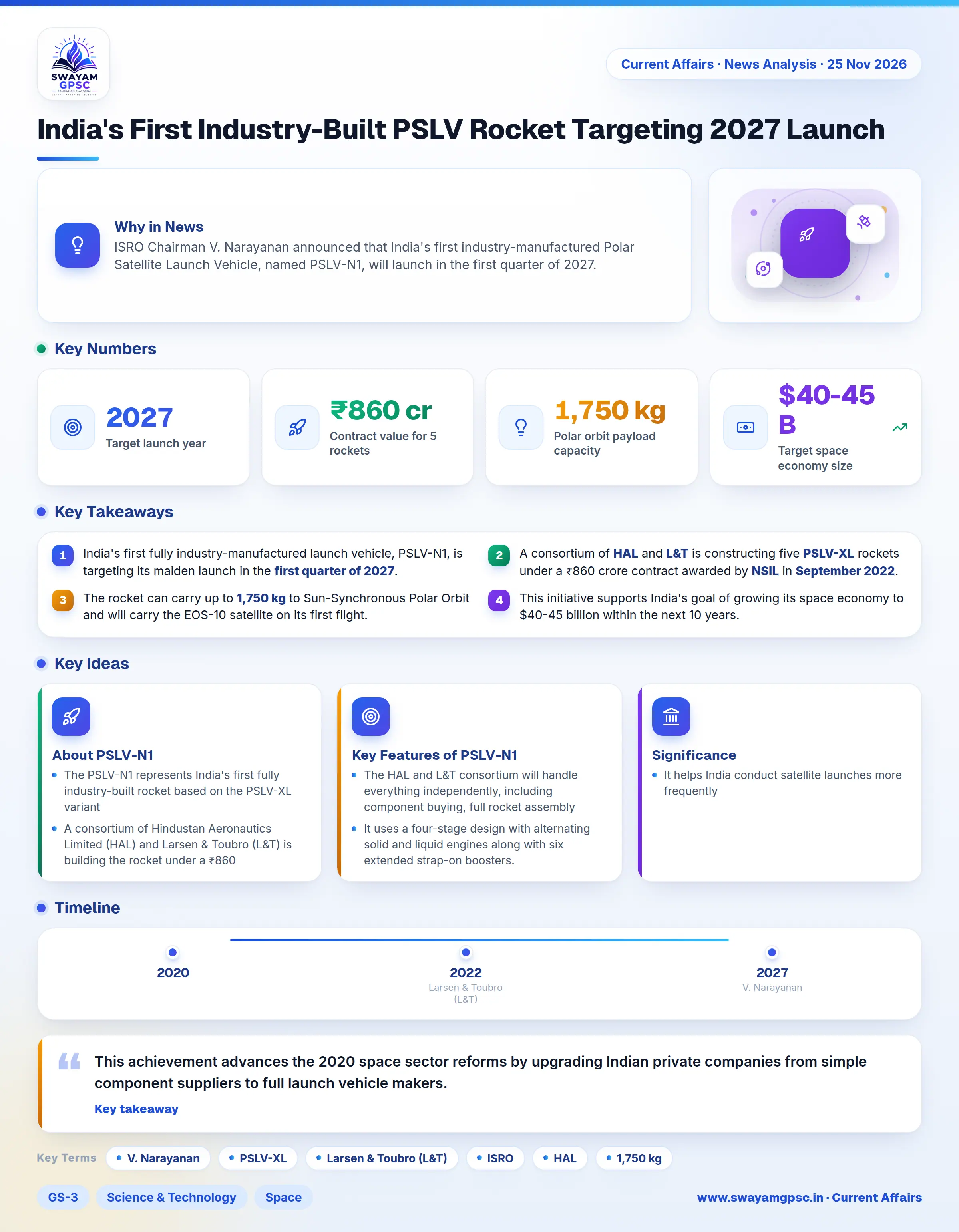
India's First Industry-Built PSLV Rocket Targeting 2027 Launch
#GS-3 #Science & Technology #Space #PSLV-N1 #ISRO #NSIL #HAL #L&T
Key takeaways
- India's first fully industry-manufactured launch vehicle, PSLV-N1, is targeting its maiden launch in the first quarter of 2027.
- A consortium of HAL and L&T is constructing five PSLV-XL rockets under a ₹860 crore contract awarded by NSIL in September 2022.
- The rocket can carry up to 1,750 kg to Sun-Synchronous Polar Orbit and will carry the EOS-10 satellite on its first flight.
- This initiative supports India's goal of growing its space economy to $40-45 billion within the next 10 years.
Why in News
- ISRO Chairman V. Narayanan announced that India's first industry-manufactured Polar Satellite Launch Vehicle, named PSLV-N1, will launch in the first quarter of 2027.
About PSLV-N1
- The PSLV-N1 represents India's first fully industry-built rocket based on the PSLV-XL variant, shifting manufacturing from government assembly to the domestic private sector.
- A consortium of Hindustan Aeronautics Limited (HAL) and Larsen & Toubro (L&T) is building the rocket under a ₹860 crore contract signed in September 2022 with NewSpace India Limited (NSIL).
- This project aims to increase satellite launch capacity so ISRO can focus more on advanced space research, technology design, and deep-space missions.
Key Features of PSLV-N1
- The HAL and L&T consortium will handle everything independently, including component buying, full rocket assembly, and complete pre-launch testing.
- It uses a four-stage design with alternating solid and liquid engines along with six extended strap-on boosters. The rocket can carry 1,750 kg to Sun-Synchronous Polar Orbit and 1,425 kg to Geosynchronous Transfer Orbit.
- The design includes upgraded components and improved quality checks for the third stage as recommended by ISRO's Failure Assessment Committee following issues with PSLV-C61 and PSLV-C62.
- It inherits the proven launch capability that powered major national missions like Chandrayaan-1, Mangalyaan, and Aditya-L1, along with carrying 434 foreign satellites from 34 countries.
- The inaugural flight will launch the EOS-10 Earth Observation Satellite together with commercial payloads to boost India's satellite operations.
Significance
- This achievement advances the 2020 space sector reforms by upgrading Indian private companies from simple component suppliers to full launch vehicle makers.
- It helps India conduct satellite launches more frequently, supporting the nation's goal to create a $40-45 billion space economy within the next 10 years.