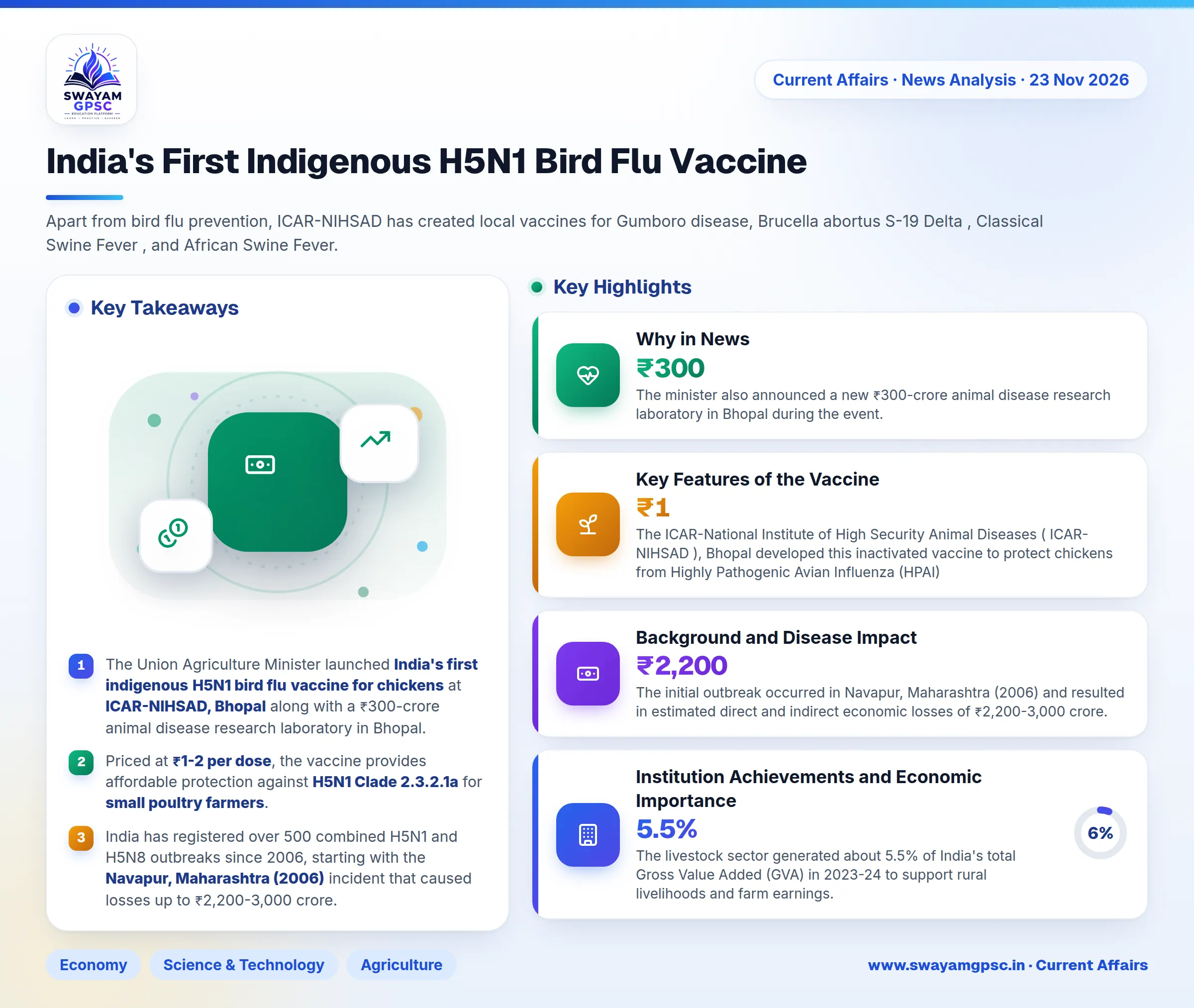
India's First Indigenous H5N1 Bird Flu Vaccine
#Economy #Science & Technology #Agriculture #Achievements of Indians in Science & Technology #Economics of Animal-Rearing
Key takeaways
- The Union Agriculture Minister launched India's first indigenous H5N1 bird flu vaccine for chickens at ICAR-NIHSAD, Bhopal along with a ₹300-crore animal disease research laboratory in Bhopal.
- Priced at ₹1-2 per dose, the vaccine provides affordable protection against H5N1 Clade 2.3.2.1a for small poultry farmers.
- India has registered over 500 combined H5N1 and H5N8 outbreaks since 2006, starting with the Navapur, Maharashtra (2006) incident that caused losses up to ₹2,200-3,000 crore.
- The livestock sector accounted for roughly 5.5% of India's total Gross Value Added (GVA) in 2023-24.
Why in News
- The Union Agriculture and Farmers Welfare Minister launched India's first indigenous H5N1 bird flu vaccine for chickens at ICAR-NIHSAD, Bhopal.
- The minister also announced a new ₹300-crore animal disease research laboratory in Bhopal during the event.
Key Features of the Vaccine
- The ICAR-National Institute of High Security Animal Diseases ( ICAR-NIHSAD ), Bhopal developed this inactivated vaccine to protect chickens from Highly Pathogenic Avian Influenza (HPAI), H5N1 Clade 2.3.2.1a.
- This product is recognized as the world's first vaccine specifically targeting H5N1 Clade 2.3.2.1a.
- The vaccine is priced affordably at ₹1-2 per dose to help small poultry farmers manage preventive care since no commercial vaccine for this specific clade existed before.
Background and Disease Impact
- India has faced over 500 combined H5N1 and H5N8 outbreaks since 2006 across the country.
- The initial outbreak occurred in Navapur, Maharashtra (2006) and resulted in estimated direct and indirect economic losses of ₹2,200-3,000 crore.
Institution Achievements and Economic Importance
- Apart from bird flu prevention, ICAR-NIHSAD has created local vaccines for Gumboro disease, Brucella abortus S-19 Delta , Classical Swine Fever , and African Swine Fever.
- The livestock sector generated about 5.5% of India's total Gross Value Added (GVA) in 2023-24 to support rural livelihoods and farm earnings.
Significance
- This new H5N1 vaccine boosts India's animal-health research capabilities and supports national self-reliance.
- The rollout helps lower poultry disease outbreaks, safeguards farmers, and cuts down heavy financial losses.