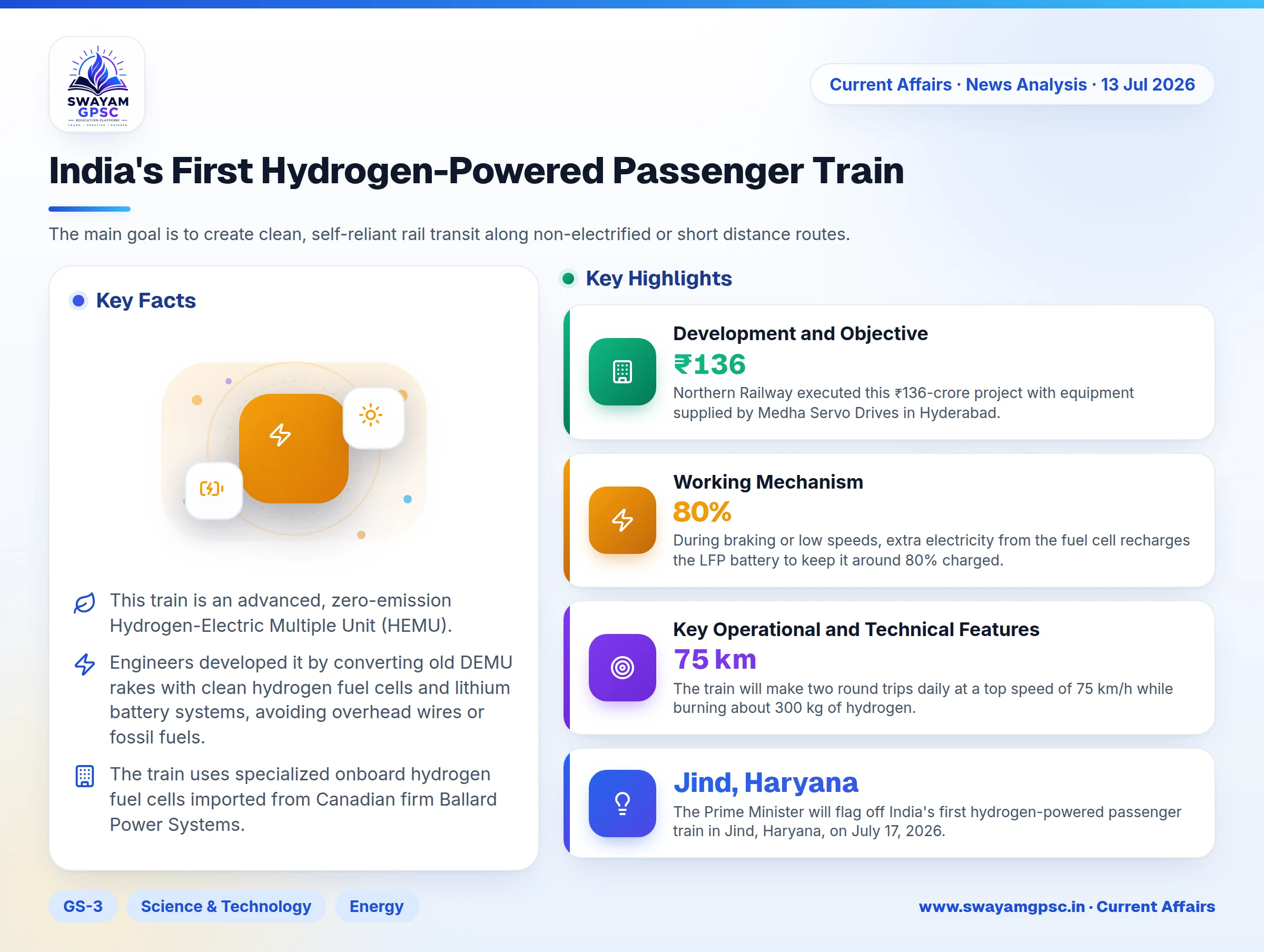
India's First Hydrogen-Powered Passenger Train
#GS-3 #Science & Technology #Energy #Environment #Sustainable Development #Economy #Infrastructure #Current Events #National
Why in News
- The Prime Minister will flag off India's first hydrogen-powered passenger train in Jind, Haryana, on July 17, 2026.
About the Hydrogen Train
- This train is an advanced, zero-emission Hydrogen-Electric Multiple Unit (HEMU).
- Engineers developed it by converting old DEMU rakes with clean hydrogen fuel cells and lithium battery systems, avoiding overhead wires or fossil fuels.
Development and Objective
- Northern Railway executed this ₹136-crore project with equipment supplied by Medha Servo Drives in Hyderabad.
- The train uses specialized onboard hydrogen fuel cells imported from Canadian firm Ballard Power Systems.
- The main goal is to create clean, self-reliant rail transit along non-electrified or short distance routes.
Working Mechanism
- The fuel cells combine compressed hydrogen from storage tanks with outside oxygen to make electricity, leaving only water vapor and heat as byproducts.
- A Lithium Ferro Phosphate (LFP) battery works alongside the fuel cell to supply extra power whenever the train starts or accelerates.
- During braking or low speeds, extra electricity from the fuel cell recharges the LFP battery to keep it around 80% charged.
Key Operational and Technical Features
- This is one of the world's longest hydrogen trainsets, featuring eight passenger coaches and two power cars that generate 2400 kW (3200 hp).
- It will run on the 89-km Jind-Sonipat section in Haryana and can carry up to 682 passengers per trip.
- The train will make two round trips daily at a top speed of 75 km/h while burning about 300 kg of hydrogen.
- Each driving power car carries a storage rack holding 440 kg of hydrogen compressed at pressures between 200 and 500 bar.
- The railways set up a dedicated hydrogen fueling station with a 3,000-kg capacity at Jind.
- This fueling station features a chiller unit that cools the gas to -15 degree C to make it dense for safe and quick refueling.