India's First Geothermal Wells Commissioned in Puga Valley
#GS-1 #Geography #Resources #GS-3 #Science & Technology #Energy #Environment #Sustainable Development #Current Events #National
Why in News
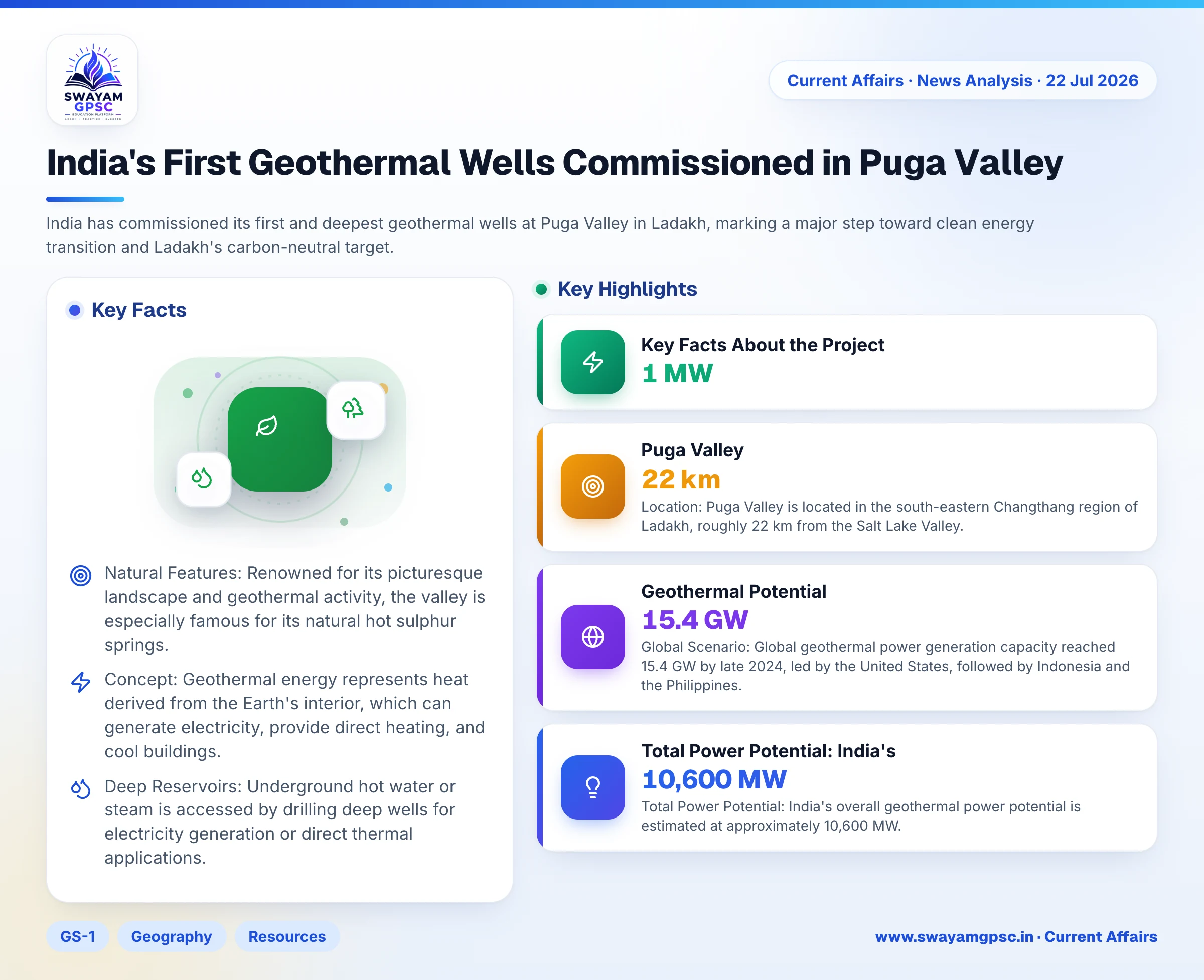
- India has commissioned its first and deepest geothermal wells at Puga Valley in Ladakh, marking a major step toward clean energy transition and Ladakh's carbon-neutral target.
Key Facts About the Project
- Location and Depth: Both wells are drilled to a depth of 1,000 metres at an elevation of over 14,000 feet in Puga Valley, which is one of India's most promising geothermal sites.
- Power Generation Target: The wells will power a proposed 1 MW pilot geothermal power plant, serving as India's first demonstration-scale geothermal power project.
- Working Principle: The project taps heat stored naturally beneath the Earth to generate reliable renewable electricity 24 hours a day, unlike weather-dependent solar or wind energy.
- Temperature Recorded: Engineers measured a maximum temperature of 135°C at a depth of 400 metres, and further tests are evaluating higher underground temperatures and commercial potential.
- Executing Agency: The ONGC Energy Centre is implementing this project in collaboration with the Ladakh Administration and the Ladakh Autonomous Hill Development Council, Leh.
Puga Valley
- Location: Puga Valley is located in the south-eastern Changthang region of Ladakh, roughly 22 km from the Salt Lake Valley.
- Natural Features: Renowned for its picturesque landscape and geothermal activity, the valley is especially famous for its natural hot sulphur springs.
Understanding Geothermal Energy
- Concept: Geothermal energy represents heat derived from the Earth's interior, which can generate electricity, provide direct heating, and cool buildings.
- Renewable Nature: It is considered renewable because Earth's internal heat is continuously replenished through residual heat and the decay of radioactive elements.
Sources of Geothermal Energy
- Deep Reservoirs: Underground hot water or steam is accessed by drilling deep wells for electricity generation or direct thermal applications.
- Near-surface Resources: Hot springs and shallow hydrothermal reservoirs occur mainly in geologically active regions and are easier to tap.
- Shallow Ground: Upper ground layers maintain a stable temperature year-round, which geothermal heat pumps can utilize to heat and cool buildings.
Institutional Framework
- National Policy: The National Policy on Geothermal Energy, 2025 aims to boost the exploration and development of India's untapped geothermal resources.
- Nodal Ministry: The Ministry of New and Renewable Energy serves as the primary agency responsible for executing this policy.
Geothermal Potential
- Global Scenario: Global geothermal power generation capacity reached 15.4 GW by late 2024, led by the United States, followed by Indonesia and the Philippines.
- Hot Springs in India: The Geological Survey of India has identified 381 hot springs across the country, with surface temperatures ranging from 35°C to 89°C.
- Recognized Provinces: India officially recognizes 10 geothermal provinces, including Himalayan, Naga-Lusai, Andaman and Nicobar Islands, Son-Narmada-Tapi, West Coast, Cambay Graben, Aravalli, Mahanadi, Godavari, and South Indian Cratonic regions.
- Key Identified Sites: Prominent sites include Puga and Chumathang in Ladakh, Manikaran in Himachal Pradesh, Tapoban in Uttarakhand, Bakreshwar in West Bengal, Tuwa in Gujarat, Tattapani in Chhattisgarh, and Deulajhari in Odisha.
- Total Power Potential: India's overall geothermal power potential is estimated at approximately 10,600 MW.
Frequently Asked Questions
- Why in News: India commissioned its first and deepest geothermal wells at Puga Valley in Ladakh to feed the nation's first demonstration-scale geothermal plant.
- Location: Puga Valley lies in the Changthang region of south-eastern Ladakh, roughly 22 km from Salt Lake Valley.
- Unique Features: These are India's first geothermal wells, drilled to a depth of 1,000 metres at an elevation over 14,000 feet.
- Proposed Capacity: The wells will supply thermal energy to a proposed 1 MW pilot geothermal power plant.
- Definition: Geothermal energy refers to the heat trapped inside the Earth that can be used for generating electricity and direct heating.