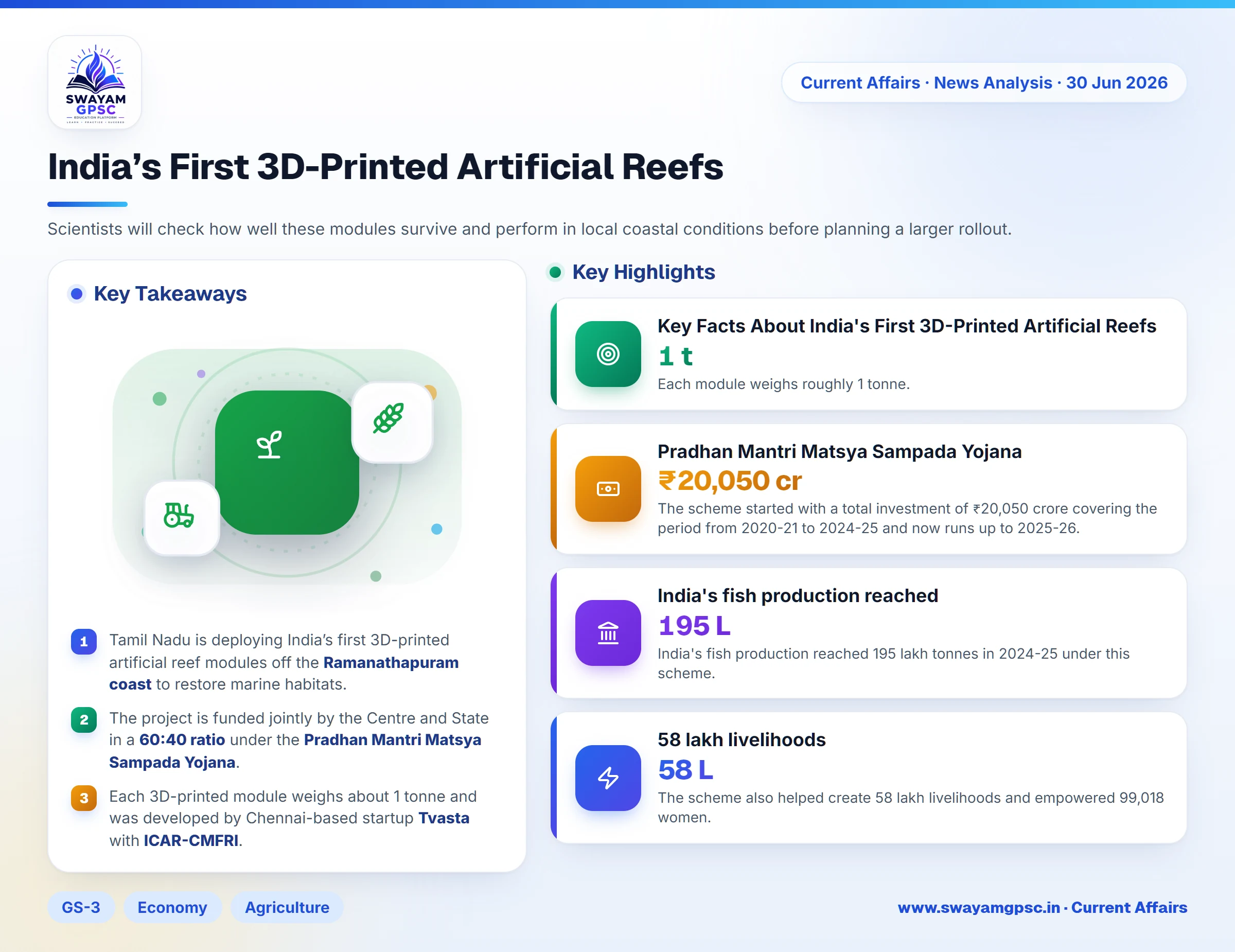
India’s First 3D-Printed Artificial Reefs
#GS-3 #Economy #Agriculture #Infrastructure #Current Events #National #Gujarat
Key takeaways
- Tamil Nadu is deploying India’s first 3D-printed artificial reef modules off the Ramanathapuram coast to restore marine habitats.
- The project is funded jointly by the Centre and State in a 60:40 ratio under the Pradhan Mantri Matsya Sampada Yojana.
- Each 3D-printed module weighs about 1 tonne and was developed by Chennai-based startup Tvasta with ICAR-CMFRI.
- India's fish production reached 195 lakh tonnes in 2024-25 through various fisheries development initiatives.
Why in News
- Tamil Nadu will deploy India’s first 3D-printed artificial reef modules to support marine habitat restoration.
- This initiative is part of the second phase of the Pradhan Mantri Matsya Sampada Yojana.
Key Facts About India's First 3D-Printed Artificial Reefs
- The pilot test will place six newly developed reef designs off the Ramanathapuram coast.
- Scientists will check how well these modules survive and perform in local coastal conditions before planning a larger rollout.
- The ICAR-Central Marine Fisheries Research Institute through its Visakhapatnam Regional Centre is helping with this project.
- A Chennai-based startup named Tvasta, which was incubated at IIT Madras, designed and built these structures.
- Each module weighs roughly 1 tonne.
- Unlike old concrete reefs that use iron inside, these modules do not have iron reinforcement.
- They feature complex 3D-printed structures with crevices, folds and attachment surfaces.
- This special design helps increase porosity, surface area and habitat suitability for corals and sponges.
- The Centre and State are funding this project together in a 60:40 ratio.
- This work is part of a bigger artificial reef project spanning 213 sites in Tamil Nadu.
- Traditional fishing communities will benefit through improved fish stocks and healthier marine ecosystems.
What is a 3D Printed Artificial Reef
- 3D-printed artificial reefs are human-made underwater structures built to restore weak or damaged marine habitats and support biodiversity.
- Advanced 3D-printing methods allow engineers to make intricate, customized and species-specific designs that normal concrete cannot match.
- These reefs contain varied cavity sizes, folds, textures and complex surfaces that give marine organisms a place to hide and breed.
- Their structure encourages corals, sponges, algae, crustaceans and fish to grow and build a new marine ecosystem.
- By creating extra habitats and nursery areas, these reefs can increase fish biomass and support sustainable fisheries management.
- They offer great flexibility in design, faster changes, site-specific material choices and the ability to target particular marine species.
- Their success depends heavily on durability, non-toxic materials, correct placement and long-term checks, because artificial reefs do not always work as planned.
- These reefs serve as an innovative tool to strengthen marine biodiversity, help coastal communities and reduce pressure on natural coral reefs.
Pradhan Mantri Matsya Sampada Yojana
- The government launched the Pradhan Mantri Matsya Sampada Yojana (PMMSY) on 10th September 2020 to bring a Blue Revolution to the fisheries sector.
- The main goal is to increase fish production, improve productivity, modernize the value chain, and strengthen post-harvest infrastructure.
- The scheme started with a total investment of ₹20,050 crore covering the period from 2020-21 to 2024-25 and now runs up to 2025-26.
- It consists of two main parts: a Central Sector Scheme funded fully by the centre, and a Centrally Sponsored Scheme run with state support.
- The scheme focuses on boosting production, building fisheries infrastructure, managing post-harvest tasks, and supporting women.
- India's fish production reached 195 lakh tonnes in 2024-25 under this scheme.
- The scheme also helped create 58 lakh livelihoods and empowered 99,018 women.