India's Export Performance 2026-27: Key Trends and Future Strategy
#GS-3 #Economy #Infrastructure #Growth #Exports #Foreign Trade #MSMEs
Key takeaways
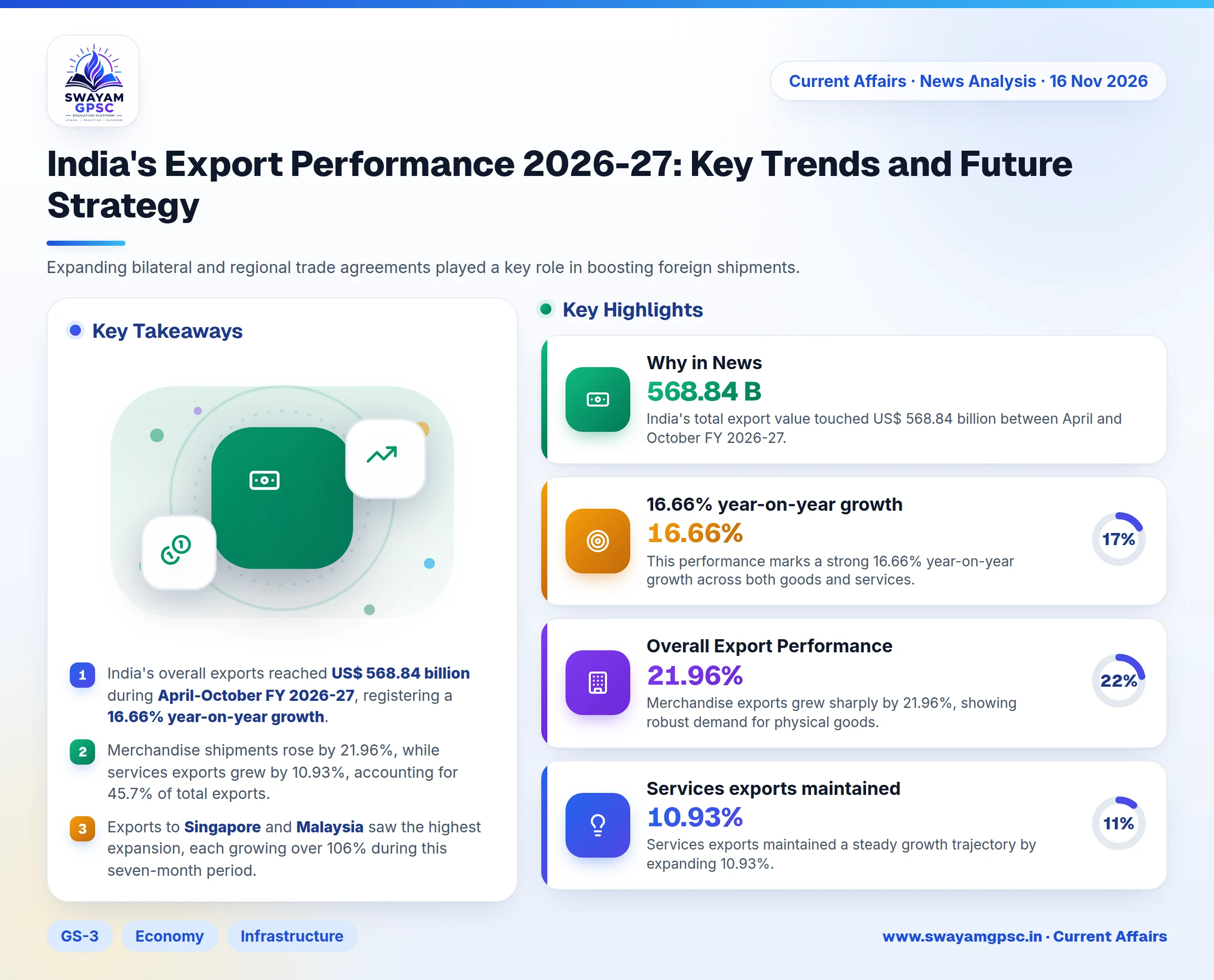
- India's overall exports reached US$ 568.84 billion during April-October FY 2026-27, registering a 16.66% year-on-year growth.
- Merchandise shipments rose by 21.96%, while services exports grew by 10.93%, accounting for 45.7% of total exports.
- Exports to Singapore and Malaysia saw the highest expansion, each growing over 106% during this seven-month period.
- The government backed exporters through the ₹25,060 crore Export Promotion Mission and the ₹497 crore RELIEF component.
- India's foreign exchange reserves stood at a strong US$ 719.55 billion as of November 6, 2026.
Why in News
- India's total export value touched US$ 568.84 billion between April and October FY 2026-27.
- This performance marks a strong 16.66% year-on-year growth across both goods and services.
- The nation achieved seven straight months of positive export growth during this seven-month period.
About India's Export Performance 2026-27
- This progress reflects outbound trade achievements covering goods and services during the first seven months of the financial year.
- Targeted export promotion policies and digital logistics platforms actively backed this trade expansion.
- Expanding bilateral and regional trade agreements played a key role in boosting foreign shipments.
Overall Export Performance
- Total combined exports reached US$ 568.84 billion with an overall expansion rate of 16.66%.
- Merchandise exports grew sharply by 21.96%, showing robust demand for physical goods.
- Services exports maintained a steady growth trajectory by expanding 10.93%.
- Monthly exports in October 2026 alone hit US$ 89.99 billion, registering a 29.90% surge over the same month last year.
Top 5 Fastest-Growing Export Destinations
- Shipments to Singapore recorded the highest rise with an extraordinary growth rate of 107.50%.
- Exports directed toward Malaysia grew rapidly, registering a 106.87% increase.
- Outbound trade to Spain surged significantly by 88.38% over the period.
- Despatch of goods to South Africa saw a strong jump of 62.20%.
- Exports heading to neighboring Sri Lanka expanded steadily by 60.42%.
Top 5 Fastest-Growing Export Categories
- The Other Cereals category topped the growth charts by surging 109.74%.
- Foreign demand for Petroleum Products grew strongly, recording a 47.71% increase.
- Shipments of Electronic Goods continued their rapid upward path with 46.92% growth.
- Exports under Meat, Dairy & Poultry expanded significantly by 40.81%.
- Traditional Handicrafts exports registered a healthy growth rate of 36.05%.
Other Important Highlights
- Non-petroleum exports rose 18.01% to reach US$ 259.22 billion, demonstrating underlying economic strength outside fuel.
- The services sector contributed 45.7% of total trade revenues, reinforcing India's global position.
- Exporters generated US$ 622.1 million by tapping into 1,985 new product-market combinations between April and September 2026.
- Net foreign direct investment inflows stood at US$ 8.8 billion during the April-September 2026 timeframe.
- India's foreign exchange reserves reached a robust total of US$ 719.55 billion by November 6, 2026.
Policy Initiatives Driving Export Growth
- The ₹25,060 crore Export Promotion Mission (EPM) provides financial backing and compliance support to MSMEs and new traders.
- The ₹497 crore RELIEF component buffers exporters against rising international freight rates and insurance fees.
- The RoDTEP and RoSCTL schemes offer duty rebates to exporters until December 2026.
- Input access frameworks like Advance Authorisation, DFIA, and EPCG provide duty-free capital goods and raw materials.
- Grassroots trade infrastructure expanded through 249 Districts as Export Hubs and 1,013 Dak Ghar Niryat Kendras alongside 8 new SEZs.
- Digital customs integration improved via ULIP, LDB, ICEGATE, and Trade Connect, simplifying cargo tracking and clearance.
Challenges
- Ongoing global conflicts in West Asia and Eastern Europe drive up shipping costs and war-risk premiums for Indian exporters.
- Red Sea and Persian Gulf route disruptions force traders to rely on government assistance to manage freight spikes.
- Advanced economies increasingly impose non-tariff barriers, strict phytosanitary norms, and carbon taxes on imports.
- The European Union's Carbon Border Adjustment Mechanism (CBAM) poses compliance hurdles for Indian steel and engineering exports.
- Manufacturing exports in high-growth sectors like electronics still depend heavily on imported raw components.
- Small exporters in rural districts struggle with high credit costs, certification charges, and limited overseas brand visibility.
Way Forward
- Finalize pending Free Trade Agreements with the US, Canada, and GCC while smoothly implementing the upcoming India-EU FTA.
- Link Foreign Trade Policy benefits with the PLI scheme to build local component supply chains for electronics and chemicals.
- Provide affordable export credit, factoring support, and collateral-free digital loans to smaller businesses under the Export Promotion Mission.
- Build certified quality testing facilities and carbon-accounting centers in regional clusters to help MSMEs meet global standards.
Conclusion
- India's trade performance in early FY 2026-27 showcases strong external resilience led by electronics, agriculture, and services.
- Digital trade networks and target schemes like the Export Promotion Mission position the country firmly within global supply chains.
- Maintaining long-term momentum requires reducing shipping costs, deepening domestic manufacturing depth, and supporting smaller exporters through global green regulations.