India’s Emerging Technology Ecosystem and Growth
#GS-2 #GS-3 #Governance & Social Justice #Economy #Science & Technology #Infrastructure #Artificial Intelligence #National #Current Events #Quick Facts For Prelims #IT & Computers #Achievements of Indians in Science & Technology
Key takeaways
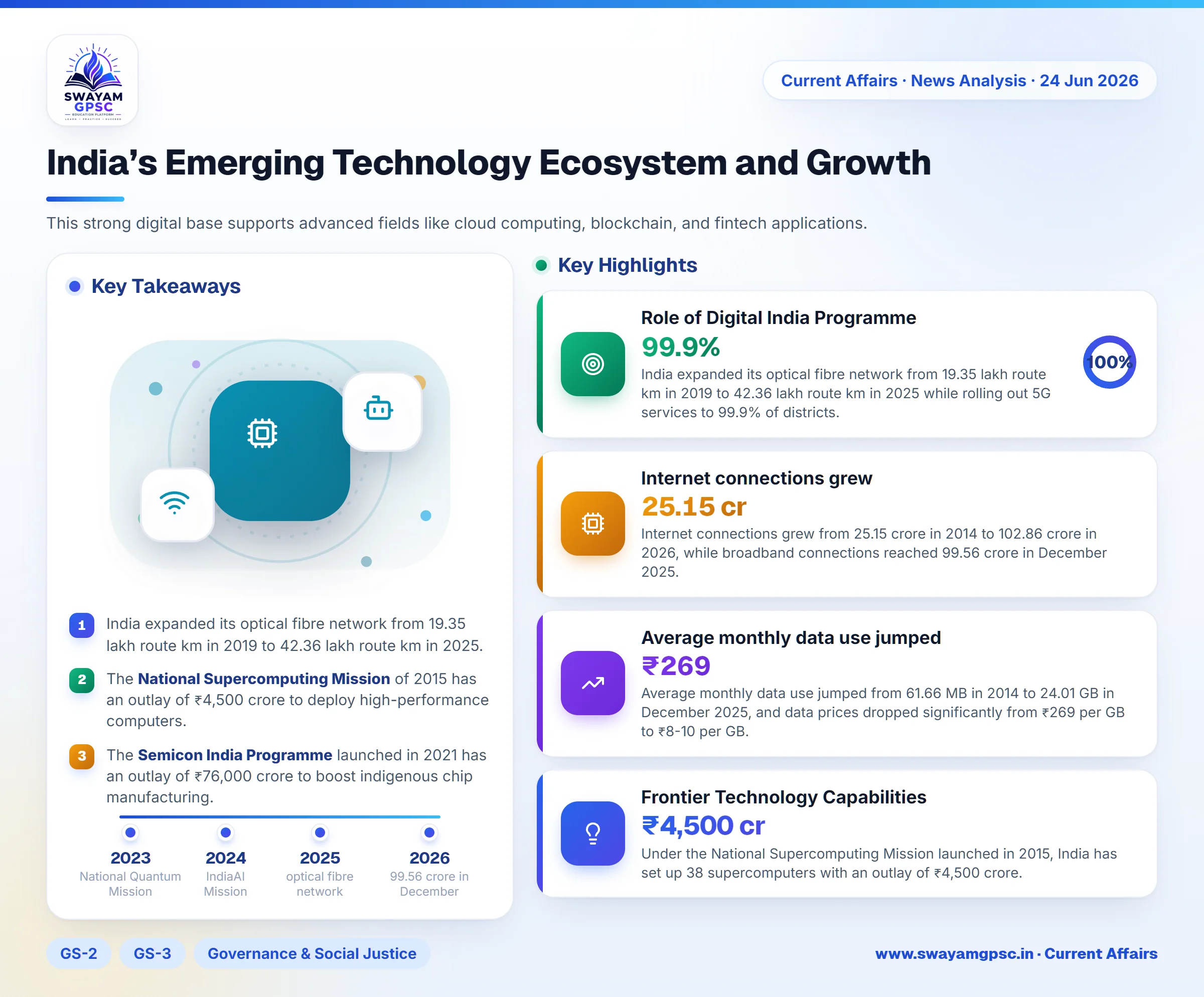
- India expanded its optical fibre network from 19.35 lakh route km in 2019 to 42.36 lakh route km in 2025.
- The National Supercomputing Mission of 2015 has an outlay of ₹4,500 crore to deploy high-performance computers.
- The Semicon India Programme launched in 2021 has an outlay of ₹76,000 crore to boost indigenous chip manufacturing.
- Approved in 2023, the National Quantum Mission carries an outlay of ₹6,003.65 crore for advanced quantum technologies.
- India climbed to 38th rank in the Global Innovation Index 2025, improving substantially from its 81st position in 2015.
Why in News
- India is now viewed globally as an emerging technology power rather than just a large market for digital products.
- This massive shift happens because of Digital Public Infrastructure (DPI), local innovations, new startups, and dedicated national missions in areas like Artificial Intelligence (AI), semiconductors, and quantum technologies.
Role of Digital India Programme
- Over the past decade, India used technology to support its Viksit Bharat vision by building robust digital infrastructure and boosting innovation.
- Launched in 2015, the Digital India Programme laid the bedrock for modern technology by improving connectivity and digital service delivery across all sectors.
- India expanded its optical fibre network from 19.35 lakh route km in 2019 to 42.36 lakh route km in 2025 while rolling out 5G services to 99.9% of districts.
- Internet connections grew from 25.15 crore in 2014 to 102.86 crore in 2026, while broadband connections reached 99.56 crore in December 2025.
- Average monthly data use jumped from 61.66 MB in 2014 to 24.01 GB in December 2025, and data prices dropped significantly from ₹269 per GB to ₹8-10 per GB.
- This strong digital base supports advanced fields like cloud computing, blockchain, and fintech applications.
Frontier Technology Capabilities
- Supercomputers run billions of calculations every second to solve complicated problems in weather forecasting and scientific research.
- Under the National Supercomputing Mission launched in 2015, India has set up 38 supercomputers with an outlay of ₹4,500 crore.
- The indigenous PARAM Rudra series uses domestic hardware and software to push India toward self-reliance in high-performance computing.
- Semiconductors power modern digital devices, AI systems, and defence electronics.
- The Semicon India Programme of 2021 has an outlay of ₹76,000 crore to back manufacturing, design, and research.
- Announced in Budget 2026-27, the India Semiconductor Mission 2.0 brings an initial outlay of ₹1,000 crore to focus on equipment, materials, and resilient supply chains.
- The Design Linked Incentive (DLI) Scheme of 2021 helps startups, MSMEs, and colleges build fabless semiconductor designs.
- By June 2026, authorities approved 12 projects worth ₹1.64 lakh crore, including one chip fab, two compound semiconductor fabs, and nine packaging units.
- Quantum technologies use quantum mechanics to revolutionize computing, healthcare, and finance.
- Approved in 2023, the National Quantum Mission has an outlay of ₹6,003.65 crore to build quantum computing and communication networks.
- India completed a 1,000-km secure quantum communication network, and laid the foundation for India’s first Quantum Valley in Amaravati in 2026.
- The IndiaAI Mission was launched in 2024 with an outlay of over ₹10,300 crore to build computing infrastructure and support young innovators.
- A shared computing setup featuring over 38,000 GPUs is being built to give researchers easy access to AI tools.
- AI Kosh currently hosts 12,115 datasets and 306 AI models across 20 different sectors.
- Cloud computing gives government and businesses secure access to digital storage and data processing.
- India started its indigenous cloud journey with MeghRaj in 2014, followed by MeghRaj 2.0 to improve security.
- By June 2026, government department adoption of MeghRaj grew from 342 departments in 2015-16 to 2,323 departments.
- MeghRaj powers major platforms like DigiLocker, MyGov, and the National Scholarship Portal.
- Blockchain offers a secure and decentralized ledger for governance and financial transactions.
- MeitY launched the National Blockchain Framework in 2021 with an outlay of ₹64.76 crore.
- Key platforms include the Vishvasya Blockchain Stack, NBFLite sandbox, Praamaanik app verification system, and National Blockchain Portal.
- By October 2025, blockchain platforms verified over 3 crore property documents to reduce fraud.
- Data centres store and process critical digital information for modern tech applications.
- India's data centre capacity surged from 375 MW in 2020 to nearly 1,500 MW by 2025.
- Major data centre hubs have come up in Mumbai, Navi Mumbai, Hyderabad, Bengaluru, Noida, and Jamnagar.
- Biotechnology drives growth in genomics, precision medicine, and industrial innovation.
- Key support programs include the National Biopharma Mission of 2017 with an outlay of ₹1,500 crore, the BioE3 Policy of 2023, and Intensifying the Impact of Industrial Innovation (i4).
- India's bioeconomy surpassed USD 150 billion in 2023 and reached USD 190 billion by June 2026.
- DBT-BIRAC set up 94 bioincubators across 25 States and UTs to support startup enterprises.
Research and Development Capacity
- The Anusandhan National Research Foundation (ANRF) started operations in 2024 to encourage teamwork among universities and industries.
- ANRF runs programs like the Mission for Advancement in High-impact Areas (MAHA) and Partnerships for Accelerated Innovation and Research (PAIR).
- By March 2026, research grants worth ₹264.70 crore were awarded in high-impact technology fields.
- Approved in July 2025, the RDI Scheme brings a large corpus of ₹1 lakh crore funded through DST to finance private sector innovation.
- Launched in 2018 by MeitY alongside NASSCOM, the FutureSkills PRIME program helps workers reskill in digital domains.
- By March 2026, the program registered over 27.53 lakh candidates, with roughly 80% of learners coming from Tier-2 and Tier-3 cities.
- The National Institute of Electronics and Information Technology (NIELIT) trains youth through 56 centres, 750 affiliated institutes, and over 9,000 facilitation centres.
- NIELIT became a Deemed-to-be University in July 2024 and established IndiaAI Data Labs across 27 centres.
- Four AI Centres of Excellence were set up with an allocation of ₹1,490 crore to build practical traffic, flood, and disease prediction tools.
- The Skilling for AI Readiness (SOAR) programme started in July 2025 to teach AI to school students from classes 6 to 12 via the Skill India Digital Hub (SIDH).
- By March 2026, SIDH had over 1.5 crore registered candidates offering more than 1,000 courses across 23 languages.
- Launched by MeitY in 2022 with an outlay of ₹250 crore, the Chips to Start-up (C2S) Programme trains 85,000 professionals in chip design.
Global Technology Partnerships and Credibility
- India climbed to 38th position in the Global Innovation Index 2025, rising significantly from 81st place in 2015.
- The Network Readiness Index published by the Portulans Institute highlights India's steady progress in digital infrastructure and technology use.
- India hosts over 2,100 Global Capability Centres (GCCs) across 3,728 units, employing roughly 2.36 million professionals.
- Formed in 2023, the Bharat 6G Alliance brings experts together to build indigenous advanced communication standards.
- Set up in 2020, the New, Emerging and Strategic Technologies (NEST) Division under the Ministry of External Affairs handles technology diplomacy.
- Held in 2025, SEMICON India 2025 attracted over 350 exhibiting companies from 48 countries and secured 13 MoUs.
- The India AI Impact Summit 2026 gathered delegates from over 100 countries and 20 international organisations, attracting USD 200 billion in investment commitments.
- India officially joined Pax Silica, which is a strategic coalition of democratic nations working to secure critical minerals and semiconductor supply chains.
- India Stack platforms like Aadhaar, UPI, and DigiLocker led to cooperation agreements with 23 countries, while UPI works seamlessly in nations like Singapore, UAE, and France.
Way Forward
- India must sustain high public investments in research, digital infrastructure, and skilling to support long-term goals.
- Building deeper international alliances will help secure resilient supply chains for critical tech components like semiconductors and rare minerals.
- Expanding rural digital literacy ensures that the benefits of emerging technologies reach every corner of society evenly.
- Focusing on ethical AI frameworks and data security will solidify India's leadership in human-centric technology development.