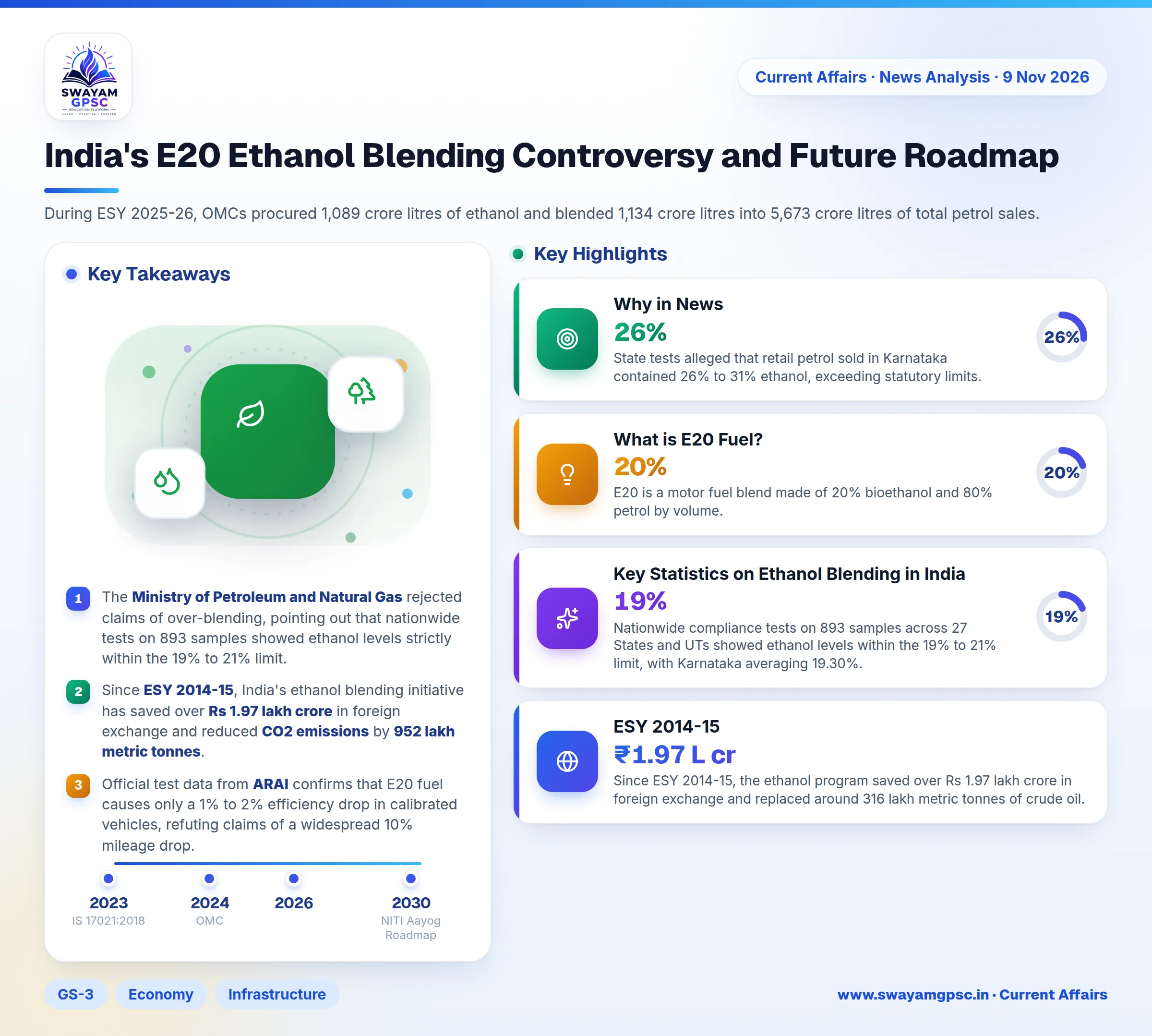
India's E20 Ethanol Blending Controversy and Future Roadmap
#GS-3 #Economy #Infrastructure #Environment #Climate Change #Sustainable Development #Energy
Key takeaways
- The Ministry of Petroleum and Natural Gas rejected claims of over-blending, pointing out that nationwide tests on 893 samples showed ethanol levels strictly within the 19% to 21% limit.
- Since ESY 2014-15, India's ethanol blending initiative has saved over Rs 1.97 lakh crore in foreign exchange and reduced CO2 emissions by 952 lakh metric tonnes.
- Official test data from ARAI confirms that E20 fuel causes only a 1% to 2% efficiency drop in calibrated vehicles, refuting claims of a widespread 10% mileage drop.
Why in News
- The Ministry of Petroleum and Natural Gas and public sector Oil Marketing Companies (OMCs) rejected claims made by the Karnataka Government.
- State tests alleged that retail petrol sold in Karnataka contained 26% to 31% ethanol, exceeding statutory limits.
What is E20 Fuel?
- E20 is a motor fuel blend made of 20% bioethanol and 80% petrol by volume.
- The standard specification for this blended fuel is governed by IS 17021.
Key Statistics on Ethanol Blending in India
- Nationwide compliance tests on 893 samples across 27 States and UTs showed ethanol levels within the 19% to 21% limit, with Karnataka averaging 19.30%.
- Since ESY 2014-15, the ethanol program saved over Rs 1.97 lakh crore in foreign exchange and replaced around 316 lakh metric tonnes of crude oil.
- The initiative reduced CO2 emissions by nearly 952 lakh metric tonnes and transferred over Rs 1.66 lakh crore to domestic farmers.
- During ESY 2025-26, OMCs procured 1,089 crore litres of ethanol and blended 1,134 crore litres into 5,673 crore litres of total petrol sales.
Evolution of Ethanol Blending in India
- Between 2001 and 2003, India ran pilot projects in select states to test 5% ethanol blending in motor petrol.
- The National Policy on Biofuels 2018 expanded feedstock options to include surplus food grains, damaged rice, and maize.
- In 2021-2022, the government moved the target year for 20% ethanol blending from 2030 to 2025-26, based on the NITI Aayog Roadmap.
- From 2023 to 2026, E20 fuel was rolled out commercially across retail stations under updated IS 17021:2018 standards.
Key Initiatives Taken So Far
- The National Policy on Biofuels provided regulatory support, streamlined inter-state transport, and fixed feedstock-based pricing.
- The government introduced Interest Subvention Schemes offering loan subsidies for setting up 1G and 2G ethanol plants.
- Automated blending systems were installed at refinery depots to stop manual tampering of fuel proportions.
- The Centre for High Technology (CHT) set up Quality Coordination Cells (QCC) to perform nationwide compliance testing.
Flaws Flagged in the Karnataka Testing Exercise
- State officials drew fuel samples without OMC presence, violating the 2005 Control Order and MDG 2024.
- The state failed to provide parallel retention samples or detailed lab sheets to OMCs for counter-testing.
- Test certificates used incomplete Gas Chromatography methods without following ASTM D4815/D6839 standards.
- The reported samples showed lower fuel density between 0.742 and 0.749 g/cc, which contradicts physical laws because adding ethanol raises fuel density above 0.752 g/cc.
The Debate on Mileage Drop and Consumer Impact
- Activists claimed a blanket 10% drop in mileage, but official tests by ARAI and SIAM show only a 1% to 2% drop in E20-calibrated engines and 3% to 6% in older engines.
- Claims of Rs 62,000 crore annual fuel losses are based on flawed assumptions about nationwide vehicle performance.
- Activists alleged Rs 39,000 crore in vehicle repair costs, but data shows over 34 crore vehicles operate on E20 daily without systemic mechanical failures.
- Allegations that retailers profit by over-blending are false because excess ethanol increases procurement costs for OMCs.
Way Forward
- State authorities, OMCs, and accredited labs must conduct all fuel quality audits through joint verifiable sampling.
- Automobile manufacturers should accelerate the production of E20-calibrated engines across all vehicle segments.
- Depot-level automated blending logs and QCC test reports should be published on digital portals for transparency.
- State legal metrology laboratories need standardized Gas Chromatography equipment and reference fuels to eliminate testing errors.
Conclusion
- This debate highlights the need for aligned quality testing between state authorities and central standards.
- Strict compliance with legal sampling protocols and joint audits will preserve consumer trust and support national biofuel targets.