India's Cultural Heritage Conservation and Development
#GS-1 #Indian Heritage Sites #Culture #Heritage #Art & Architecture #Economy #Infrastructure #Governance & Social Justice #Good Governance #Current Events #National
Key takeaways
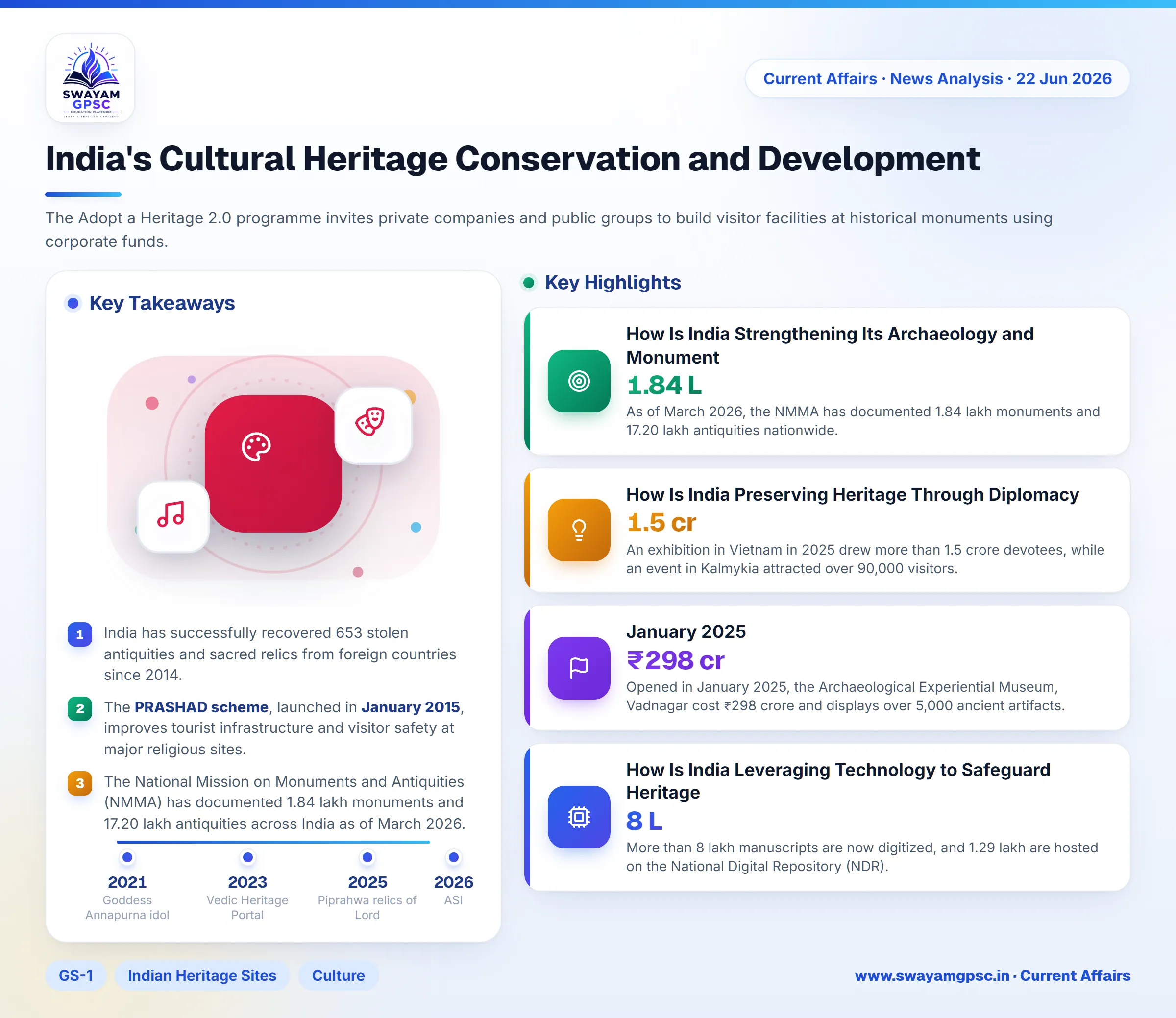
- India has successfully recovered 653 stolen antiquities and sacred relics from foreign countries since 2014.
- The PRASHAD scheme, launched in January 2015, improves tourist infrastructure and visitor safety at major religious sites.
- The National Mission on Monuments and Antiquities (NMMA) has documented 1.84 lakh monuments and 17.20 lakh antiquities across India as of March 2026.
- The Gyan Bharatam Mission (2025) has successfully digitized over 8 lakh ancient manuscripts for public research and access.
Why in News
- India's rich cultural legacy reflects thousands of years of traditions and forms the core of the national civilisational identity.
- Over the past 12 years, the government has placed a strong focus on protecting and promoting cultural heritage through multiple preservation programmes.
How Has India Integrated Heritage with Growth
- India now connects heritage protection with tourism, job creation, and cultural diplomacy instead of just guarding old monuments.
- The Adopt a Heritage 2.0 programme invites private companies and public groups to build visitor facilities at historical monuments using corporate funds.
- Launched in January 2015, the PRASHAD scheme improves infrastructure, cleanliness, and safety at key pilgrimage and tourism sites across the country.
- Evaluation reports show that the PRASHAD scheme makes travel easier and improves visitor satisfaction at chosen religious locations.
- Major projects like the Somnath Promenade and Kedarnath upgrades have made important pilgrimage centers much more accessible to travelers.
- The Swadesh Darshan 1.0 scheme focused on building tourism infrastructure across specific themes like tribal, spiritual, and coastal circuits.
- The revamped Swadesh Darshan 2.0 shifts focus toward sustainable destination development rather than just connecting circuits.
- The Challenge Based Destination Development framework uses competition and community involvement to turn locations into sustainable tourism hubs.
How Is India Strengthening Its Archaeology and Monument Preservation
- The Archaeological Survey of India (ASI) acts as the main agency for research and monument protection through about 38 regional circles.
- As of April 2026, the ASI manages and protects 3,686 centrally protected monuments across the country.
- The National Mission on Monuments and Antiquities (NMMA) builds a reliable database and inventory of built heritage and artifacts.
- As of March 2026, the NMMA has documented 1.84 lakh monuments and 17.20 lakh antiquities nationwide.
- The HRIDAY Scheme was launched in January 2015 to blend urban growth with heritage conservation in historic cities.
- Cities like Ajmer, Varanasi, and Amritsar saw major upgrades in public amenities and heritage preservation before the scheme ended on 31st March 2019.
How Is India Preserving Heritage Through Diplomacy
- India has stepped up efforts to recover valuable artifacts and sacred relics stolen and taken abroad during colonial times.
- The Piprahwa relics of Lord Buddha returned home in 2025 after 127 years away from India.
- The Goddess Annapurna idol came back from Canada in 2021 after being away for 108 years.
- Sacred statues of Rama, Sita, and Lakshmana returned from the UK in 2020, alongside other overseas recoveries.
- Global exhibitions of Buddha relics help build stronger cultural ties with countries like Vietnam and Russia.
- An exhibition in Vietnam in 2025 drew more than 1.5 crore devotees, while an event in Kalmykia attracted over 90,000 visitors.
- India has successfully brought back 653 antiquities since 2014, with 613 recovered in the last five years alone.
- Recovered items go to bodies like the Indira Gandhi National Centre for the Arts (IGNCA) and the National Museum for safe keeping.
- The Museum Grant Scheme gives financial support to build new museums and modernize existing ones at state and district levels.
- The government is shifting toward immersive exhibits like virtual and theme-based museums instead of traditional static displays.
- Opened in January 2025, the Archaeological Experiential Museum, Vadnagar cost ₹298 crore and displays over 5,000 ancient artifacts.
- The Yuge Yugeen Bharat National Museum in New Delhi is being built under the Central Vista Redevelopment Project to showcase India's history.
How Is India Leveraging Technology to Safeguard Heritage
- The Gyan Bharatam Mission (2025) works to digitize and protect India's vast collection of ancient manuscripts.
- More than 8 lakh manuscripts are now digitized, and 1.29 lakh are hosted on the National Digital Repository (NDR).
- The National Manuscript Survey (2026) was started to create a complete national database of all manuscripts.
- Experts use modern tools like LiDAR, GIS mapping, and drone surveys for precise monument conservation planning.
- Artificial intelligence tools process large heritage datasets to improve public access to cultural items.
- The Vedic Heritage Portal (2023) acts as a digital library for preserving ancient Rigveda, Yajurveda, Samaveda, and Atharvaveda traditions.
- The portal contains over 500 hours of audio recordings, manuscripts, and chanting archives.
- The National Film Heritage Mission (NFHM) restores and digitizes classic films across all Indian languages.
- As of December 2025, the mission has digitized 1,469 titles containing 4.3 lakh minutes of historic film content.
- The National Museum of Indian Cinema (NMIC) in Mumbai preserves vintage film equipment and memorabilia for the public.
Conclusion
- India's heritage policy under the vision of Vikas Bhi, Virasat Bhi treats cultural legacy as an active driver of growth and national pride.
- Advanced technologies and large-scale restoration projects ensure better protection for both tangible and intangible heritage assets.