India's Cotton Sector: Growth, Initiatives, and Global Position
#GS-1 #Geography #Economic Geography of India #GS-3 #Economy #Agriculture #Current Events #National
Why in News
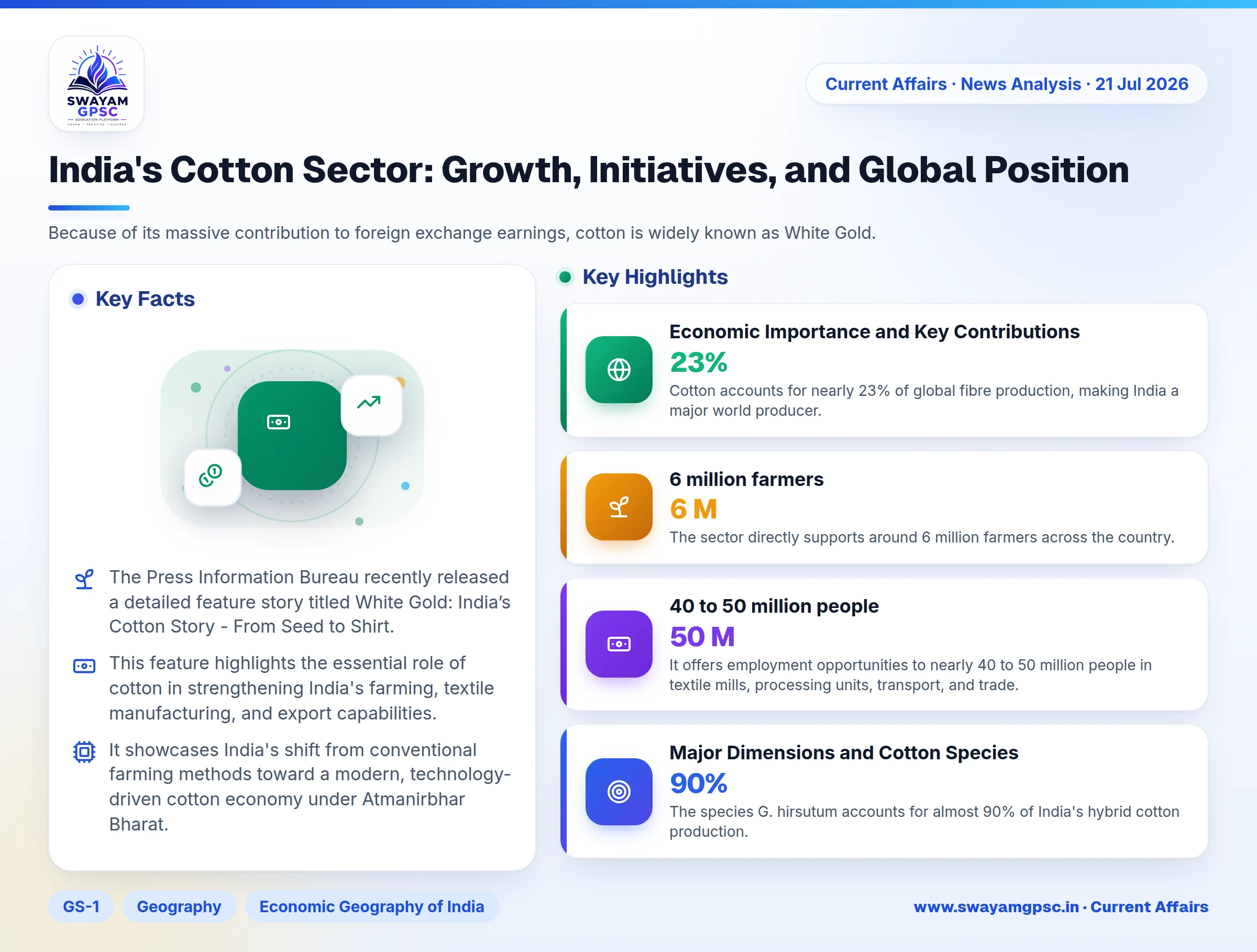
- The Press Information Bureau recently released a detailed feature story titled White Gold: India’s Cotton Story - From Seed to Shirt.
- This feature highlights the essential role of cotton in strengthening India's farming, textile manufacturing, and export capabilities.
- It showcases India's shift from conventional farming methods toward a modern, technology-driven cotton economy under Atmanirbhar Bharat.
Economic Importance and Key Contributions
- Cotton accounts for nearly 23% of global fibre production, making India a major world producer.
- The sector directly supports around 6 million farmers across the country.
- It offers employment opportunities to nearly 40 to 50 million people in textile mills, processing units, transport, and trade.
- Because of its massive contribution to foreign exchange earnings, cotton is widely known as White Gold.
- India is uniquely positioned as the only nation that grows all four species of cultivated cotton.
- Strategic government measures like MSP operations, the Mission for Cotton Productivity, and Kasturi Cotton Bharat are actively boosting sector growth.
Historical Evolution from Swadeshi to Atmanirbhar Bharat
- India has thousands of years of rich heritage in cotton farming and cloth weaving.
- In ancient times, Indian cotton fabrics were exported across Europe and Asia, often functioning as a trade currency.
- The modern cotton industry began taking root in the 19th century with textile mills in Kolkata, Mumbai, and Ahmedabad.
- Rapid growth in Ahmedabad earned it the title of Manchester of India.
- During the Swadeshi Movement, indigenous cotton mills helped cut reliance on imported British cloth.
- World War supply demands further expanded Indian mills, creating a solid base for Atmanirbhar Bharat.
Major Dimensions and Cotton Species
- India grows all four species: G. arboreum, G. herbaceum, G. barbadense, and G. hirsutum.
- The species G. hirsutum accounts for almost 90% of India's hybrid cotton production.
- All Bt cotton varieties grown in India belong to the G. hirsutum species.
- Introduced in 2002, Bt cotton uses genes from the soil bacterium Bacillus thuringiensis to resist harmful bollworms.
- The adoption of Bt cotton reduced pesticide costs, increased crop yields, and helped improve farm incomes.
- Cotton is graded by staple length, ranging from short staple under 20 mm up to extra-long staple at 32.5 mm and above.
- Production is spread across nine major states split into Northern, Central, and Southern growing zones, along with Odisha and Tamil Nadu.
Area, Production, and Consumption Status
- India has the world's largest cotton cultivation area at 114.84 lakh hectares, representing 38% of the global area.
- Approximately 62% of India's cotton land depends entirely on rain, while only 38% is irrigated.
- Globally, India ranks second in both total cotton production and domestic consumption.
- In 2024-25, output reached 297.24 lakh bales (or 5.06 million tonnes), where one bale equals 170 kg.
- Provisional production for 2025-26 stands at 290.91 lakh bales (or 4.95 million tonnes).
- Domestic consumption reached 328 lakh bales (or 5.58 million tonnes), proving the robust strength of India's textile mills.
Cotton Exports and Global Trade Footprint
- During 2024-25, India exported 18 lakh bales (or 0.31 million metric tonnes) of cotton.
- This export quantity accounted for 3.37% of total global cotton exports.
- India's total cotton export earnings reached US$ 11.49 billion in FY25.
- The United States emerged as the largest buyer of Indian cotton fabrics, capturing 26.35% of exports.
- Other prominent destinations include Bangladesh at 19.81%, Sri Lanka at 5.11%, the United Kingdom at 2.38%, and the UAE at 2.32%.
Key Government Initiatives for Sectoral Growth
- The CACP recommends Minimum Support Prices for medium and long staple cotton, guaranteeing farmers a 50% return over cost.
- The Cotton Corporation of India (CCI) operates as the nodal agency to purchase cotton whenever market prices drop below MSP.
- Procurement infrastructure expanded to 571 centers in 2025-26, serving 152 districts across 11 states.
- A 5-year Mission for Cotton Productivity was launched in 2025-26 with an outlay of Rs 5,659.22 crore.
- This mission aims to raise total production to 498 lakh bales by 2031, directly benefitting 32 lakh farmers in 140 districts.
- Built around the 5F vision (Farm, Fibre, Factory, Fashion, Foreign), the mission focuses heavily on high-yielding Extra Long Staple (ELS) cotton.
- Under the National Food Security Mission (NFSM) since 2023-24, high-density planting and closer spacing technologies were piloted across 8 states.
- The Kapas Kisan App provides digital slot booking, Aadhaar payments, and SMS updates to over 41 lakh registered farmers.
- The Kasturi Cotton Bharat initiative, backed by Rs 30 crore, establishes global traceability, QR certification, and branding for Indian cotton.
Way Forward
- Enhancing irrigation coverage across rain-fed belts will protect cotton yields from weather fluctuations.
- Expanding high-density planting and promoting Extra-Long Staple varieties can satisfy foreign demand and raise export earnings.
- Strengthening digital procurement and blockchain traceability will consolidate India's reputation for premium quality in global markets.