India's Comprehensive Strategy to Eliminate Child Marriage by 2030
#GS-1 #Indian Society #Women #GS-2 #Governance & Social Justice #Government Policies & Interventions #Welfare Schemes #Current Events #National
Key takeaways
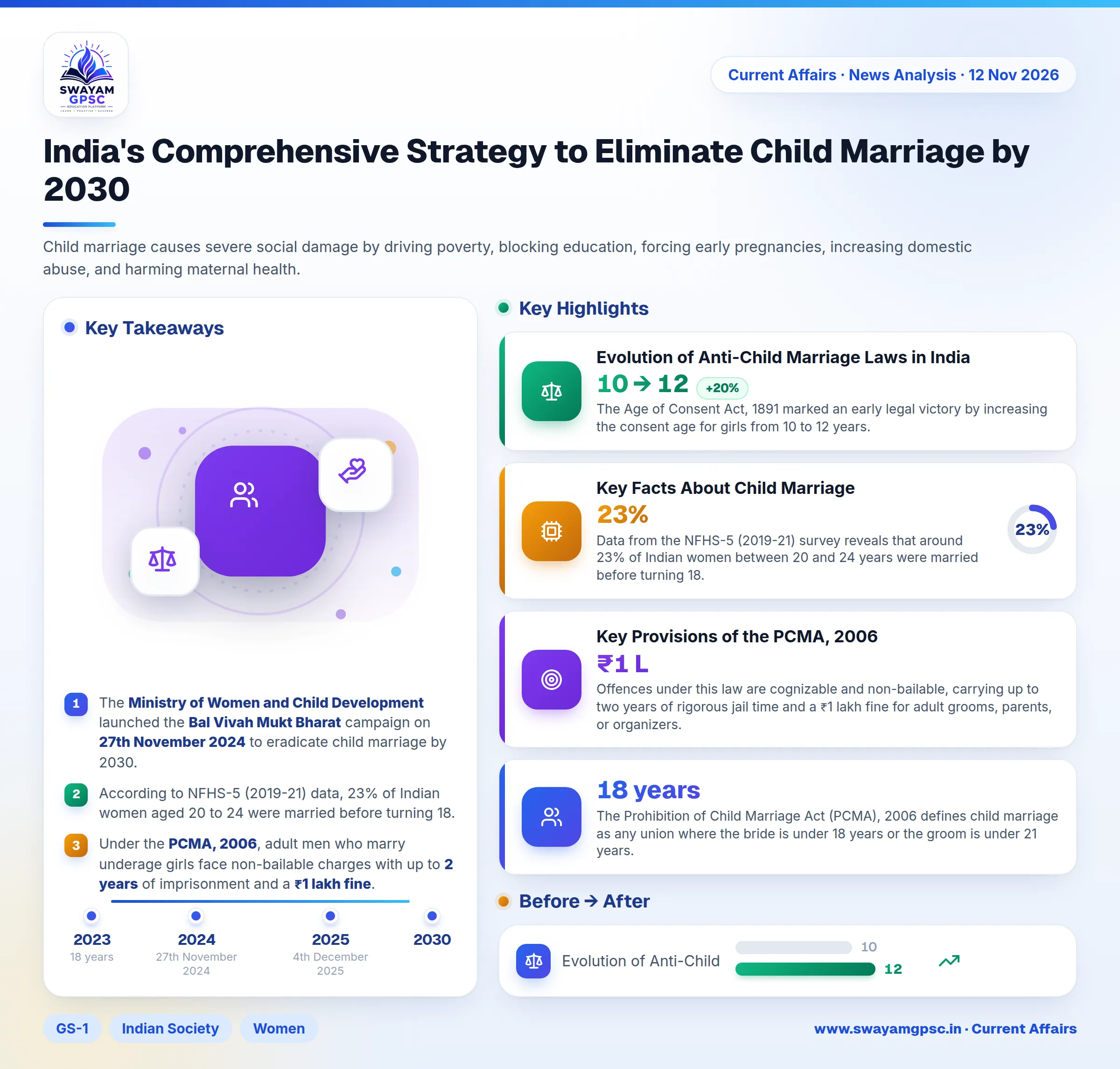
- The Ministry of Women and Child Development launched the Bal Vivah Mukt Bharat campaign on 27th November 2024 to eradicate child marriage by 2030.
- According to NFHS-5 (2019-21) data, 23% of Indian women aged 20 to 24 were married before turning 18.
- Under the PCMA, 2006, adult men who marry underage girls face non-bailable charges with up to 2 years of imprisonment and a ₹1 lakh fine.
- The Central Government fully funds targeted initiatives across 257 high-burden districts identified through national demographic surveys.
- Balod district in Chhattisgarh became India's first child marriage-free district after recording zero cases for two consecutive years across 436 Gram Panchayats.
Why in News
- The Ministry of Women and Child Development launched the Bal Vivah Mukt Bharat (BVMB) campaign to completely end child marriage across the nation by 2030.
- This strategic initiative relies on strict legal enforcement, active local community involvement, and modern digital tracking platforms to protect vulnerable children.
Key Facts About Child Marriage
- The Prohibition of Child Marriage Act (PCMA), 2006 defines child marriage as any union where the bride is under 18 years or the groom is under 21 years.
- Data from the NFHS-5 (2019-21) survey reveals that around 23% of Indian women between 20 and 24 years were married before turning 18.
- States like West Bengal and Bihar record high percentage rates of early marriages, whereas Uttar Pradesh accounts for a very high total volume of such cases.
- Child marriage causes severe social damage by driving poverty, blocking education, forcing early pregnancies, increasing domestic abuse, and harming maternal health.
- Under the PCMA, 2006, child marriages are generally voidable if the victim chooses to reject the union, but marriages involving force, fraud, or human trafficking are automatically void.
- Section 63 of the Bharatiya Nyaya Sanhita (BNS), 2023 states that sexual relations with a wife under 18 years count as rape, regardless of her consent.
- Such cases can also trigger strict criminal charges under the POCSO Act, 2012, particularly when aggravated sexual assault takes place.
- The PCMA, 2006 safeguards affected women and children by granting maintenance allowance, housing rights, legal custody, and legal status to offspring born from these unions.
Evolution of Anti-Child Marriage Laws in India
- In the 19th century, prominent social reformers like Raja Rammohan Roy, Ishwar Chandra Vidyasagar, and Mahatma Jyotirao Phule led campaigns against harmful marriage customs.
- The Age of Consent Act, 1891 marked an early legal victory by increasing the consent age for girls from 10 to 12 years.
- The Child Marriage Restraint Act, 1929, also called the Sarda Act, set the first minimum marriage age at 14 years for girls and 18 years for boys.
- A post-independence amendment in 1948 raised the minimum age of marriage for girls to 15 years.
- Another legislative update in 1978 further raised the legal marriage age to 18 years for girls and 21 years for boys.
- The Prohibition of Child Marriage Act, 2006 replaced the older 1929 law, moving the legal focus from simply restricting child marriages to banning them entirely.
- Government schemes like Beti Bachao Beti Padhao, launched in 2015, complement these laws by boosting girls' education and fighting social prejudices.
Key Provisions of the PCMA, 2006
- The law sets strict baseline ages, defining anyone under 18 years for females and under 21 years for males as a child.
- Victims can file a petition in the District Court to cancel their marriage within two years of turning adults.
- Marriages conducted through human trafficking, force, or fraud are treated as completely illegal and invalid right from the start.
- Offences under this law are cognizable and non-bailable, carrying up to two years of rigorous jail time and a ₹1 lakh fine for adult grooms, parents, or organizers.
- State governments must appoint Child Marriage Prohibition Officers (CMPOs) to gather evidence, stop illegal unions, and educate local communities.
- Judicial Magistrates hold the legal authority to issue injunction orders stopping upcoming child marriages, making any violated marriage legally void.
Overview of Bal Vivah Mukt Bharat Campaign
- The Ministry of Women and Child Development officially launched the campaign on 27th November 2024 to eliminate child marriage nationwide by 2030.
- This effort upholds the constitutional right to life under Article 21 and supports international commitments under SDG Target 5.3.
- A 2024 Supreme Court ruling in the case of Society for Enlightenment and Voluntary Action v. Union of India directed states to strictly enforce prevention measures.
- The apex court advised states to pass specific laws banning child betrothals because informal engagements take away a child's freedom and force early marriage.
- The Court ordered states to station full-time CMPOs at the district level and form special prohibition units to address complaints quickly.
- It also recommended multi-sectoral awareness campaigns with schools and Anganwadis, alongside technology systems to flag high-risk regions.
- The initiative moves away from simple criminal punishment, focusing instead on community participation, child safety, and empowerment.
- The government created the Bal Vivah Mukt Bharat Portal so citizens can find nearby CMPOs, report illegal marriages in real time, and check campaign activities.
- The Central Ministry completely funds the campaign and focuses on 257 priority districts where child marriage rates exceed national benchmarks.
- Schools, Gram Panchayats, and youth networks lead local pledge drives to mobilize public support against early marriages.
- Global organizations like UNICEF offer technical assistance and training workshops for CMPOs in alignment with the UN CRC framework.
- This strategy works closely with existing programs like Beti Bachao Beti Padhao to provide unified field-level responses.
Key Features of the 100-Day Anti-Child Marriage Drive
- The Ministry of Women and Child Development rolled out a targeted 100-day drive on 4th December 2025 across all states.
- The nationwide effort started with a central pledge-taking ceremony at Vigyan Bhawan in New Delhi.
- Gram Panchayats receive the Child Marriage-Free Village Certificate if they pledge against early marriages and report zero cases for a sustained period.
- The top ten performing districts win the Bal Vivah Mukt Bharat Yodha Award based on fast reporting, successful prevention, and zero illegal unions.
- State Chief Secretaries monitor district task forces consisting of CMPOs, PRIs, and local NGOs through weekly updates on the official portal.
- During high-risk festival dates like Akshaya Tritiya 2025, local authorities step up field surveillance to prevent illegal mass weddings.
- The program connects education, healthcare, and rural administrative systems to create a strong network against illegal marriages.
Chhattisgarh as a Model for Prevention
- Balod district in Chhattisgarh became India's first verified child marriage-free district after maintaining zero cases for two straight years across 436 Gram Panchayats and 9 urban local bodies.
- The state government of Chhattisgarh aims to transform the entire state into a child marriage-free zone by the 2028-29 financial year.
- In Surajpur district, 75 village panchayats earned official child marriage-free status on 17th September 2025 after reporting zero violations for two consecutive years.
Conclusion
- India's movement against child marriage has grown from historic social reforms into a modern framework of law and digital oversight.
- The Bal Vivah Mukt Bharat drive combines legal enforcement with grassroots action to achieve SDG Target 5.3 and support the vision of Viksit Bharat.
- Protecting children's fundamental rights by 2030 requires continuous investment in girls' education, social equality, and local community leadership.