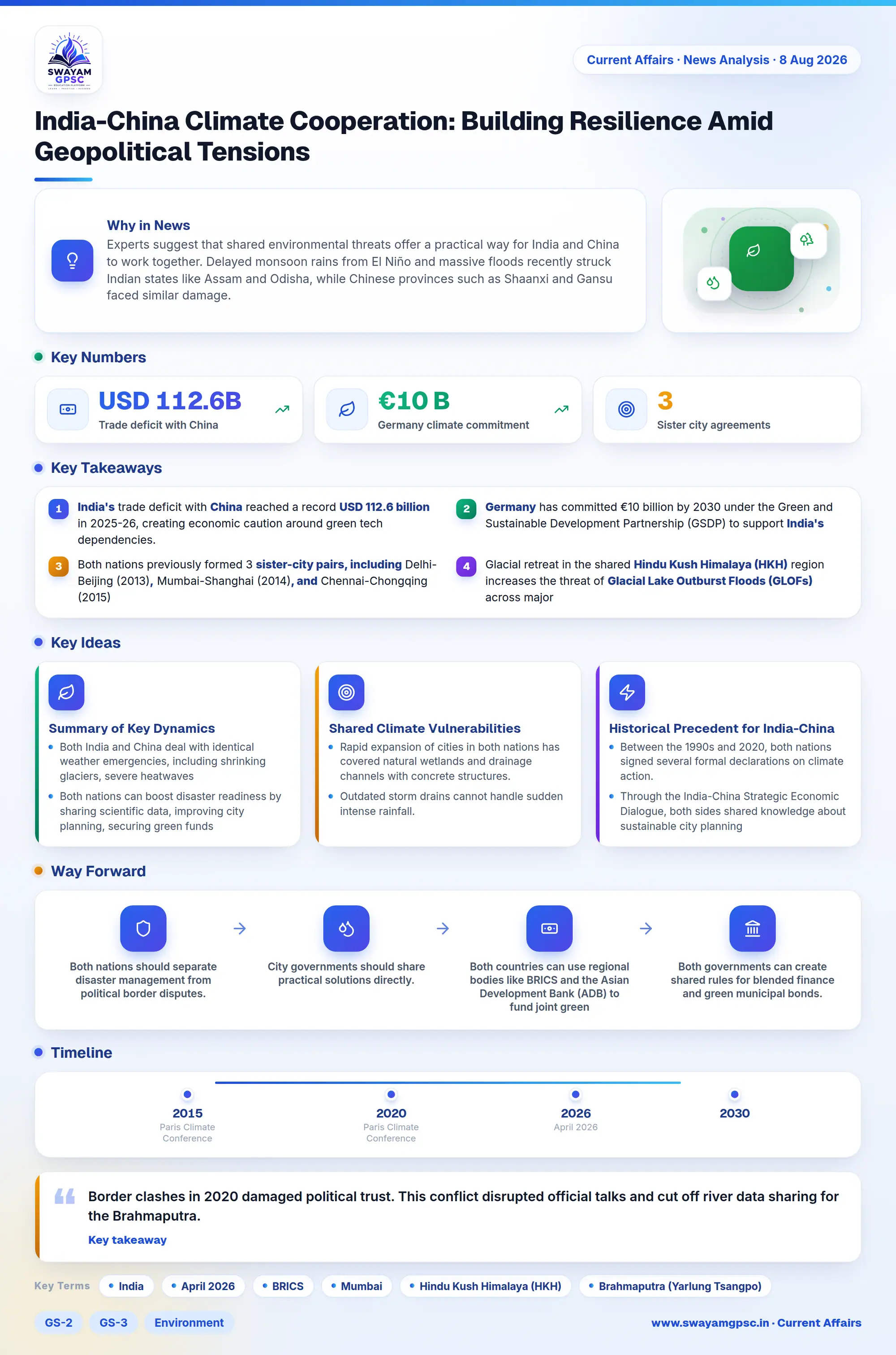
India-China Climate Cooperation: Building Resilience Amid Geopolitical Tensions
#GS-2 #GS-3 #Environment #Climate Change #Disaster Management #Disaster Preparedness #Current Events #International #India and its Neighbourhood
Key takeaways
- India's trade deficit with China reached a record USD 112.6 billion in 2025-26, creating economic caution around green tech dependencies.
- Germany has committed €10 billion by 2030 under the Green and Sustainable Development Partnership (GSDP) to support India's climate-resilient infrastructure.
- Both nations previously formed 3 sister-city pairs, including Delhi-Beijing (2013), Mumbai-Shanghai (2014), and Chennai-Chongqing (2015), to boost local environmental cooperation.
- Glacial retreat in the shared Hindu Kush Himalaya (HKH) region increases the threat of Glacial Lake Outburst Floods (GLOFs) across major river systems like the Brahmaputra.
Why in News
- Experts suggest that shared environmental threats offer a practical way for India and China to work together. Delayed monsoon rains from El Niño and massive floods recently struck Indian states like Assam and Odisha, while Chinese provinces such as Shaanxi and Gansu faced similar damage.
- In April 2026, China's Special Envoy for Climate Change visited New Delhi. This visit showed that both nations can focus on climate adaptation and disaster management even while diplomatic tensions persist.
Summary of Key Dynamics
- Both India and China deal with identical weather emergencies, including shrinking glaciers, severe heatwaves, and sudden floods. Cooperation in climate adaptation offers both countries a safe starting point to rebuild mutual confidence.
- Both nations can boost disaster readiness by sharing scientific data, improving city planning, securing green funds, and using forums like BRICS.
Shared Climate Vulnerabilities of India and China
- Rapid expansion of cities in both nations has covered natural wetlands and drainage channels with concrete structures.
- Outdated storm drains cannot handle sudden intense rainfall. This leads to heavy urban flooding, as seen in Mumbai and Guangxi.
- Glaciers are melting rapidly across the shared Hindu Kush Himalaya (HKH) region.
- Fast-melting ice increases the danger of Glacial Lake Outburst Floods (GLOFs). It also threatens shared rivers like the Brahmaputra (Yarlung Tsangpo) and the Sutlej.
- Inland regions in both countries face alternating periods of extreme heatwaves and sudden flash floods.
- Dense coastal megacities face simultaneous risks from ocean storm surges, heavy rains, and rising sea levels.
- These extreme events harm public health, disrupt business supply chains, and lower farm harvests, hurting economic progress.
Historical Precedent for India-China Climate Engagement
- Between the 1990s and 2020, both nations signed several formal declarations on climate action. Before the 2015 Paris Climate Conference, their joint statement backed fair international targets and expanded research on clean energy, electric vehicles, and disaster management. Both countries also coordinated strategies inside the BASIC Group.
- Through the India-China Strategic Economic Dialogue, both sides shared knowledge about sustainable city planning, sewage treatment, and efficient water usage.
- Both countries created city-pairing agreements like Delhi-Beijing (2013), Mumbai-Shanghai (2014), and Chennai-Chongqing (2015) to boost urban environmental management.
Challenges Constraining India-China Climate Cooperation
- Border clashes in 2020 damaged political trust. This conflict disrupted official talks and cut off river data sharing for the Brahmaputra.
- China controls most global manufacturing for solar panels, batteries, and critical minerals. India wants to cut import reliance through Atmanirbhar Bharat, especially after its trade deficit with China reached USD 112.6 billion in 2025-26. However, India recently eased some investment rules for selected Chinese businesses.
- India restricted investments from neighboring countries under Press Note 3 in 2020. Meanwhile, China limited its exports of key minerals and processing equipment.
- Diplomatic friction and weak administrative follow-through prevented the sister-city agreements from producing lasting results.
- In 2026, China, Brazil, and the European Union created the Open Coalition for Carbon Markets. India chose not to join as a founding member.
- Both countries lead separate climate platforms. India stayed away from China's BRI International Green Development Coalition, while China did not join India's International Solar Alliance (ISA) or Global Biofuels Alliance (GBA).
India's Major Bilateral Climate Partnerships Across the World
- Under the India-US Climate and Clean Energy Agenda 2030, both nations work on green hydrogen, clean technology, and electric vehicles.
- India and the United Kingdom created the Green Growth Equity Fund (GGEF) to attract private investment. They also lead the global Green Grids Initiative - One Sun One World One Grid (GGI-OSOWOG) project.
- Through the Japan-India Clean Energy Partnership (CEP) and the Joint Crediting Mechanism (JCM), both countries focus on battery tech, hydrogen, and carbon credits.
- Through the Green and Sustainable Development Partnership (GSDP), Germany pledged €10 billion by 2030 to help India build eco-friendly infrastructure and protect biodiversity.
- The India-Denmark Green Strategic Partnership (2020) drives progress in offshore wind generation, circular economy projects, and urban water management.
- Launched at COP21 in 2015, the International Solar Alliance (ISA) shows how India and France cooperate on solar energy and ocean health.
- The India-EU Clean Energy and Climate Partnership helps both sides collaborate on green finance, lower carbon emissions, and climate adaptation.
Strategic Significance for India
- International climate partnerships help India secure low-interest loans and green bonds to fund its ambitious Nationally Determined Contributions (NDCs).
- Working with nations like Denmark and Germany brings advanced green technologies like offshore wind and green hydrogen into India.
- Building climate alliances with major powers helps India champion the interests of the Global South and uphold the Common but Differentiated Responsibilities (CBDR) principle.
Way Forward
- Both nations should separate disaster management from political border disputes. They can start talks on practical topics like farming, waste management, and early warning systems before tackling competitive industries.
- City governments should share practical solutions directly. Indian cities can study China's Sponge Cities design to absorb rainwater, while Chinese cities can adopt India's community-based Heat Action Plans like the one in Ahmedabad.
- Both countries can use regional bodies like BRICS and the Asian Development Bank (ADB) to fund joint green projects without triggering direct political friction.
- Both governments can create shared rules for blended finance and green municipal bonds. This step will lower risks for private investors and strengthen funding requests for developing countries.
- Both nations must establish year-round monitoring of glaciers in the Hindu Kush Himalaya (HKH) region instead of sharing partial seasonal data. Continuous tracking is vital to predict GLOFs and protect shared river basins.