India Bans Exports of Battery Black Mass
#GS-3 #Economy #Infrastructure #Environment #Sustainable Development #Current Events #National
Key takeaways
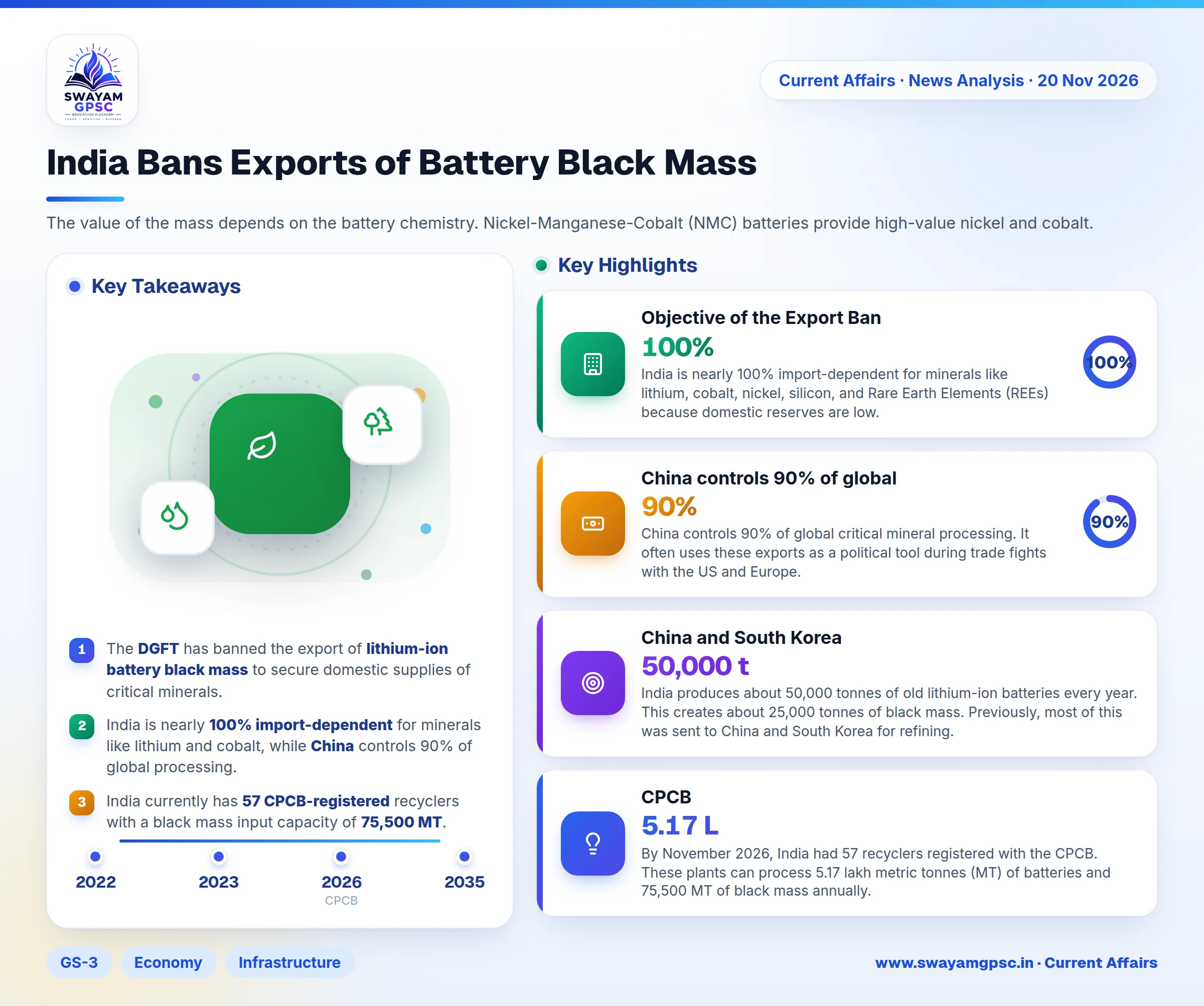
- The DGFT has banned the export of lithium-ion battery black mass to secure domestic supplies of critical minerals.
- India is nearly 100% import-dependent for minerals like lithium and cobalt, while China controls 90% of global processing.
- India currently has 57 CPCB-registered recyclers with a black mass input capacity of 75,500 MT.
- Battery demand is expected to grow from 16 GWh in 2023 to 248 GWh by 2035, as per a NITI Aayog-TERI report.
- The government launched the Capex Support Scheme to Promote Critical Mineral Processing in November 2026 to boost self-reliance.
Why in News
- The Directorate General of Foreign Trade (DGFT) has changed the export policy for lithium-ion battery black mass. It is now Prohibited instead of Free. This change starts immediately. The government wants to keep mineral-rich waste inside India to build a stronger critical mineral recycling and refining ecosystem.
What is Black Mass
- Black Mass is a powder that remains after shredding and breaking down waste lithium-ion batteries and old electronics.
- It is a vital secondary source of critical minerals. It contains lithium, cobalt, nickel, manganese, graphite, silicon, tin, and rhenium.
- The value of the mass depends on the battery chemistry. Nickel-Manganese-Cobalt (NMC) batteries provide high-value nickel and cobalt. Lithium Iron Phosphate (LFP) batteries are common in Electric Vehicles (EVs) but are less profitable for recyclers because they contain iron and phosphate.
- The Technical Review Committee (TRC) under the Ministry of Environment, Forest and Climate Change (MoEFCC) calls black mass hazardous waste unless it is processed on-site.
- The Basel Convention (1989) manages how hazardous waste, including black mass, moves across borders to ensure it is handled safely.
- India follows these global rules through the Hazardous and Other Wastes (Management and Transboundary Movement) Rules, 2016.
- Recovering minerals from products already being used is called Urban Mining.
- There are two main recovery methods. Pyrometallurgy uses high heat to melt metals. It is energy-heavy and often loses lithium in the waste slag.
- Hydrometallurgy uses chemical solutions like leaching and extraction. It recovers battery-grade compounds like lithium hydroxide, nickel sulphate, and cobalt sulphate. NITI Aayog prefers this method because it saves energy and recovers more minerals.
Objective of the Export Ban
- The ban ensures that domestic recycling plants have enough feedstock. This helps factories work at full capacity and adds value to materials within India. It also creates new jobs and investments in the circular economy.
- India is following a global trend for resource security. The United States already banned black mass exports for a year, and the European Union is planning similar rules.
- India is nearly 100% import-dependent for minerals like lithium, cobalt, nickel, silicon, and Rare Earth Elements (REEs) because domestic reserves are low.
- China controls 90% of global critical mineral processing. It often uses these exports as a political tool during trade fights with the US and Europe.
- India produces about 50,000 tonnes of old lithium-ion batteries every year. This creates about 25,000 tonnes of black mass. Previously, most of this was sent to China and South Korea for refining.
- By November 2026, India had 57 recyclers registered with the CPCB. These plants can process 5.17 lakh metric tonnes (MT) of batteries and 75,500 MT of black mass annually.
- A January 2026 NITI Aayog-TERI report predicts battery demand will grow from 16 gigawatt-hours (GWh) in 2023 to 248 GWh by 2035. Recyclable batteries will also rise from 19,000 to 233,000 tonnes.
- To support this, the government approved the Capex Support Scheme to Promote Critical Mineral Processing in November 2026 to make India self-reliant.
- The ban helps with raw materials, but India still needs better refining tools, cheaper recovery methods, and stronger EPR incentives to make the system sustainable.
Key Battery Rules
- The Battery Waste Management Rules, 2022 introduce Extended Producer Responsibility (EPR). This means companies must manage their battery waste. These rules also stop batteries from going into landfills and set targets for using recycled content.