India-Australia Civil Nuclear Cooperation Agreement
#GS-2 #GS-3 #Science & Technology #Energy #Infrastructure #Current Events #International Relations #National
Why in News
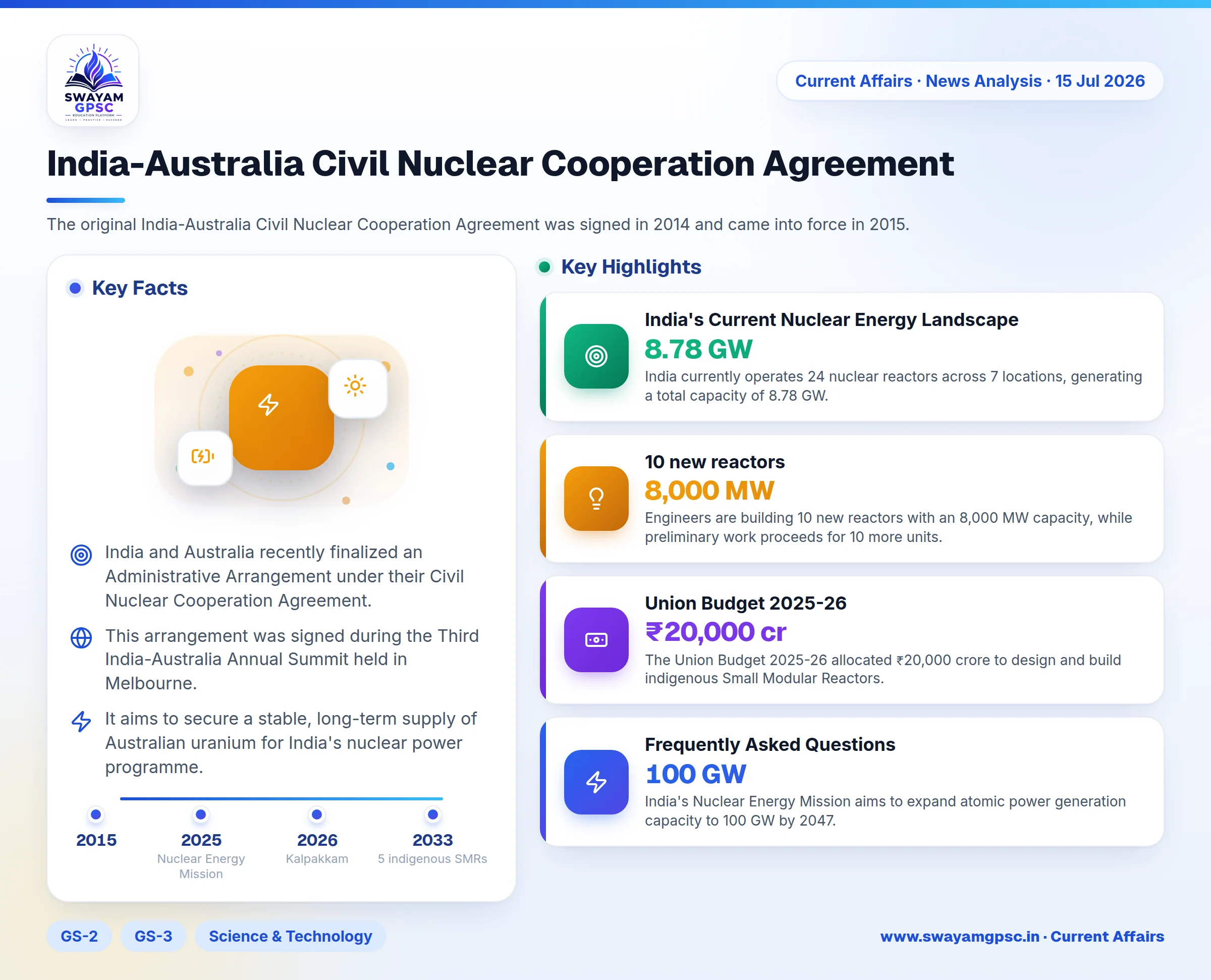
- India and Australia recently finalized an Administrative Arrangement under their Civil Nuclear Cooperation Agreement.
- This arrangement was signed during the Third India-Australia Annual Summit held in Melbourne.
- It aims to secure a stable, long-term supply of Australian uranium for India's nuclear power programme.
Key Highlights of the Administrative Arrangement
- The original India-Australia Civil Nuclear Cooperation Agreement was signed in 2014 and came into force in 2015.
- The new Administrative Arrangement establishes formal procedures to start commercial exports of Australian uranium to India.
- All uranium supplied under this setup will serve peaceful purposes under International Atomic Energy Agency (IAEA) safeguards.
- Australian mining companies can now sign direct supply contracts with eligible Indian entities, including private sector firms.
- The bilateral framework balances long-term energy cooperation with Australia's strict non-proliferation regulations.
Nuclear Suppliers Group and India's Special Status
- The Nuclear Suppliers Group (NSG) is a voluntary group of 48 member countries controlling nuclear material exports.
- India has not signed the Nuclear Non-Proliferation Treaty (NPT), yet it maintains an exemplary non-proliferation track record.
- In 2008, India signed a specific safeguards agreement with the IAEA to oversee its civil nuclear facilities.
- The NSG granted a special waiver to India in 2008, allowing member nations to trade nuclear material with India.
- This waiver laid the legal groundwork for India to sign nuclear pacts with partner countries, including Australia.
- The new arrangement combines the NSG waiver, IAEA safeguards, and bilateral rules to supply Australian uranium safely.
India's Current Nuclear Energy Landscape
- India currently operates 24 nuclear reactors across 7 locations, generating a total capacity of 8.78 GW.
- Engineers are building 10 new reactors with an 8,000 MW capacity, while preliminary work proceeds for 10 more units.
- India's fleet uses Pressurised Heavy Water Reactors, Boiling Water Reactors, and Light Water Reactors.
- The indigenous 500 MWe Prototype Fast Breeder Reactor at Kalpakkam reached first criticality in April 2026.
- This fast breeder reactor marks the start of stage two in India's three-stage nuclear power roadmap.
- India plans to tap its vast thorium reserves found in the coastal sands of Kerala, Tamil Nadu, Andhra Pradesh, and Odisha.
- The Union Budget 2025-26 allocated ₹20,000 crore to design and build indigenous Small Modular Reactors.
- The government plans to launch at least 5 indigenous SMRs by 2033 to support clean power deployment.
Significance for India
- The arrangement ensures a dependable supply of fuel for India's growing fleet of nuclear power plants.
- Stable nuclear power delivers reliable baseload electricity to support India's net-zero target by 2070.
- It supports national initiatives like the Nuclear Energy Mission and the SHANTI Act, 2025.
- This agreement strengthens India's international position, building on agreements already signed with 18 countries.
Significance for Australia
- Australia holds the largest uranium reserves in the world, representing over one-third of global resources.
- The arrangement opens a steady commercial market for Australian mining firms to contract with Indian partners.
- It strengthens the energy foundation of the India-Australia Comprehensive Strategic Partnership under international safeguards.
Way Forward
- This bilateral deal represents an important step forward for India's energy transition and raw material security.
- It strengthens trust between both nations while creating a stable framework for future clean energy expansion.
Frequently Asked Questions
- The arrangement establishes formal operational rules for exporting Australian uranium to India under IAEA supervision.
- Australia possesses the world's largest uranium deposits, helping India solve recurring fuel shortages in domestic power plants.
- India's Nuclear Energy Mission aims to expand atomic power generation capacity to 100 GW by 2047.
- The SHANTI Act allows private Indian companies and joint ventures to build and operate nuclear power facilities.
- Nuclear energy provides continuous clean electricity, helping balance solar power to meet India's 2070 net-zero goals.