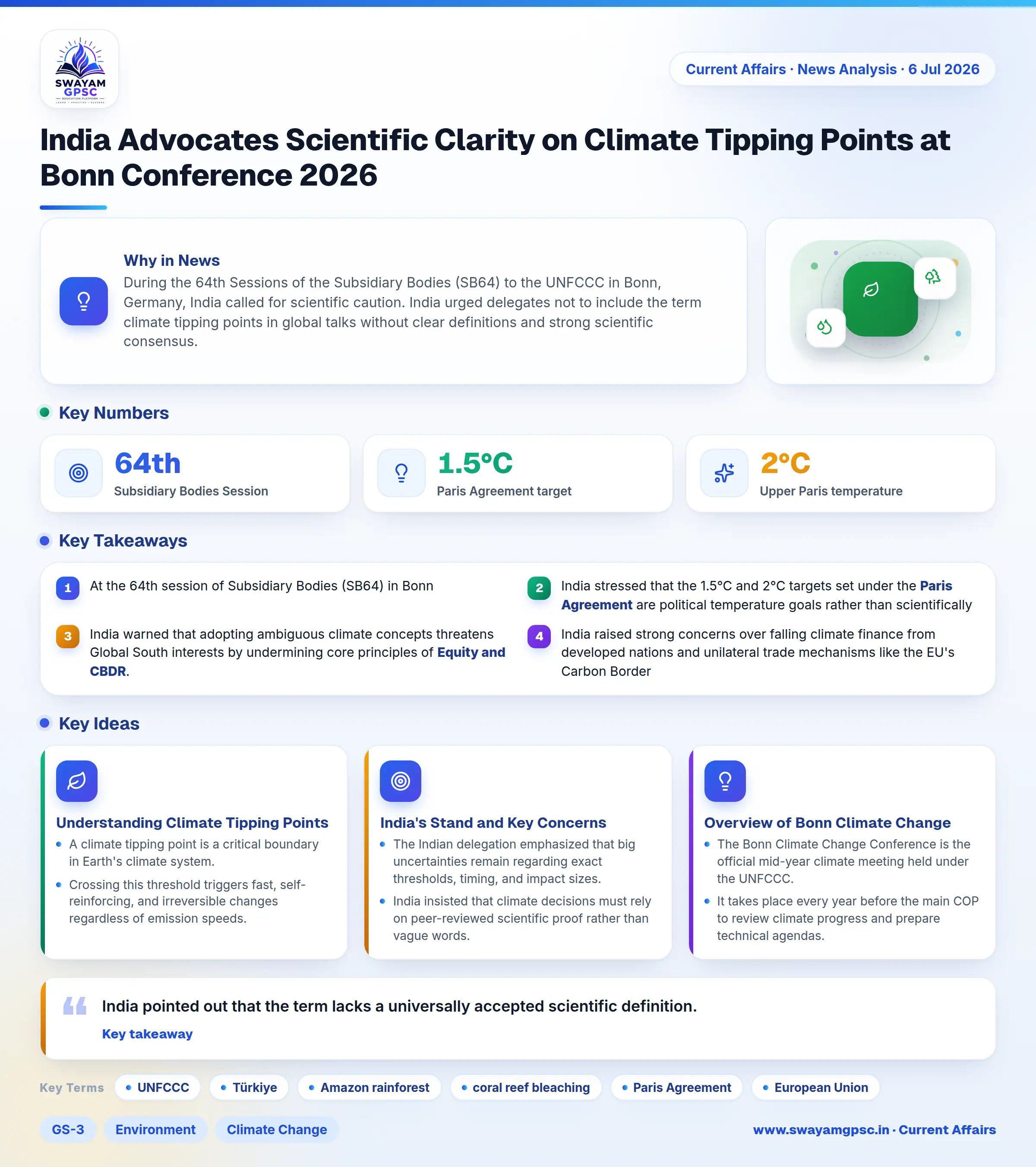
India Advocates Scientific Clarity on Climate Tipping Points at Bonn Conference 2026
#GS-3 #Environment #Climate Change #GS-2 #Current Events #International #Bonn Climate Conference #UNFCCC
Why in News
- During the **64th** Sessions of the Subsidiary Bodies (**SB64**) to the **UNFCCC** in Bonn, Germany, India called for scientific caution.
- India urged delegates not to include the term climate tipping points in global talks without clear definitions and strong scientific consensus.
- This mid-year meeting focused on laying technical foundations for the upcoming **COP31** UN Climate Change Conference in Antalya, **Türkiye**.
Understanding Climate Tipping Points
- A climate tipping point is a critical boundary in Earth's climate system.
- Crossing this threshold triggers fast, self-reinforcing, and irreversible changes regardless of emission speeds.
- Major global examples include the drying of the **Amazon rainforest** into a savanna and the collapse of the **Atlantic Meridional Overturning Circulation (AMOC)**.
- Other critical risks include severe **coral reef bleaching** and major disruptions to the **Indian and West African monsoon systems**.
India's Stand and Key Concerns
- India pointed out that the term lacks a universally accepted scientific definition.
- The Indian delegation emphasized that big uncertainties remain regarding exact thresholds, timing, and impact sizes.
- India insisted that climate decisions must rely on peer-reviewed scientific proof rather than vague words.
- India clarified that the **1.5°C** and **2°C** targets under the **Paris Agreement** are political goals, not proven tipping points.
- The **European Union** opposed India's stance and called it obstruction that could delay climate action.
- India warned that vague thresholds in **UNFCCC** rules put unfair burdens on developing countries, hurting principles of **Equity and CBDR**.
- India also expressed concern over falling climate finance and opposed unilateral trade policies like the EU's **Carbon Border Adjustment Mechanism (CBAM)**.
Overview of Bonn Climate Change Conference
- The **Bonn Climate Change Conference** is the official mid-year climate meeting held under the **UNFCCC**.
- It takes place every year before the main **COP** to review climate progress and prepare technical agendas.
- Two bodies guide this summit: the **Subsidiary Body for Implementation (SBI)** and the **Subsidiary Body for Scientific and Technological Advice (SBSTA)**.
- The **SBSTA** provides technical advice using assessments from the **Intergovernmental Panel on Climate Change (IPCC)**.