Index of Services Production: India's New Monthly Economic Indicator
#GS-3 #Economy #Growth #Index of Services Production #Ministry of Statistics and Programme Implementation #Current Events #National
Why in News
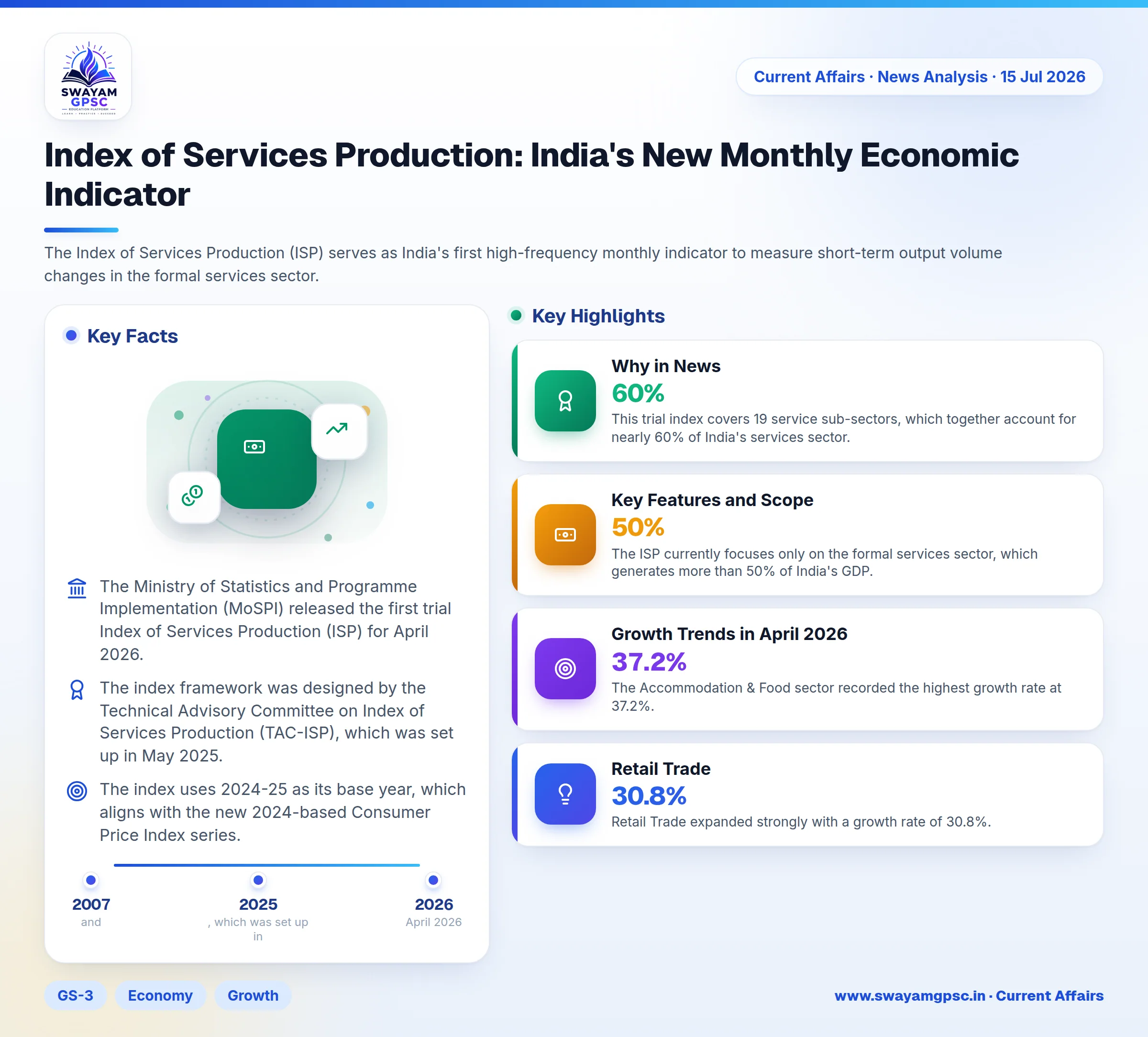
- The Ministry of Statistics and Programme Implementation (MoSPI) released the first trial Index of Services Production (ISP) for April 2026.
- This trial index covers 19 service sub-sectors, which together account for nearly 60% of India's services sector.
- The index framework was designed by the Technical Advisory Committee on Index of Services Production (TAC-ISP), which was set up in May 2025.
Key Features and Scope
- The Index of Services Production (ISP) serves as India's first high-frequency monthly indicator to measure short-term output volume changes in the formal services sector.
- The index uses 2024-25 as its base year, which aligns with the new 2024-based Consumer Price Index series.
- It relies on the National Industrial Classification (NIC), 2025 framework to categorize sub-sectors across the economy.
- Official data will be published on the 29th of every month with a time lag of about 60 days.
- The ISP currently focuses only on the formal services sector, which generates more than 50% of India's GDP.
- MoSPI plans to launch a single composite Overall ISP once individual sub-sector data becomes more stable and reliable.
- The index design aligns with international standards, including the OECD Compilation Manual for Index of Services Production (2007) and Eurostat guidelines.
Methodological Framework and Data Ecosystem
- Because service sector output is collected in monetary values, MoSPI uses price deflators to remove inflation and calculate actual physical volume.
- The Wholesale Price Index (WPI) is used to adjust data for the wholesale trade sector.
- Specific sub-sector Consumer Price Indices (CPI) are used for most service categories, while CPI-Services is used when specific indices are absent.
- The CPI-General index is applied to banking, insurance, and repair and maintenance services.
- This index marks the first time that Goods and Services Tax (GST) outward supply data is used for official government statistics.
- Tightly regulated sectors such as Railways, Aviation, Banking, and Insurance rely on administrative and secondary data streams.
- The Annual Survey of Incorporated Services Sector Enterprises (ASISSE) provides weighting data and will later help cover non-government health and education sectors.
Growth Trends in April 2026
- The inaugural ISP release revealed strong economic momentum, with 14 out of 19 sub-sectors recording double-digit year-on-year growth in April 2026.
- The Accommodation & Food sector recorded the highest growth rate at 37.2%.
- Retail Trade expanded strongly with a growth rate of 30.8%.
- Administrative & Support Services achieved an impressive growth of 28.7%.
- Real Estate registered a solid expansion of 27.7%, while Telecommunications grew by 22.8%.
- Only two sub-sectors suffered contractions, namely Air Transport at -13.9% and Railway Transport at -0.4%.
Excluded Service Sub-Sectors
- The ISP currently excludes core government functions such as public administration, defence, and extraterritorial organizations.
- Financial activities outside of regular banking and insurance, including central bank and money market operations, are kept out of the index.
- Non-market services such as social work without accommodation, membership organizations, and private households employing domestic help are excluded.
- Government-provided health and education services, along with gambling and betting activities, remain outside the current index scope.
- These exclusions exist because such activities represent non-market services, direct government administration, or informal dominance where tracking short-term output is difficult.
Significance of Index of Services Production
- The traditional Index of Industrial Production (IIP) covers only manufacturing, mining, and electricity, leaving a huge statistical gap in tracking services.
- Because services contribute nearly 55% of India's GVA in 2024-25, this monthly indicator will dramatically improve national income and GDP estimates.
- High-frequency data enables policymakers and the Reserve Bank of India to detect early economic trends and respond quickly to market changes.
- The use of GST and administrative data reduces the survey burden on businesses while delivering faster and more precise economic indicators.