Incident in Persian Gulf Involving Tanker MT Fujairah Energy
#GS-3 #Geography #Resources #Current Events #International #Persian Gulf #Strait of Hormuz #Energy Security
Key takeaways
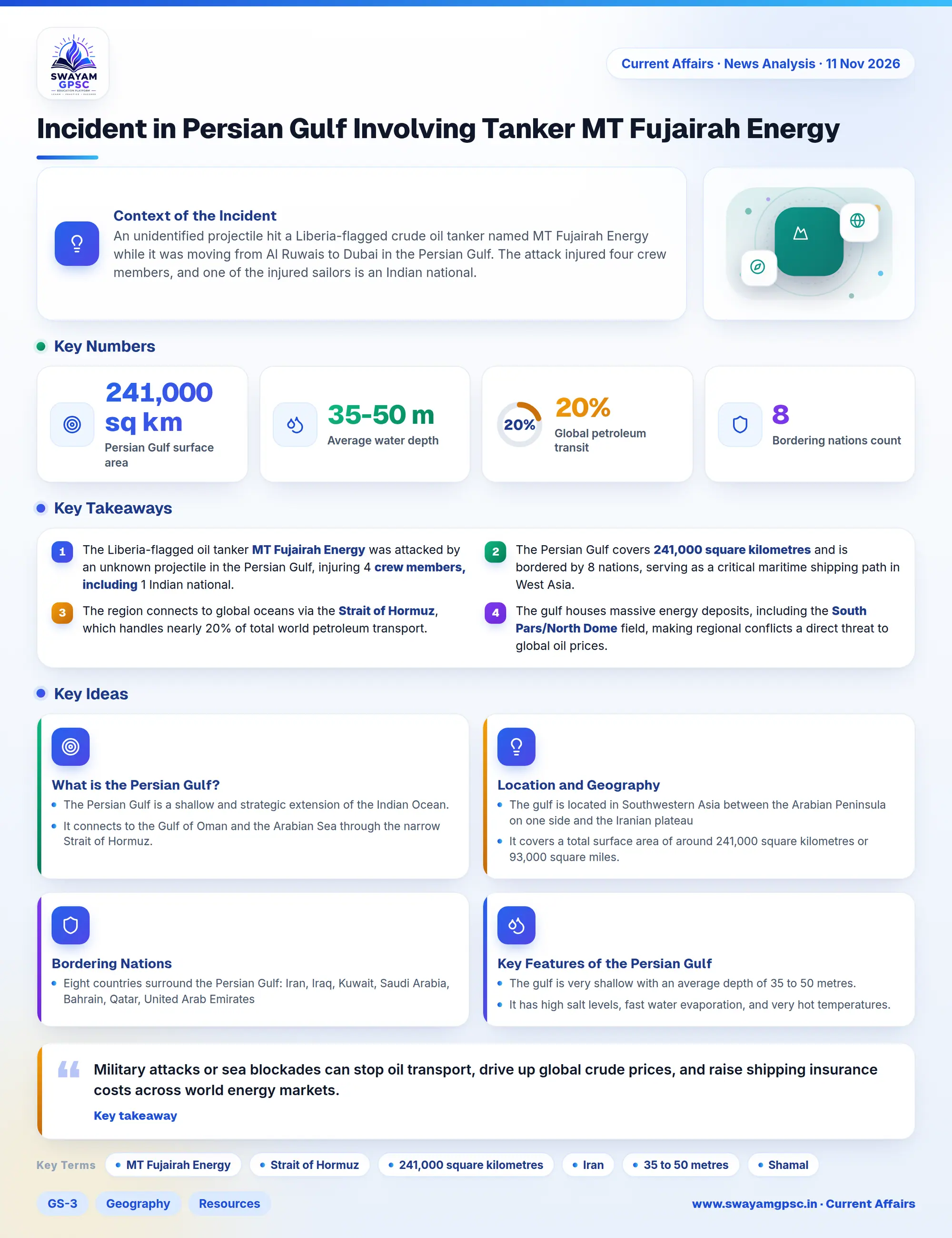
- The Liberia-flagged oil tanker MT Fujairah Energy was attacked by an unknown projectile in the Persian Gulf, injuring 4 crew members, including 1 Indian national.
- The Persian Gulf covers 241,000 square kilometres and is bordered by 8 nations, serving as a critical maritime shipping path in West Asia.
- The region connects to global oceans via the Strait of Hormuz, which handles nearly 20% of total world petroleum transport.
- The gulf houses massive energy deposits, including the South Pars/North Dome field, making regional conflicts a direct threat to global oil prices.
Context of the Incident
- An unidentified projectile hit a Liberia-flagged crude oil tanker named MT Fujairah Energy while it was moving from Al Ruwais to Dubai in the Persian Gulf.
- The attack injured four crew members, and one of the injured sailors is an Indian national.
What is the Persian Gulf?
- The Persian Gulf is a shallow and strategic extension of the Indian Ocean.
- It connects to the Gulf of Oman and the Arabian Sea through the narrow Strait of Hormuz.
- This water body acts as the primary global sea route for moving crude oil and liquefied natural gas.
Location and Geography
- The gulf is located in Southwestern Asia between the Arabian Peninsula on one side and the Iranian plateau on the other.
- It covers a total surface area of around 241,000 square kilometres or 93,000 square miles.
Bordering Nations
- Eight countries surround the Persian Gulf: Iran, Iraq, Kuwait, Saudi Arabia, Bahrain, Qatar, United Arab Emirates, and Oman through its Musandam Peninsula enclave.
Key Features of the Persian Gulf
- The gulf is very shallow with an average depth of 35 to 50 metres. Deep waters run along the Iranian coast, while shallow shelf zones line the Arabian coast.
- It has high salt levels, fast water evaporation, and very hot temperatures. Strong seasonal northwesterly dust winds called Shamal also blow across the area.
- Very little fresh water enters from the Arabian side. Most fresh water flows in through the Shatt al-Arab delta, fed by the Tigris, Euphrates, and Karun rivers.
- The seabed holds vast oil and natural gas deposits inside rock formations. This includes the South Pars/North Dome gas field, which is among the largest in the world.
- The gulf opens into the Strait of Hormuz, a vital sea chokepoint that carries nearly 20% of all global petroleum consumption.
Implications of Gulf Tensions
- Military attacks or sea blockades can stop oil transport, drive up global crude prices, and raise shipping insurance costs across world energy markets.
- Conflicts in this area put Indian sailors and workers at risk. This disrupts their safety and requires fast action from diplomatic and consular channels.
- Rising tensions lead to larger naval deployments and mine-clearing operations, which increases military activity near the Strait of Hormuz.