Impact of Climate Change on India's Dairy Sector
#GS-3 #GS-2 #Economy #Environment #Governance & Social Justice #Agriculture #Climate Change #Economics of Animal-Rearing #Health #Government Policies & Interventions
Key takeaways
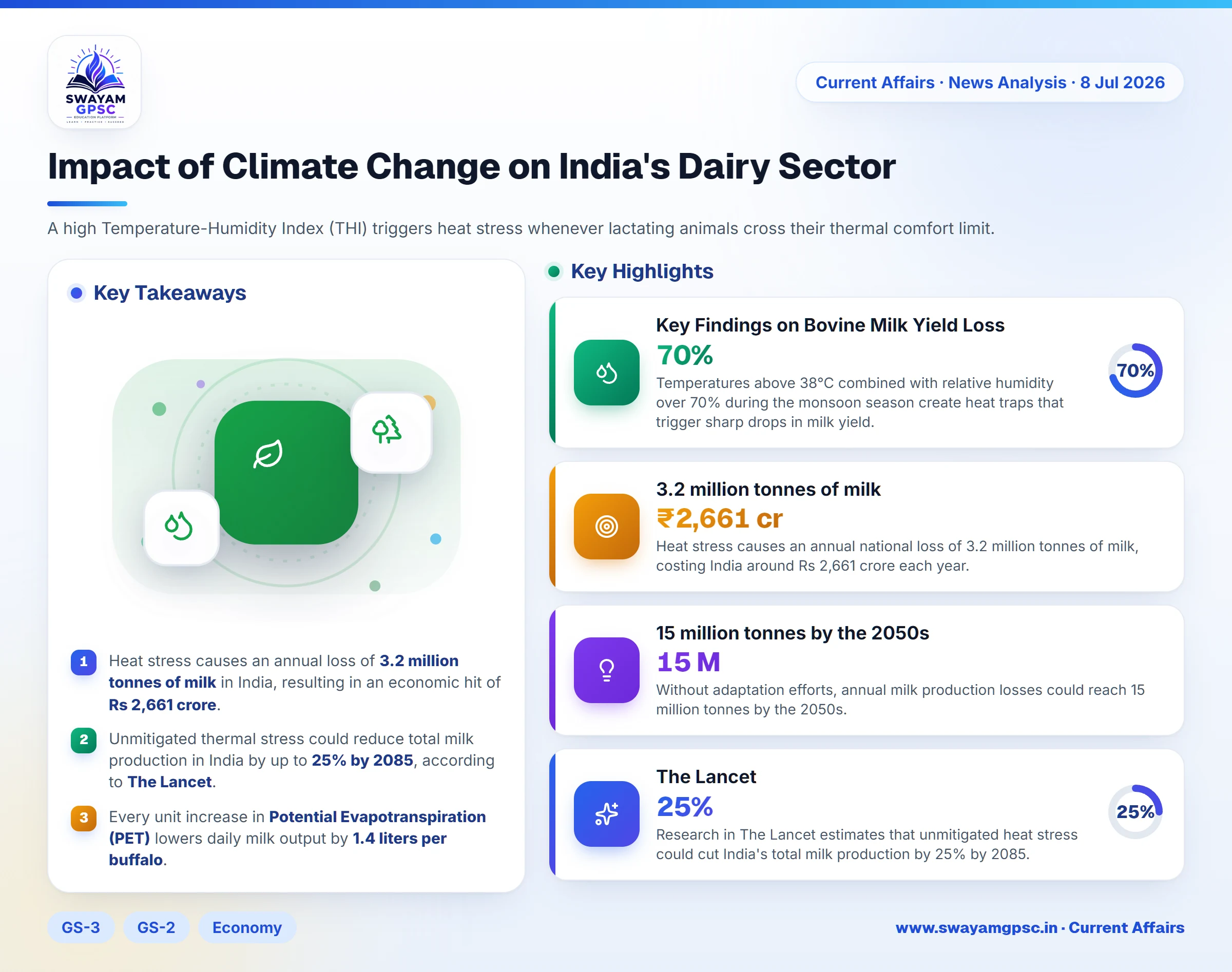
- Heat stress causes an annual loss of 3.2 million tonnes of milk in India, resulting in an economic hit of Rs 2,661 crore.
- Unmitigated thermal stress could reduce total milk production in India by up to 25% by 2085, according to The Lancet.
- Every unit increase in Potential Evapotranspiration (PET) lowers daily milk output by 1.4 liters per buffalo.
- Dairy farming provides daily income for 80 million smallholder farmers and generates nearly 30% of Agricultural Gross Value Added (GVA).
- Indigenous Bos indicus breeds like Sahiwal, Hariana, and Gir display superior heat resistance compared to cross-bred cattle and buffaloes.
Why in News
- A recent study in Scientific Reports shows that heat stress from climate change is reducing milk yield across the trans-Gangetic plains of northwestern India, especially in Haryana.
Key Findings on Bovine Milk Yield Loss
- Temperatures above 38°C combined with relative humidity over 70% during the monsoon season create heat traps that trigger sharp drops in milk yield.
- Winter temperature variations show minimal impact on dairy production, confirming heat stress as the main threat.
- Potential Evapotranspiration (PET) serves as a key metric for measuring atmospheric moisture demand on cattle.
- A single unit rise in PET cuts milk yield by roughly 1.4 liters per buffalo per day.
- Heat stress causes an annual national loss of 3.2 million tonnes of milk, costing India around Rs 2,661 crore each year.
- Without adaptation efforts, annual milk production losses could reach 15 million tonnes by the 2050s.
- Research in The Lancet estimates that unmitigated heat stress could cut India's total milk production by 25% by 2085.
Science of Heat Stress in Cattle
- A high Temperature-Humidity Index (THI) triggers heat stress whenever lactating animals cross their thermal comfort limit.
- Animals divert metabolic energy away from milk synthesis toward cooling mechanisms like panting and sweating, dropping milk yields by 20-30%.
- Rising body temperatures increase cortisol levels, which disrupt the milk ejection reflex and create a negative energy balance.
- Prolonged heat stress weakens cattle immune systems, raising disease risks and increasing veterinary expenses for farmers.
Differential Breed Vulnerability to Heat
- Buffaloes face high heat vulnerability because dark skin and fewer sweat glands hamper heat release, requiring water wallowing to cool down.
- Cross-bred cattle suffer high vulnerability due to elevated metabolic heat production and poor genetic adaptation to tropical climates.
- Indigenous cattle from Bos indicus breeds like Sahiwal, Hariana, and Gir show strong resilience through efficient sweating mechanisms and lower body heat production.
Implications of Declining Milk Yields
- Lower milk production weakens the economic safety net for 80 million smallholder farmers who supply 85% of India's milk.
- Milk supply shortages spur food inflation because dairy products carry significant weight in the Consumer Price Index (CPI).
- Declining livestock yields hamper agricultural growth, as the sector contributes nearly 30% of Agricultural Gross Value Added (GVA).
- Falling per-animal output reduces collection volumes, threatening the economic survival of village dairy cooperatives.
- Decreased dairy income hurts gender equality under SDG 5, as women represent over 70% of India's dairy workforce.
- Reduced milk supply threatens nutritional security under POSHAN Abhiyaan and SDG 2 by limiting access to protein, calcium, and Vitamin B12.
- Fewer cattle disrupt local nutrient cycles by reducing Farm Yard Manure (FYM) availability, forcing farmers to rely on chemical fertilizers.
- Farmers may expand herd sizes to compensate for lower yields, causing a vicious climate cycle through increased enteric methane emissions.
- A shrinking dairy sector reduces demand for crop straw, which can increase stubble burning and air pollution across northern plains.
- Falling output threatens national food self-sufficiency, as India's current average yield of 1,777 kg/animal/year remains below the global average of 2,699 kg.
Government Initiatives for the Livestock Sector
- The government promotes indigenous cattle development and genetic selection through the Rashtriya Gokul Mission.
- The National Livestock Mission (NLM) supports sustainable livestock rearing, feed supply, and entrepreneurship.
- The Animal Husbandry Infrastructure Development Fund (AHIDF) offers financial incentives to build dairy processing facilities.
- The National Animal Disease Control Programme (NADCP) works to eradicate major livestock diseases across the country.
- Digital tools like e-Pashuhaat and Pashu Sanjivni connect farmers to quality cattle trading and animal healthcare services.
Way Forward for Climate-Smart Dairy Strategy
- Regional weather networks should track Temperature-Humidity Index (THI) and Potential Evapotranspiration (PET) to send early heat warnings to farmers.
- Breeding policies under the Rashtriya Gokul Mission must prioritize heat-resilient traits found in indigenous Bos indicus breeds like Gir and Sahiwal.
- Local communities should strengthen in-situ conservation programs to preserve native breeds as reservoirs of climate tolerance.
- Smallholders need expanded subsidies under the Animal Husbandry Infrastructure Development Fund (AHIDF) for livestock sheds, sprinklers, and misting systems.
- Agroforestry expansion can offer natural canopy shade for livestock while drought-resistant forage crops secure feeding supplies.
- Financial institutions should offer heat-index livestock insurance and flexible loans to protect farmers against climate losses.
Conclusion
- Protecting India's dairy sector requires launching White Revolution 2.0 centered on heat-resilient cattle breeds and climate-smart farm infrastructure.
- Adopting a comprehensive One Health approach will protect rural livelihoods, gender equity, and national nutrition against rising temperatures.