Immersive Technologies and India's AVGC-XR Ecosystem
#GS-3 #Science & Technology #ICT #GS-2 #Current Events #National #Gujarat #AVGC-XR #Immersive Technologies #Digital Twin
Key takeaways
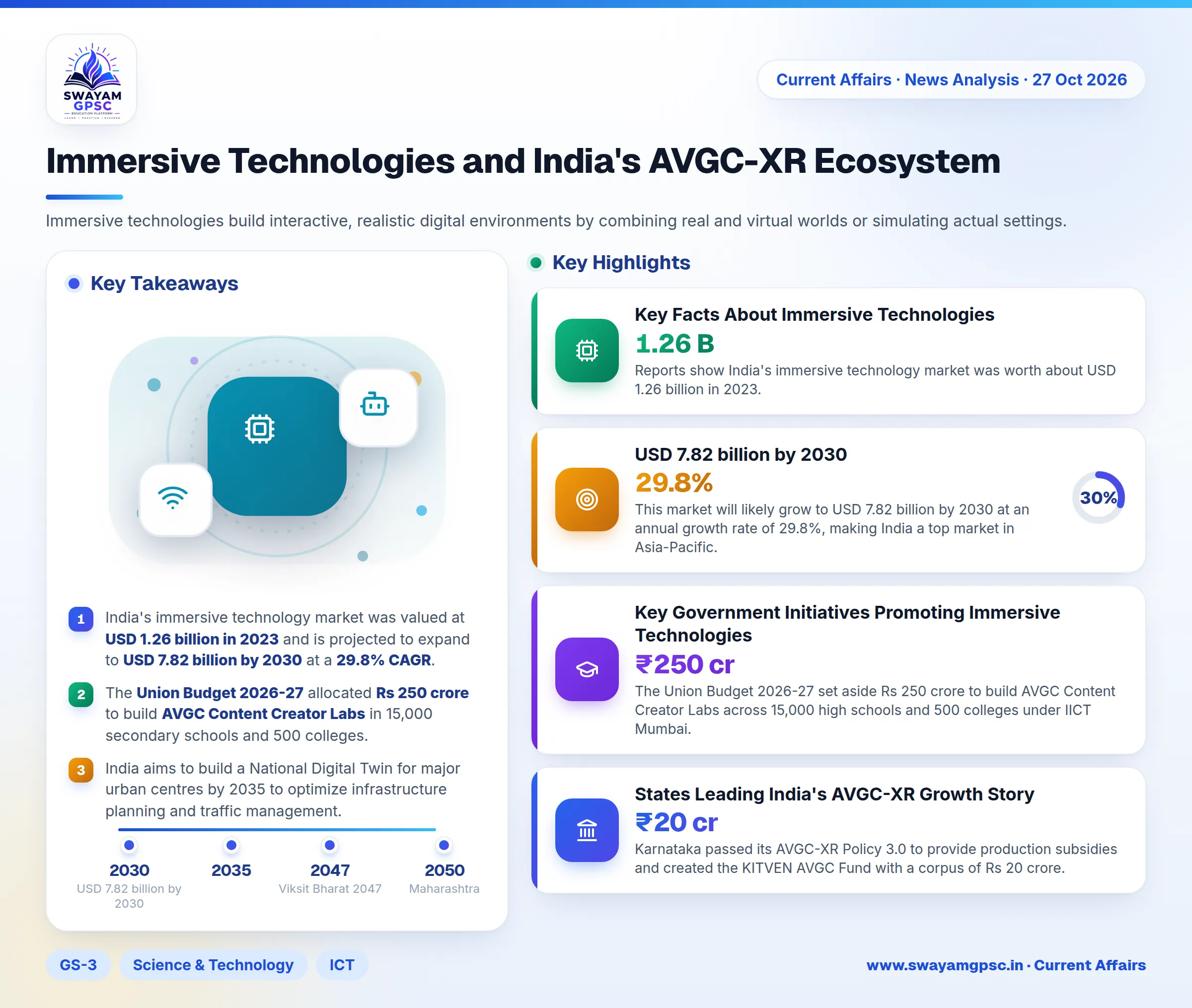
- India's immersive technology market was valued at USD 1.26 billion in 2023 and is projected to expand to USD 7.82 billion by 2030 at a 29.8% CAGR.
- The Union Budget 2026-27 allocated Rs 250 crore to build AVGC Content Creator Labs in 15,000 secondary schools and 500 colleges.
- India aims to build a National Digital Twin for major urban centres by 2035 to optimize infrastructure planning and traffic management.
- States are actively backing the sector, with Maharashtra committing a Rs 3,268 crore plan and Telangana's IMAGE Tower already supporting 150+ companies and 30,000 jobs.
Why in News
- India is speeding up the adoption of immersive technologies using artificial intelligence, high-speed connectivity, and strong computing power.
- These new tools are transforming sectors like education, healthcare, urban planning, and the creative economy across the country.
- This push aims to position India as a major global center for innovation in immersive systems.
Key Facts About Immersive Technologies
- Immersive technologies build interactive, realistic digital environments by combining real and virtual worlds or simulating actual settings.
- They engage several human senses, letting users handle digital objects and feel like they are truly inside the experience.
- Extended Reality (XR) acts as an overall umbrella term that includes Virtual Reality (VR), Augmented Reality (AR), and Mixed Reality (MR).
- Virtual Reality (VR) forms an entirely computer-generated space, allowing users to move and interact through special headsets or gear.
- Augmented Reality (AR) overlays digital graphics or 3D models onto the real world while keeping your physical surroundings visible.
- Mixed Reality (MR) blends physical objects with virtual elements, making digital items react to real-world objects around them.
- 360-Degree Video lets viewers look around in any direction within a pre-recorded real-world environment.
- Haptic Technology uses physical sensations like vibrations or pressure to mimic the feeling of touching digital objects.
- A Digital Twin is a data-backed virtual model of a real object, facility, or city that helps monitor, simulate, and predict performance live.
- Recent progress in Artificial Intelligence (AI), rapid networks, and processing power drives better immersive experiences in learning, health, travel, and gaming.
- Reports show India's immersive technology market was worth about USD 1.26 billion in 2023.
- This market will likely grow to USD 7.82 billion by 2030 at an annual growth rate of 29.8%, making India a top market in Asia-Pacific.
Key Applications of Immersive Technologies in India
- In education and skill development, AR and VR simulations give students hands-on practice with complex scientific and historical concepts.
- IIT Madras is creating AR/VR learning packages for rural high schools so children can explore school subjects virtually.
- In healthcare and medical training, virtual simulations allow doctors and trainees to practice surgeries and complex treatments risk-free.
- For cultural heritage and tourism, digital museums and AR tours preserve historic places and let more people explore them remotely.
- The JATAN software helped digitize artifacts across eight national museums and two Archaeological Survey of India (ASI) site museums.
- The Indian Museum in Kolkata along with ASI museums at Hampi and Nalanda now offer digital visitor displays.
- In urban planning and infrastructure, planners combine digital twins, AI, 5G, and IoT sensors to design public works better.
- The Sangam: Digital Twin initiative by the Department of Telecommunications builds virtual infrastructure models, as seen in the Varanasi Urban 3D Spatial Planning Project.
- India plans to set up a National Digital Twin for every major city by 2035 to guide urban design and asset maintenance.
- For transport and mobility management, virtual city models track traffic flows, commuter habits, and tourist travel to improve transport systems.
- At the India Mobile Congress 2025, officials demonstrated a Mobility Digital Twin that mapped traffic in Delhi and visitor routes in Ayodhya.
- In the creative economy and entertainment, spatial computing and VR empower local studios in gaming, digital media, and virtual film production.
Key Government Initiatives Promoting Immersive Technologies
- India supports immersive systems through a national Animation, Visual Effects, Gaming, Comics, and Extended Reality (AVGC-XR) framework.
- The Ministry of Information and Broadcasting (MIB) set up the AVGC Promotion Task Force in April 2022 to coordinate policies between departments.
- India opened the Indian Institute of Creative Technologies (IICT) in Mumbai in 2025 as a premier national institute working with tech firms like Google, Meta, Adobe, and Netflix.
- The Union Budget 2026-27 set aside Rs 250 crore to build AVGC Content Creator Labs across 15,000 high schools and 500 colleges under IICT Mumbai.
- The Ministry of Electronics and Information Technology (MeitY) launched the GENESIS Scheme in 2022 to fund 1,600 tech startups in smaller Tier-II and Tier-III cities over five years.
- The government introduced WaveX as a media-tech accelerator to back young companies building new AVGC-XR platforms.
- The CSIR will run the Emerging Science, Technology and Innovation Conclave (ESTIC) 2026 from 27th to 29th October 2026 at Bharat Mandapam, New Delhi.
States Leading India's AVGC-XR Growth Story
- Karnataka passed its AVGC-XR Policy 3.0 to provide production subsidies and created the KITVEN AVGC Fund with a corpus of Rs 20 crore.
- Maharashtra introduced its AVGC-XR Policy 2025 featuring a Rs 3,268 crore outlay to build industry hubs leading up to 2050.
- Telangana released its IMAGE Policy in 2016 around Hyderabad's IMAGE Tower, hosting over 150 AVGC companies, 100 startups, and 30,000 direct jobs.
- Tamil Nadu launched its AVGC-XR Policy 2026 aiming to support 200 startups, create 2 lakh jobs, and capture 20% of the national market by 2030.
- Kerala implemented its AVGC-XR Policy 2024 focused on specialized technical training to create 50,000 jobs by 2029.
- Madhya Pradesh approved its AVGC-XR Policy 2025 to fund original intellectual property and open regional skill labs.
- Uttar Pradesh is constructing a specialized AVGC-XR Park in Jewar equipped with motion-capture facilities and virtual studios.
- Rajasthan offers grants up to Rs 50 lakh for animation or VR projects and Rs 1 crore for game development under its AVGC-XR Policy 2024.
- Gujarat is drafting a full AVGC-XR policy for infrastructure and startups, backed by 16 state institutes offering animation and gaming courses.
Conclusion
- Immersive tools are bridging the gap between physical spaces and virtual systems across education, healthcare, and public administration.
- Expanding India's AVGC-XR capabilities through startup funding and local innovation will boost digital access and help achieve Viksit Bharat 2047.