ICJ Ruling on Myanmar Rohingya Genocide
#GS-2 #Current Events #International #Constitutional Bodies #Governance & Social Justice
Key takeaways
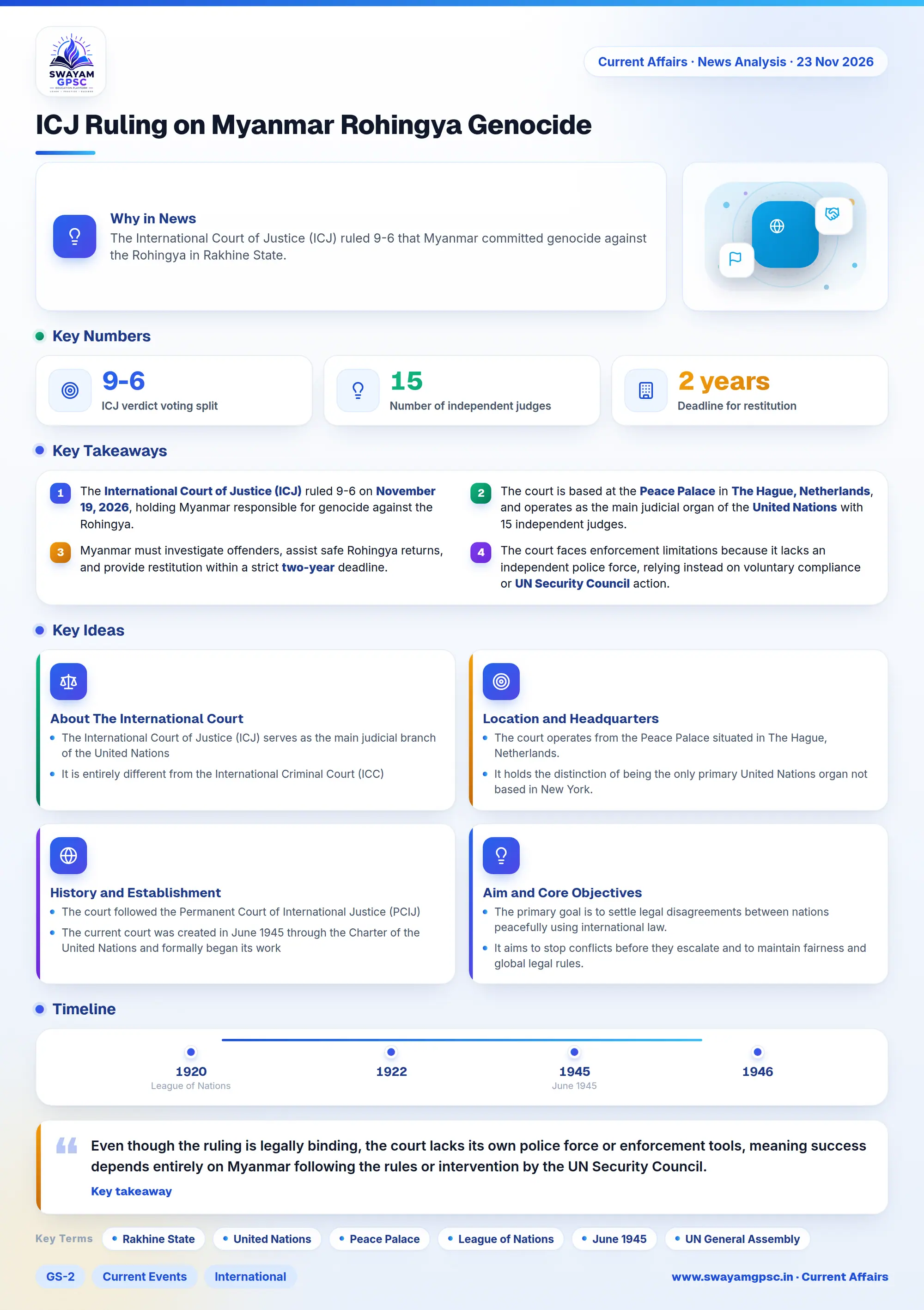
- The International Court of Justice (ICJ) ruled 9-6 on November 19, 2026, holding Myanmar responsible for genocide against the Rohingya.
- The court is based at the Peace Palace in The Hague, Netherlands, and operates as the main judicial organ of the United Nations with 15 independent judges.
- Myanmar must investigate offenders, assist safe Rohingya returns, and provide restitution within a strict two-year deadline.
- The court faces enforcement limitations because it lacks an independent police force, relying instead on voluntary compliance or UN Security Council action.
Why in News
- The International Court of Justice (ICJ) ruled 9-6 that Myanmar committed genocide against the Rohingya in Rakhine State.
About The International Court of Justice (ICJ)
- The International Court of Justice (ICJ) serves as the main judicial branch of the United Nations, acting as a civil international tribunal for legal disputes between countries and offering advisory opinions.
- It is entirely different from the International Criminal Court (ICC), which focuses on prosecuting individual criminals rather than settling disputes between sovereign nations.
Location and Headquarters
- The court operates from the Peace Palace situated in The Hague, Netherlands.
- It holds the distinction of being the only primary United Nations organ not based in New York.
History and Establishment
- The court followed the Permanent Court of International Justice (PCIJ), which was set up by the League of Nations in 1920 and started functioning in 1922.
- The current court was created in June 1945 through the Charter of the United Nations and formally began its work in April 1946.
Aim and Core Objectives
- The primary goal is to settle legal disagreements between nations peacefully using international law.
- It aims to stop conflicts before they escalate and to maintain fairness and global legal rules.
Key Functions of the ICJ
- It resolves legal arguments between willing nations concerning land borders, sea claims, treaty breaches, and international agreements.
- It offers advice on international legal matters requested by the UN General Assembly, the Security Council, and other approved United Nations agencies.
- It gives urgent interim orders called binding provisional measures to safeguard rights and keep evidence safe until a final decision is reached.
- It explains the meaning of international treaties and customs, helping to define clear legal duties for countries.
- The court consists of 15 independent judges who serve nine-year terms, chosen by the UN General Assembly and the Security Council, with English and French as its working languages.
ICJ Verdict on Myanmar Key Highlights
- On November 19, 2026, the court delivered a 9-6 decision finding Myanmar guilty of genocide against the Rohingya, while acknowledging The Gambia as a valid party under the Genocide Convention.
- The judges concluded that genocidal intent existed based on widespread killings, sexual violence, and targeted harassment, which violated duties to prevent genocide and ignored a 2020 evidence-saving order.
- The court instructed Myanmar to punish the offenders, allow safe repatriation for the Rohingya, and offer financial restitution, setting a two-year deadline to submit progress reports.
- Even though the ruling is legally binding, the court lacks its own police force or enforcement tools, meaning success depends entirely on Myanmar following the rules or intervention by the UN Security Council.