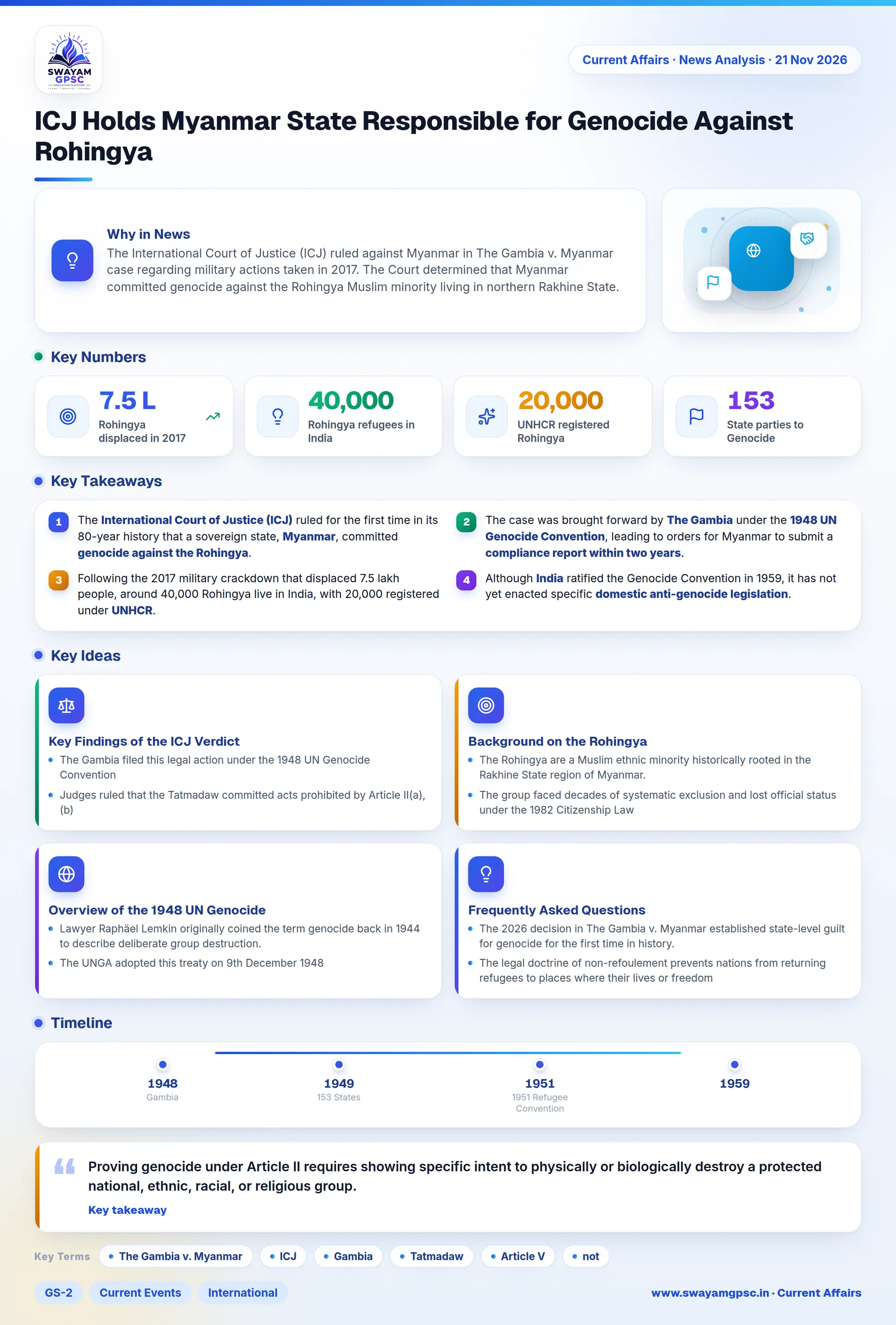
ICJ Holds Myanmar State Responsible for Genocide Against Rohingya
#GS-2 #Current Events #International #India and its Neighbourhood #Effect of Policies & Politics of Countries on India's Interests #Human Rights #ICJ
Key takeaways
- The International Court of Justice (ICJ) ruled for the first time in its 80-year history that a sovereign state, Myanmar, committed genocide against the Rohingya.
- The case was brought forward by The Gambia under the 1948 UN Genocide Convention, leading to orders for Myanmar to submit a compliance report within two years.
- Following the 2017 military crackdown that displaced 7.5 lakh people, around 40,000 Rohingya live in India, with 20,000 registered under UNHCR.
- Although India ratified the Genocide Convention in 1959, it has not yet enacted specific domestic anti-genocide legislation.
Why in News
- The International Court of Justice (ICJ) ruled against Myanmar in The Gambia v. Myanmar case regarding military actions taken in 2017.
- The Court determined that Myanmar committed genocide against the Rohingya Muslim minority living in northern Rakhine State.
- This ruling marks the first time in the ICJ's 80-year existence where a sovereign State committed genocide directly.
- While judgments from the ICJ carry legal authority, enforcing them relies on the UN Security Council where vetoes can block action.
Key Findings of the ICJ Verdict
- The Gambia filed this legal action under the 1948 UN Genocide Convention, which permits any member State to sue another state for treaty violations.
- Judges ruled that the Tatmadaw committed acts prohibited by Article II(a), (b), and (d) of the Genocide Convention with explicit intent to destroy the group.
- The ruling formally identified the Rohingya as a distinct ethnic group and rejected claims that they are illegal migrants.
- Myanmar failed in its international duty to prevent genocide by actors operating alongside security forces and neglected to punish those responsible.
- The state breached Article V of the treaty because it did not pass domestic anti-genocide legislation to protect vulnerable groups.
- The judges found that Myanmar did not violate rules concerning direct public incitement by private individuals.
- The verdict instructs Myanmar to facilitate a safe, voluntary, and dignified return of displaced Rohingya currently staying in Cox's Bazar, Bangladesh.
- Myanmar must pass domestic anti-genocide laws and actively prosecute suspects involved in these atrocities.
- The Court ordered financial compensation for damage caused, requiring Myanmar to submit a official compliance report within two years.
- Earlier cases like Bosnia and Herzegovina v. Serbia and Montenegro (2007) and Croatia v. Serbia (2015) failed to prove direct genocidal intent by a state.
- By defining structural destruction as harming a group's ability to survive over time, the 2026 judgment creates a significant legal precedent.
Background on the Rohingya
- The Rohingya are a Muslim ethnic minority historically rooted in the Rakhine State region of Myanmar.
- The group faced decades of systematic exclusion and lost official status under the 1982 Citizenship Law, turning them into stateless people.
- Military clearings following attacks by the Arakan Rohingya Salvation Army (ARSA) in August 2017 killed around 10,000 people and displaced 7.5 lakh residents.
- An estimated 40,000 Rohingya reside inside India, with approximately 20,000 registered through UNHCR.
- Although India did not sign the 1951 Refugee Convention, it respects the customary rule of non-refoulement.
- Following the judgment, India affirmed its goal to support the safe, sustainable repatriation of Rohingya refugees back to Myanmar.
Overview of the 1948 UN Genocide Convention
- Lawyer Raphäel Lemkin originally coined the term genocide back in 1944 to describe deliberate group destruction.
- The UNGA adopted this treaty on 9th December 1948, bringing it into formal effect in 1951 as a foundational international law.
- Proving genocide under Article II requires showing specific intent to physically or biologically destroy a protected national, ethnic, racial, or religious group.
- A violation occurs when a state executes any of five listed acts, including killing members or causing serious bodily or mental harm.
- Legal acts also include inflicting harmful life conditions, imposing birth prevention measures, and forcibly transferring children.
- Member states accept legal obligations to prevent and punish acts of genocide through their own national courts.
- A total of 153 States have ratified the treaty; India signed in 1949 and ratified in 1959 without passing specific domestic implementing laws.
- The definition inside this treaty directly informed Article 6 of the Rome Statute governing the International Criminal Court.
Frequently Asked Questions
- The 2026 decision in The Gambia v. Myanmar established state-level guilt for genocide for the first time in history.
- The legal doctrine of non-refoulement prevents nations from returning refugees to places where their lives or freedom remain endangered.
- The ICJ resolves legal disputes between sovereign nations, whereas the ICC prosecutes individual human beings for major international crimes.
- India provides assistance to displaced populations while favoring a safe, voluntary and sustainable repatriation framework.