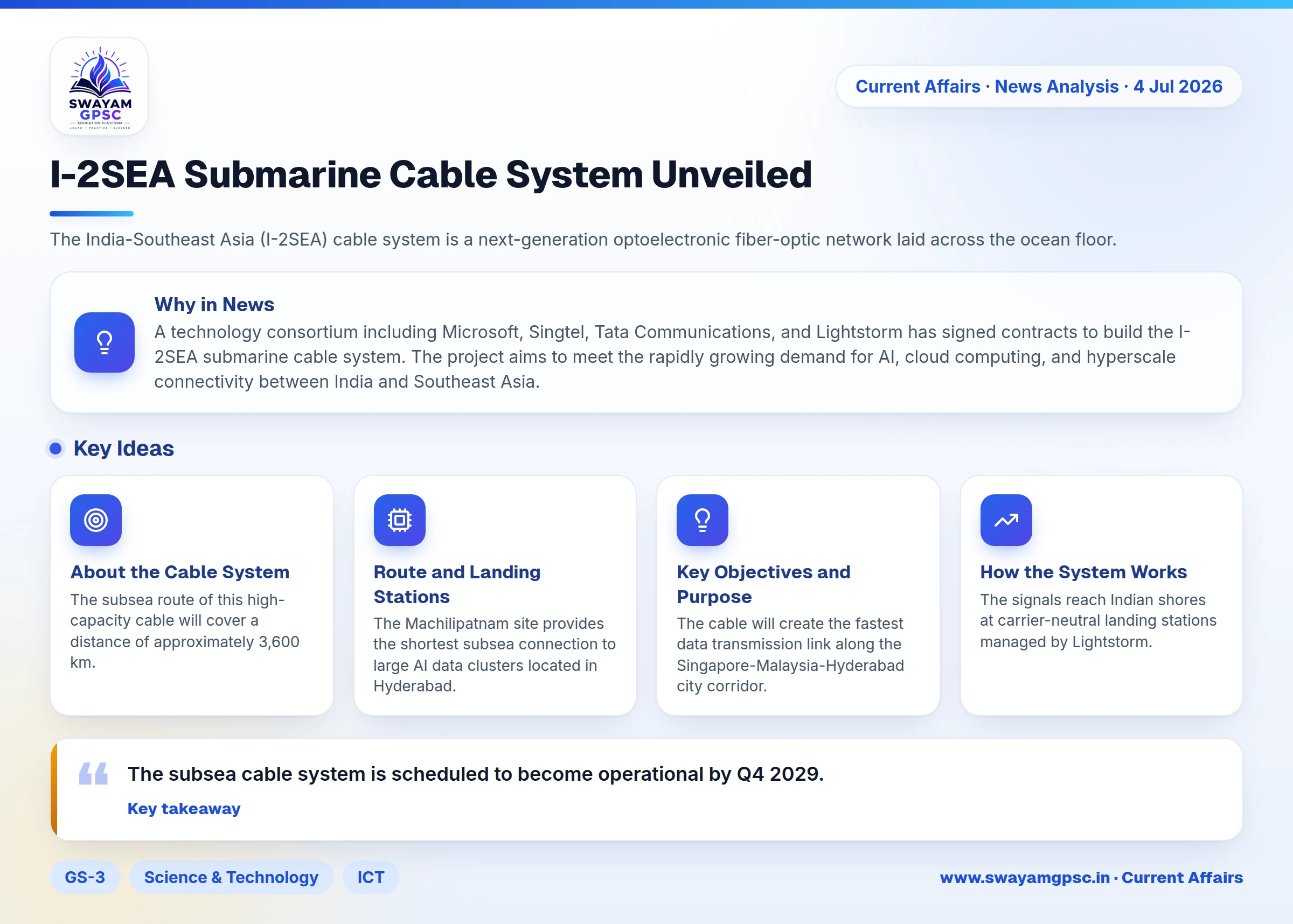
I-2SEA Submarine Cable System Unveiled
#GS-3 #Science & Technology #ICT #Economy #Infrastructure #Current Events #International #I-2SEA Cable
Why in News
- A technology consortium including Microsoft, Singtel, Tata Communications, and Lightstorm has signed contracts to build the I-2SEA submarine cable system.
- The project aims to meet the rapidly growing demand for AI, cloud computing, and hyperscale connectivity between India and Southeast Asia.
About the Cable System
- The India-Southeast Asia (I-2SEA) cable system is a next-generation optoelectronic fiber-optic network laid across the ocean floor.
- Undersea fiber-optic cables carry the majority of global internet and telecommunications traffic between continents.
- Unlike older subsea cables designed for general web browsing, this system is specifically built to handle heavy data loads for AI model training, GPU clusters, and hyperscale workloads.
- The subsea route of this high-capacity cable will cover a distance of approximately 3,600 km.
Route and Landing Stations
- In Southeast Asia, the system connects Singapore, a major cloud interconnect hub, with Kuala Lumpur, the heart of Malaysia's data center corridor.
- In India, the cable features two strategically separate landing sites on the east coast at Machilipatnam and South Chennai.
- The Machilipatnam site provides the shortest subsea connection to large AI data clusters located in Hyderabad.
- The South Chennai site offers a new landing location that helps bypass heavily congested existing subsea shipping routes.
- Onshore links will connect the system from Machilipatnam to Mumbai and over 80 data centres across India.
Key Objectives and Purpose
- The main objective is to provide high-capacity, low-latency digital connectivity for organizations running complex AI models.
- It specifically serves hyperscalers, GPU infrastructure providers, and enterprises conducting real-time AI training.
- The cable will create the fastest data transmission link along the Singapore-Malaysia-Hyderabad city corridor.
How the System Works
- High-speed data generated by cloud nodes or AI models moves across the ocean through the 3,600 km subsea cable.
- The signals reach Indian shores at carrier-neutral landing stations managed by Lightstorm.
- Onshore equipment plugs the subsea signal directly into Lightstorm's 30,000 km land-based fiber network.
- Companies can track data paths in real time and expand network capacity instantly using the SmartNet AI Fabric and Polarin platform.
Key Features and Specifications
- The architecture features carrier-neutral landing infrastructure and an open, interoperable design.
- To protect against damage from shipping traffic in the Malacca Strait and Bay of Bengal, the cable will be buried three meters deep in shallow waters.
- The project is structured under a Joint Build Agreement between global technology companies and regional network operators.
- Japanese firm NEC Corporation serves as the main system supplier providing subsea hardware.
- Marine deployment, sea trenching, and route clearance will be carried out by ASEAN Cableship Pte Ltd (ACPL).
Significance
- The subsea cable system is scheduled to become operational by Q4 2029.
- It will strengthen digital links and infrastructure cooperation between India and Southeast Asia.
- The project will boost the growth of AI infrastructure, cloud services, and the broader digital economy across both regions.