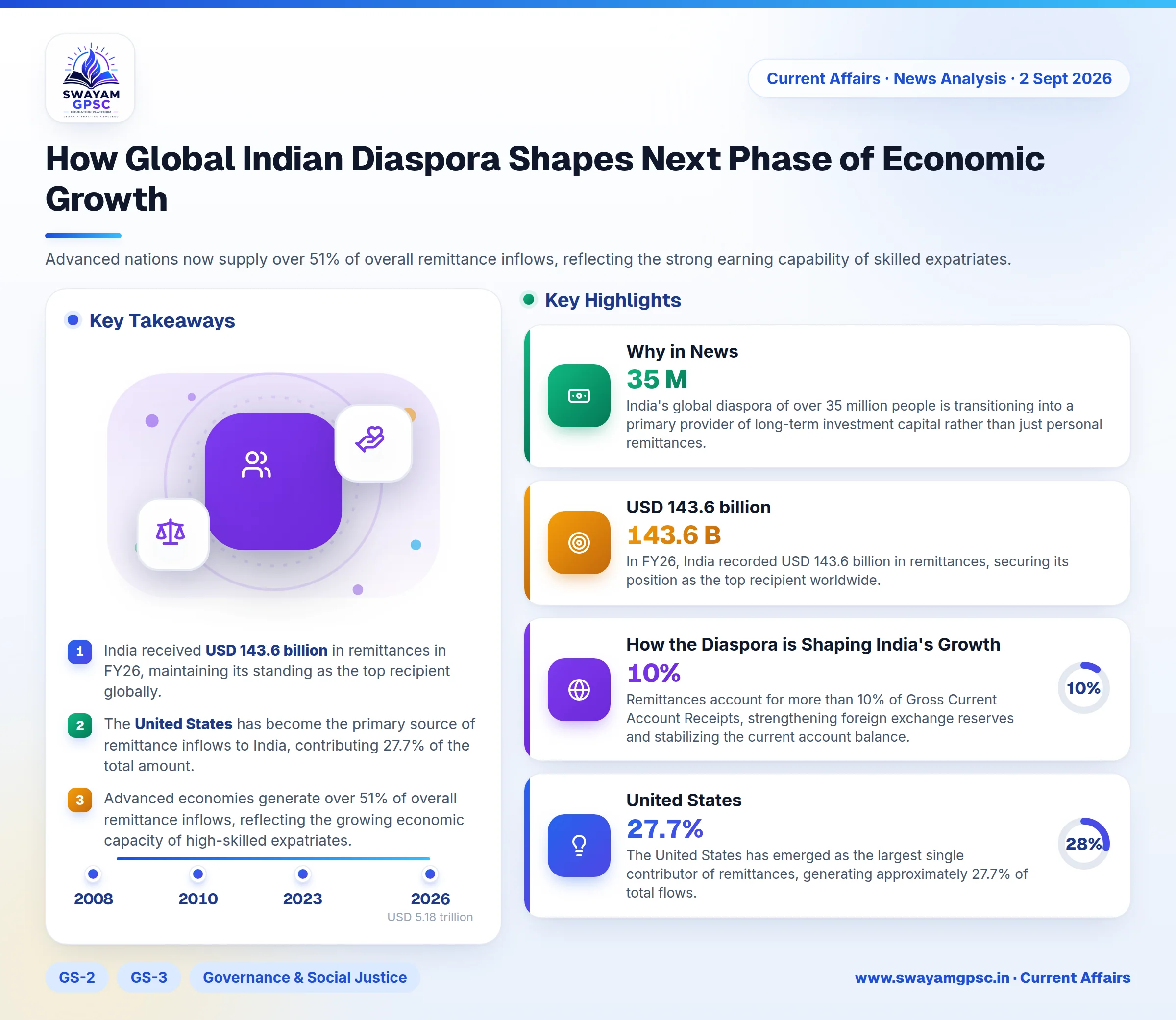
How Global Indian Diaspora Shapes Next Phase of Economic Growth
#GS-2 #GS-3 #Governance & Social Justice #Current Events #Economy #Indian Society #National #Effects of Globalization #Gujarati Diaspora #Growth #Infrastructure #Indian Diaspora #Remittances
Key takeaways
- India received USD 143.6 billion in remittances in FY26, maintaining its standing as the top recipient globally.
- The United States has become the primary source of remittance inflows to India, contributing 27.7% of the total amount.
- Advanced economies generate over 51% of overall remittance inflows, reflecting the growing economic capacity of high-skilled expatriates.
- India's foreign exchange reserves reached over USD 700 billion, driven by steady capital inflows and strong economic indicators.
- Domestic equity market capitalization touched USD 5.18 trillion in July 2026, supported by non-resident investments in AIFs, REITs, and InvITs.
Why in News
- India's global diaspora of over 35 million people is transitioning into a primary provider of long-term investment capital rather than just personal remittances.
- In FY26, India recorded USD 143.6 billion in remittances, securing its position as the top recipient worldwide.
- Expanding digital public infrastructure and stronger economic fundamentals are driving Non-Resident Indians (NRIs) to actively invest across domestic financial markets.
How the Diaspora is Shaping India's Growth
- Remittances account for more than 10% of Gross Current Account Receipts, strengthening foreign exchange reserves and stabilizing the current account balance.
- Overseas Indians are shifting their focus from supporting families directly toward supplying structured growth capital.
- This transition highlights rising investor trust in the long-term potential of the domestic economic ecosystem.
- The United States has emerged as the largest single contributor of remittances, generating approximately 27.7% of total flows.
- Advanced nations now supply over 51% of overall remittance inflows, reflecting the strong earning capability of skilled expatriates.
- Indian expatriates previously held most of their assets in physical gold, real estate, or standard fixed deposits.
- Today, non-resident investors route capital into Alternative Investment Funds (AIFs), Real Estate Investment Trusts (REITs), and Infrastructure Investment Trusts (InvITs).
- This growing non-resident participation helped propel the domestic equity market capitalization to USD 5.18 trillion in July 2026.
- Non-resident investors are capitalizing on economic formalization promoted by GST, the Insolvency and Bankruptcy Code (IBC), and Production Linked Incentive (PLI) initiatives.
- Overseas capital flows are accelerating due to well-capitalized banks, controlled inflation, and foreign exchange reserves exceeding USD 700 billion.
- Digital Public Infrastructure tools like Aadhaar, UPI, DigiLocker, and the Account Aggregator system have removed distance barriers for global investors.
- Streamlined electronic Know Your Customer (e-KYC) protocols allow non-residents to allocate capital into domestic assets effortlessly.
- Upgraded regulations by the Reserve Bank of India (RBI) and Securities and Exchange Board of India (SEBI) have strengthened market integrity.
- The creation of GIFT IFSC in Gujarat offers global Indians a tax-efficient, dollar-denominated gateway to invest locally.
- Indian tech leaders in global corporate roles facilitate knowledge sharing, boosting key initiatives like the India Semiconductor Mission (ISM) and National Quantum Mission.
- Overseas citizens serve as soft-power ambassadors whose political and corporate presence strengthens bilateral trade ties and diplomatic relations.
Challenges
- A major segment of Indian workers in Gulf Cooperation Council (GCC) nations works in low-skilled jobs with severe employment instability.
- Restrictive practices like the Kafala system in Gulf nations limit worker mobility and reduce wage security.
- Western nations are implementing stricter visa policies, such as significant fee increases for H-1B visas in the United States.
- Domestic institutions lack sufficient research funding and infrastructure to bring back top scientific talent from abroad.
- Second and third-generation Overseas Citizens of India (OCIs) and Persons of Indian Origin (PIOs) maintain weaker economic ties with India compared to earlier migrants.
- Non-Resident Indians cannot vote remotely through postal or digital systems, requiring physical presence in India to exercise voting rights.
- Bureaucratic delays and compliance mandates under the Foreign Contribution (Regulation) Act (FCRA), 2010 hinder philanthropic investments.
- India lacks a single centralized database tracking its overseas population across different destination countries.
- Existing grievance platforms like e-Migrate and Madad remain fragmented, delaying legal aid during international crises.
- Anti-immigrant sentiment and hate crimes in host countries create safety concerns and strain local consular teams.
- Heavy reliance on remittances to balance current account deficits hides structural weakness in domestic export growth.
- Traditional banking channels keep cross-border money transfer fees higher than the 3% target set by UN SDG 10.c.
- Informal financial channels like Hawala operate without proper verification, increasing money laundering risks.
- Fraudulent recruitment agencies deceive job seekers with false promises, resulting in wage theft and forced labor.
- Deceptive recruiters have forced some Indian citizens into supporting combat zones in the Russia-Ukraine war.
- Unofficial migration pathways called donkey routes expose travelers to human trafficking, detention, and physical dangers.
India's Initiatives to Boost Diaspora Engagement
- The Overseas Citizen of India (OCI) scheme offers lifelong, multiple-entry visas and economic parity with non-residents, excluding voting and agricultural land rights.
- The government organizes Pravasi Bharatiya Divas every two years on January 9 to honor diaspora achievements with the Pravasi Bharatiya Samman Award.
- The VAJRA Scheme allows overseas Indian researchers to conduct high-end collaborative projects in publicly funded domestic labs.
- The PRABHASS portal connects global scientific talent with government ministries to address national technological challenges.
Initiatives to Boost Remittances
- The FCNR(B) Swap Facility (2025-26) enables the RBI to offer dollar-rupee swaps to banks, lowering hedging costs for foreign-currency deposits.
- India is expanding UPI connections globally to enable instant cross-border payments between individuals.
- Non-repatriable investments made by NRIs and OCIs receive domestic treatment, exempting them from strict FDI limits.
- The India-UAE Local Currency Settlement (LCS) Framework (2023) enables direct trade settlement in rupees and dirhams.
- Updated regulations under the Foreign Exchange Management Regulations, 2023 have expanded allowed channels for cross-border transactions in local currencies.
Way Forward
- Extending the UPI-RuPay network across major remittance corridors like the United States and the United Kingdom will reduce hidden transaction fees.
- Re-issuing modern diaspora bonds, similar to the Resurgent India Bonds (1998) and India Millennium Deposits (2000), can fund green energy and infrastructure projects.
- Creating flexible visiting professorships and joint patents will build a sustainable brain-circulation model without requiring permanent relocation.
- Setting up specialized advisory boards with global Indian executives can guide policy formulation in Artificial Intelligence and biotechnology.
- Using influential diaspora networks can help build strategic partnerships, similar to their role during the Indo-US Civil Nuclear Agreement in 2008.
- Signing comprehensive Social Security Agreements (SSAs) with Gulf nations will protect the legal rights of semi-skilled workers.
- Updating the OCI platform to streamline regulatory approvals will attract venture investments from younger diaspora generations.
- Improving digital financial literacy among migrant workers will shift transfers from costly cash agents to secure digital platforms.