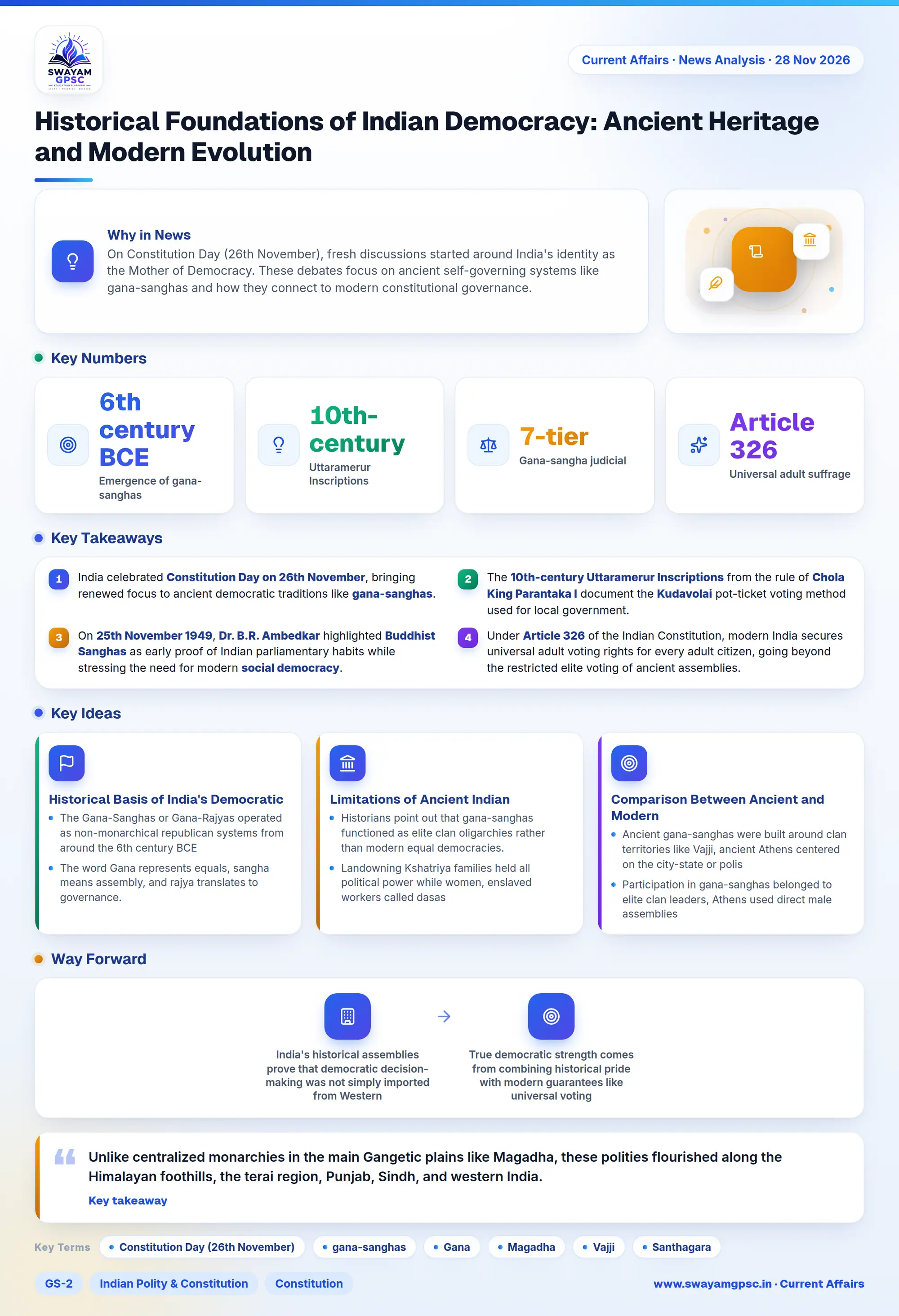
Historical Foundations of Indian Democracy: Ancient Heritage and Modern Evolution
#GS-2 #Indian Polity & Constitution #Constitution #Current Events #National #GS-1 #History #Ancient India
Key takeaways
- India celebrated Constitution Day on 26th November, bringing renewed focus to ancient democratic traditions like gana-sanghas.
- The 10th-century Uttaramerur Inscriptions from the rule of Chola King Parantaka I document the Kudavolai pot-ticket voting method used for local government.
- On 25th November 1949, Dr. B.R. Ambedkar highlighted Buddhist Sanghas as early proof of Indian parliamentary habits while stressing the need for modern social democracy.
- Under Article 326 of the Indian Constitution, modern India secures universal adult voting rights for every adult citizen, going beyond the restricted elite voting of ancient assemblies.
Why in News
- On Constitution Day (26th November), fresh discussions started around India's identity as the Mother of Democracy.
- These debates focus on ancient self-governing systems like gana-sanghas and how they connect to modern constitutional governance.
Historical Basis of India's Democratic Heritage
- The Gana-Sanghas or Gana-Rajyas operated as non-monarchical republican systems from around the 6th century BCE until the Gupta Empire took control.
- The word Gana represents equals, sangha means assembly, and rajya translates to governance.
- Unlike centralized monarchies in the main Gangetic plains like Magadha, these polities flourished along the Himalayan foothills, the terai region, Punjab, Sindh, and western India.
- Major confederations included the Vajji led by the Lichchhavis of Vaishali and Malla, alongside smaller clans such as the Sakyas, Koliyas, Bulis, Kalamas, Moriyas, and Bhaggas.
- Governance operated through an assembly hall called the Santhagara where chosen heads titled Raja led open discussions without passing leadership down family lines.
- Members debated matters openly in the assembly hall and used voting when they could not reach full agreement.
- Administrators, treasurers, and military heads supported the government, which also ran an organized seven-tier judicial hierarchy to handle trials.
- These open systems encouraged new philosophical thinking, nurturing leaders like Mahavira from the Jnatrika clan and Gautama Buddha from the Sakya clan.
- Despite their open intellectual environment, these systems operated as patriarchal oligarchies where political leadership remained limited to male Kshatriya chiefs.
- Ancient texts like the Rig Veda and Atharva Veda show early roots of consultation through bodies such as the Sabha, Samiti, and Vidatha.
- Women actively attended early assemblies like the Sabha and Vidatha and studied Vedic texts, though later period social shifts restricted their public participation.
- Kautilya's Arthashastra from the 3rd century BCE highlighted citizen welfare as the core responsibility of rulers through Raja Dharma and Praja Dharma.
- Monastic orders codified clear rules such as formal motions called Natti, quorum rules known as Gana-puraka, and secret voting using wooden sticks called Salaka.
- In his historic Constituent Assembly address on 25th November 1949, Dr. B.R. Ambedkar pointed to Buddhist Sanghas as evidence of India's long democratic history.
- The 10th-century Uttaramerur Inscriptions under Chola King Parantaka I detail the Kudavolai pot-ticket voting system used for choosing local council members.
- During the 12th century in Karnataka, Basavanna established the Anubhava Mantapa as an open hall for spiritual and social debate across all castes and genders.
- The ancient text Indica by Megasthenes recorded city management through five-member boards handling municipal duties in Pataliputra.
- Emperor Ashoka built state communication on civic duty, public welfare, and religious harmony through widespread Rock and Pillar Edicts.
- Nationalist historians like K.P. Jayaswal and R.C. Majumdar highlighted ancient republics to counter colonial arguments about Oriental Despotism.
- To honor this deep tradition of self-governance, independent India named itself Bharatiya Ganrajya in its official language versions.
Limitations of Ancient Indian Governance Systems
- Historians point out that gana-sanghas functioned as elite clan oligarchies rather than modern equal democracies.
- Landowning Kshatriya families held all political power while women, enslaved workers called dasas, and laborers called kammakaras had no voice.
- Southern local assemblies documented in the Uttaramerur Inscriptions required strict land ownership, education, and caste status from candidates.
- Ancient systems lacked universal representation because they did not follow the core principle of one person, one vote, one value.
- Political authority depended on birth, gender, and property instead of equal citizenship rights.
- Centralized empires like the Mauryas and Guptas absorbed most ancient republics, breaking any direct line to modern institutions.
- India's 1950 Constitution relied on modern global models of rights and governance rather than restarting ancient tribal assemblies.
- Applying modern terms like individual rights and separation of powers to 6th-century BCE clan systems distorts actual history.
- On 25th November 1949, Dr. B.R. Ambedkar warned that ancient India lost its early democratic habits because of deep social inequalities.
- He emphasized that a healthy nation needs social democracy based on liberty, equality, and fraternity alongside legal constitutional rules.
Comparison Between Ancient and Modern Democratic Frameworks
- Ancient gana-sanghas were built around clan territories like Vajji, ancient Athens centered on the city-state or polis, while the modern Republic of India is a sovereign nation-state.
- Participation in gana-sanghas belonged to elite clan leaders, Athens used direct male assemblies, and modern India uses indirect representative elections.
- Voting rights were limited to landowning men in ancient systems, whereas modern India guarantees universal voting rights under Article 326 regardless of background.
- Ancient systems relied on elder councils or citizen courts, while modern India balances power through an independent judiciary, fundamental rights, and federal structures.
Way Forward
- India's historical assemblies prove that democratic decision-making was not simply imported from Western nations.
- True democratic strength comes from combining historical pride with modern guarantees like universal voting, civil liberties, and equal rights for all citizens.