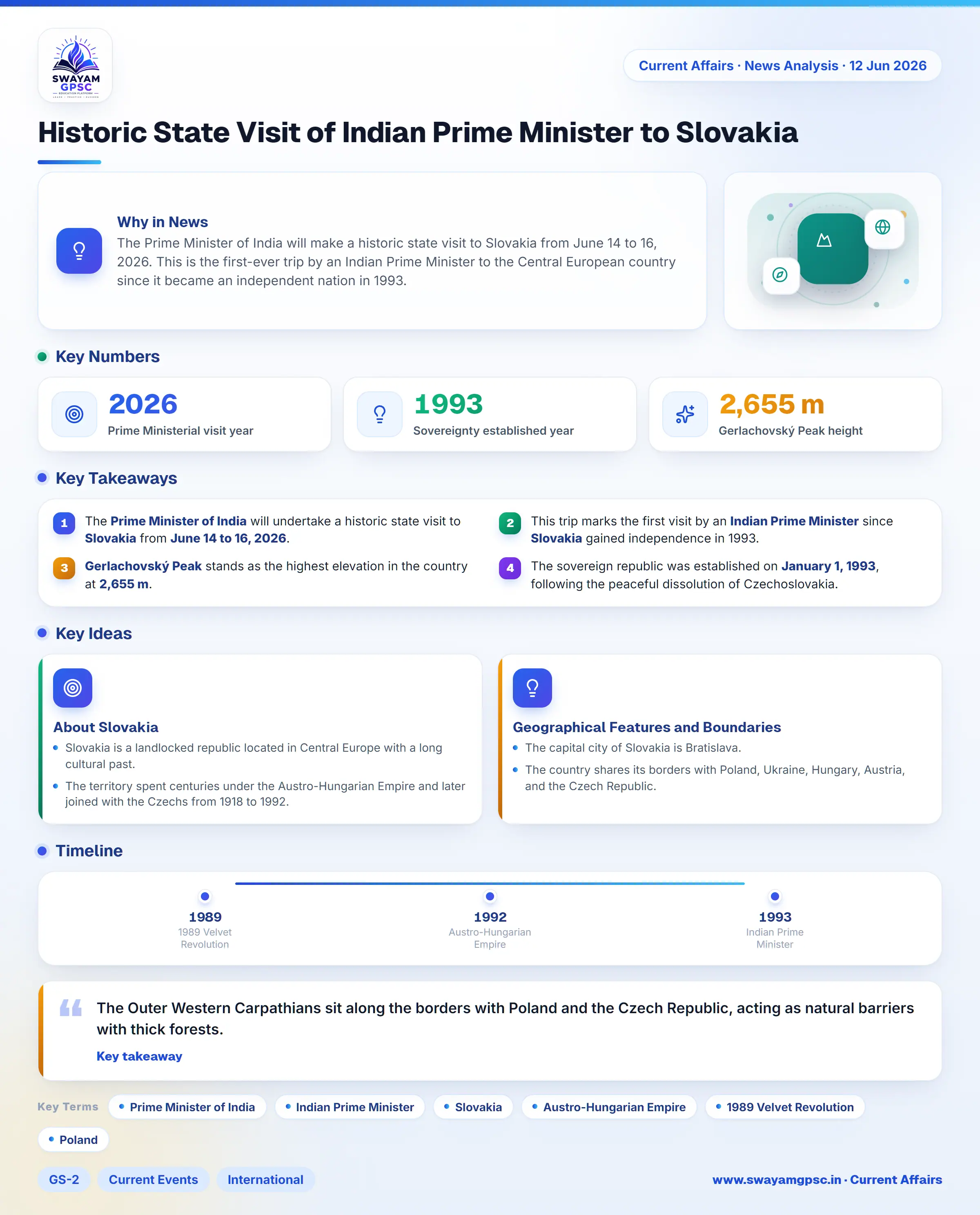
Historic State Visit of Indian Prime Minister to Slovakia
#GS-2 #Current Events #International #Economy #Geography
Key takeaways
- The Prime Minister of India will undertake a historic state visit to Slovakia from June 14 to 16, 2026.
- This trip marks the first visit by an Indian Prime Minister since Slovakia gained independence in 1993.
- Gerlachovský Peak stands as the highest elevation in the country at 2,655 m.
- The sovereign republic was established on January 1, 1993, following the peaceful dissolution of Czechoslovakia.
Why in News
- The Prime Minister of India will make a historic state visit to Slovakia from June 14 to 16, 2026.
- This is the first-ever trip by an Indian Prime Minister to the Central European country since it became an independent nation in 1993.
About Slovakia
- Slovakia is a landlocked republic located in Central Europe with a long cultural past.
- The territory spent centuries under the Austro-Hungarian Empire and later joined with the Czechs from 1918 to 1992.
- A peaceful protest known as the 1989 Velvet Revolution ended the communist government in the region.
- A sovereign Slovakia officially began its journey as an independent nation on January 1, 1993.
- Today, the country has grown into a strong industrial economy and a vital European partner for India.
Geographical Features and Boundaries
- The capital city of Slovakia is Bratislava.
- The country shares its borders with Poland, Ukraine, Hungary, Austria, and the Czech Republic.
- The Western Carpathian Mountain System runs through the country and creates its main mountain backbone.
- Geographers divide these mountains into the Outer, Central, and Inner Carpathian zones.
- The Outer Western Carpathians sit along the borders with Poland and the Czech Republic, acting as natural barriers with thick forests.
- The Central Western Carpathians hold the tallest peaks, including the High Tatras and Low Tatras.
- Gerlachovský Peak stands at 2,655 m and serves as the highest point in the entire country.
- The Inner Western Carpathians lie in the southern part and include the Slovak Ore Mountains.
- Mineral wealth in the southern zone has driven local mining and heavy industry for generations.
- The Danubian Lowland and Eastern Slovakian Lowland form fertile plains across the south.
- Local farmers use these southern plains as the primary food-growing regions of the nation.
- Major rivers drain into the Danube basin, connecting local waters to the wider European network.
- The Váh and Hron rivers provide vital water supplies for farming, electricity generation, and transport.