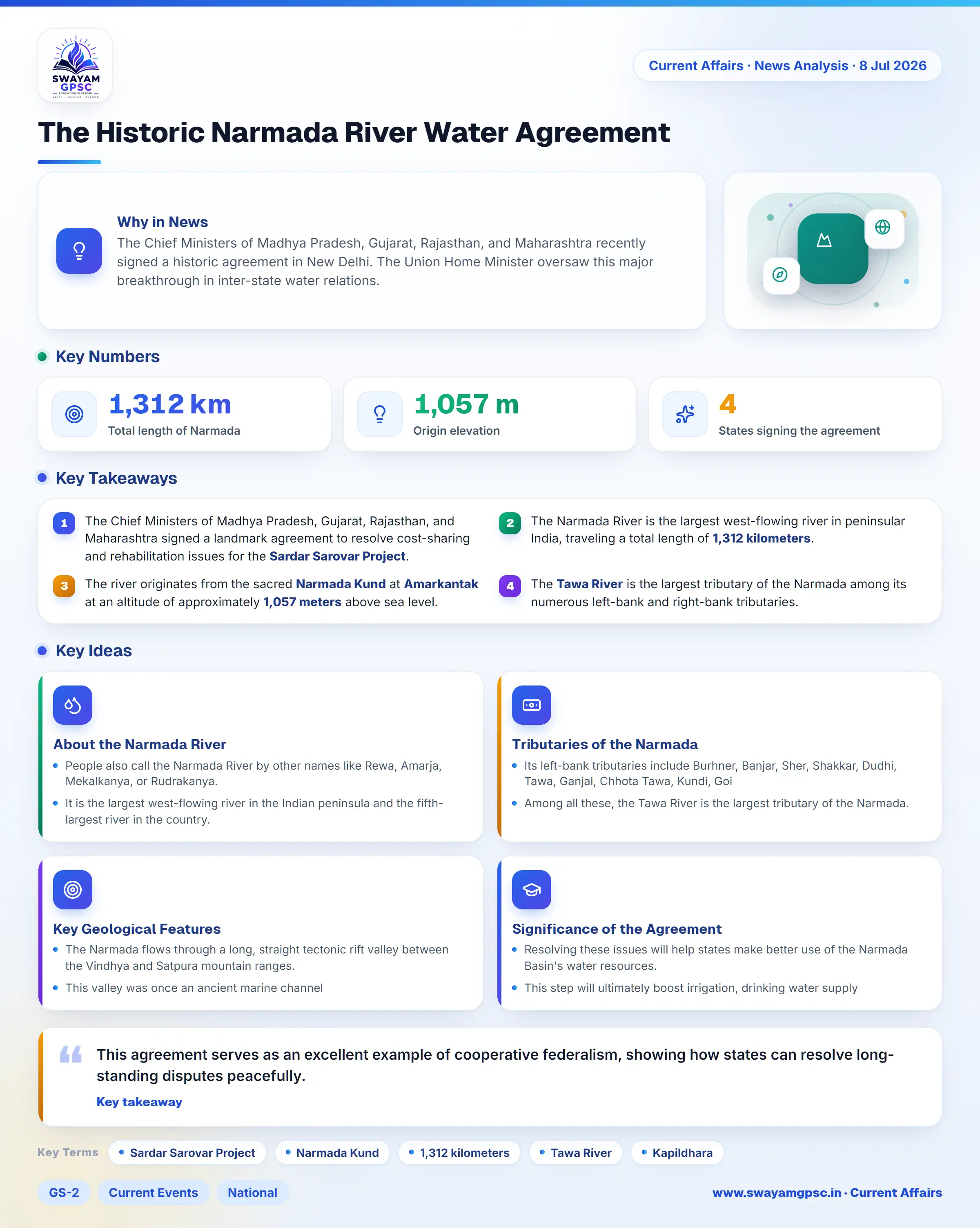
The Historic Narmada River Water Agreement
#GS-2 #Current Events #National #GS-3 #Geography #Resources #Economy #Infrastructure #Mapping
Key takeaways
- The Chief Ministers of Madhya Pradesh, Gujarat, Rajasthan, and Maharashtra signed a landmark agreement to resolve cost-sharing and rehabilitation issues for the Sardar Sarovar Project.
- The Narmada River is the largest west-flowing river in peninsular India, traveling a total length of 1,312 kilometers.
- The river originates from the sacred Narmada Kund at Amarkantak at an altitude of approximately 1,057 meters above sea level.
- The Tawa River is the largest tributary of the Narmada among its numerous left-bank and right-bank tributaries.
Why in News
- The Chief Ministers of Madhya Pradesh, Gujarat, Rajasthan, and Maharashtra recently signed a historic agreement in New Delhi.
- The Union Home Minister oversaw this major breakthrough in inter-state water relations.
- The agreement resolves long-pending disputes over cost-sharing, land acquisition, and rehabilitation expenses for people displaced by the Sardar Sarovar Project.
- The states agreed to settle these issues through a one-time financial payment.
About the Narmada River
- People also call the Narmada River by other names like Rewa, Amarja, Mekalkanya, or Rudrakanya.
- It is the largest west-flowing river in the Indian peninsula and the fifth-largest river in the country.
- It serves as the vital lifeline for the states of Madhya Pradesh and Gujarat.
- The river originates from a sacred spring called Narmada Kund at Amarkantak in the Maikal Hills of eastern Madhya Pradesh, at an altitude of about 1,057 meters.
- While most peninsular rivers flow east into the Bay of Bengal, the Narmada flows westward.
- The river travels a total distance of 1,312 kilometers before reaching the sea.
Tributaries of the Narmada
- Its left-bank tributaries include Burhner, Banjar, Sher, Shakkar, Dudhi, Tawa, Ganjal, Chhota Tawa, Kundi, Goi, and Karjan.
- Among all these, the Tawa River is the largest tributary of the Narmada.
- Its right-bank tributaries include Hiran, Gaur, Barna, Tindoni, Kolar, Chankeshwar, Kanar, Man, Uri, and Orsang.
Key Geological Features
- The Narmada flows through a long, straight tectonic rift valley between the Vindhya and Satpura mountain ranges.
- This valley was once an ancient marine channel, and hard faulted rocks now keep the river confined within a narrow path.
- Because it carries very little sediment through its rocky path, the Narmada forms a deep estuary instead of a delta.
- The steep rocky slopes create beautiful waterfalls, such as Kapildhara near Amarkantak and Dhuandhar Falls near Jabalpur.
Significance of the Agreement
- This agreement serves as an excellent example of cooperative federalism, showing how states can resolve long-standing disputes peacefully.
- Resolving these issues will help states make better use of the Narmada Basin's water resources.
- This step will ultimately boost irrigation, drinking water supply, and hydropower generation across western and central India.