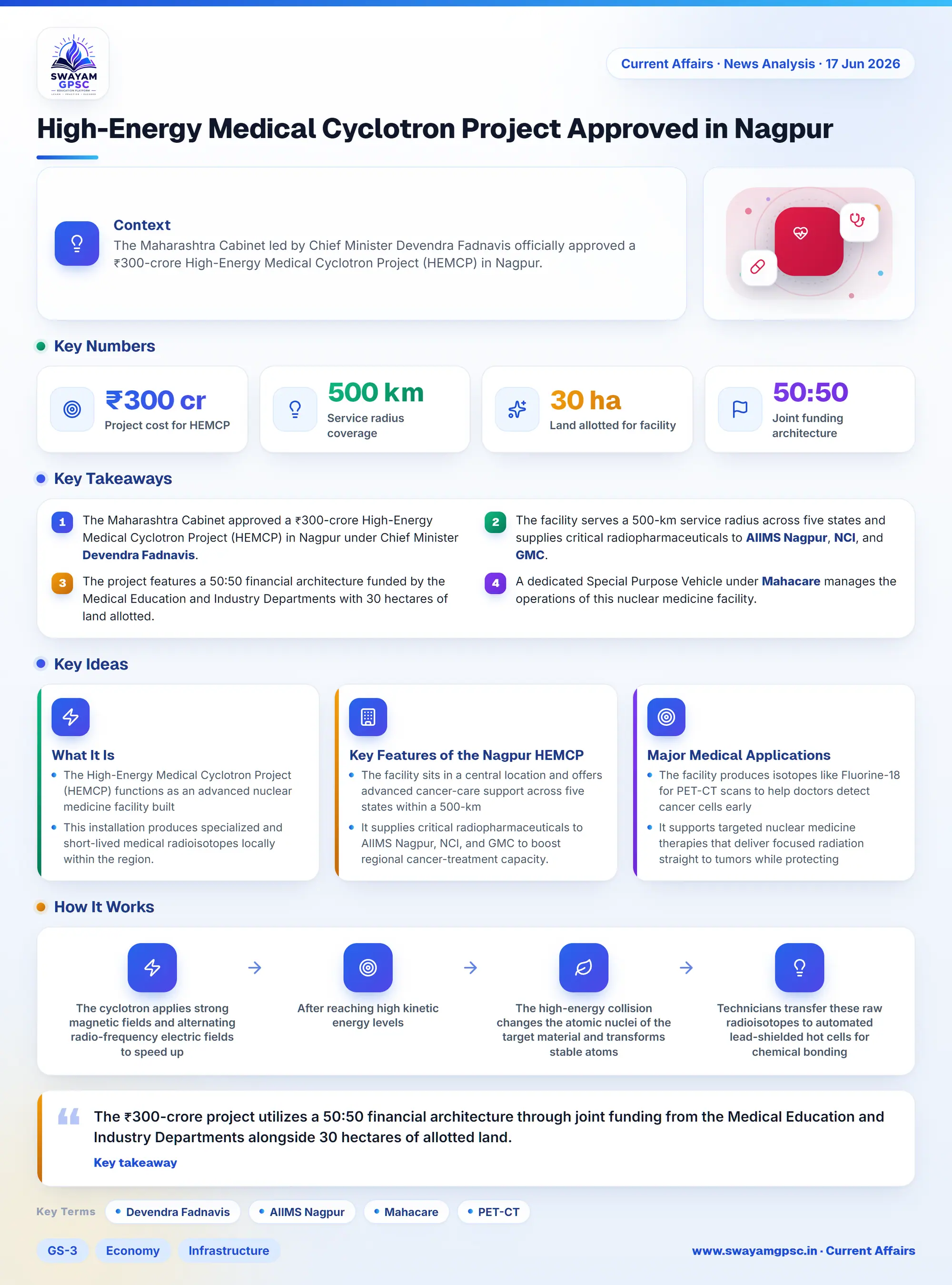
High-Energy Medical Cyclotron Project Approved in Nagpur
#GS-3 #Economy #Infrastructure #Science & Technology #Health #National #Gujarat
Key takeaways
- The Maharashtra Cabinet approved a ₹300-crore High-Energy Medical Cyclotron Project (HEMCP) in Nagpur under Chief Minister Devendra Fadnavis.
- The facility serves a 500-km service radius across five states and supplies critical radiopharmaceuticals to AIIMS Nagpur, NCI, and GMC.
- The project features a 50:50 financial architecture funded by the Medical Education and Industry Departments with 30 hectares of land allotted.
- A dedicated Special Purpose Vehicle under Mahacare manages the operations of this nuclear medicine facility.
Context
- The Maharashtra Cabinet led by Chief Minister Devendra Fadnavis officially approved a ₹300-crore High-Energy Medical Cyclotron Project (HEMCP) in Nagpur.
What It Is
- The High-Energy Medical Cyclotron Project (HEMCP) functions as an advanced nuclear medicine facility built around a particle accelerator.
- This installation produces specialized and short-lived medical radioisotopes locally within the region.
- These radioisotopes prove essential for advanced oncological imaging, targeted cancer treatments, and molecular research activities.
How It Works
- The cyclotron applies strong magnetic fields and alternating radio-frequency electric fields to speed up charged subatomic particles along a spiral path inside a vacuum chamber.
- After reaching high kinetic energy levels, these particles form a focused beam and strike a stable target material like specific isotopes or liquid metals.
- The high-energy collision changes the atomic nuclei of the target material and transforms stable atoms into short-lived radioactive isotopes such as Fluorine-18, Carbon-11, or Iodine-123.
- Technicians transfer these raw radioisotopes to automated lead-shielded hot cells for chemical bonding with biological molecules like glucose.
- This process creates medical-grade radiopharmaceuticals that patients can safely ingest or receive through intravenous methods for scanning purposes.
Key Features of the Nagpur HEMCP
- The facility sits in a central location and offers advanced cancer-care support across five states within a 500-km service radius.
- It supplies critical radiopharmaceuticals to AIIMS Nagpur, NCI, and GMC to boost regional cancer-treatment capacity.
- The ₹300-crore project utilizes a 50:50 financial architecture through joint funding from the Medical Education and Industry Departments alongside 30 hectares of allotted land.
- A dedicated Special Purpose Vehicle under Mahacare oversees operations to guarantee professional management and coordination.
Major Medical Applications
- The facility produces isotopes like Fluorine-18 for PET-CT scans to help doctors detect cancer cells early and accurately.
- It supports targeted nuclear medicine therapies that deliver focused radiation straight to tumors while protecting healthy surrounding tissue.
- The center acts as a research hub for clinical trials and assists in the development of new imaging tracers and cancer treatments.
- Local production guarantees fast delivery of short-lived isotopes to hospitals for accurate patient-specific diagnostic dosing.