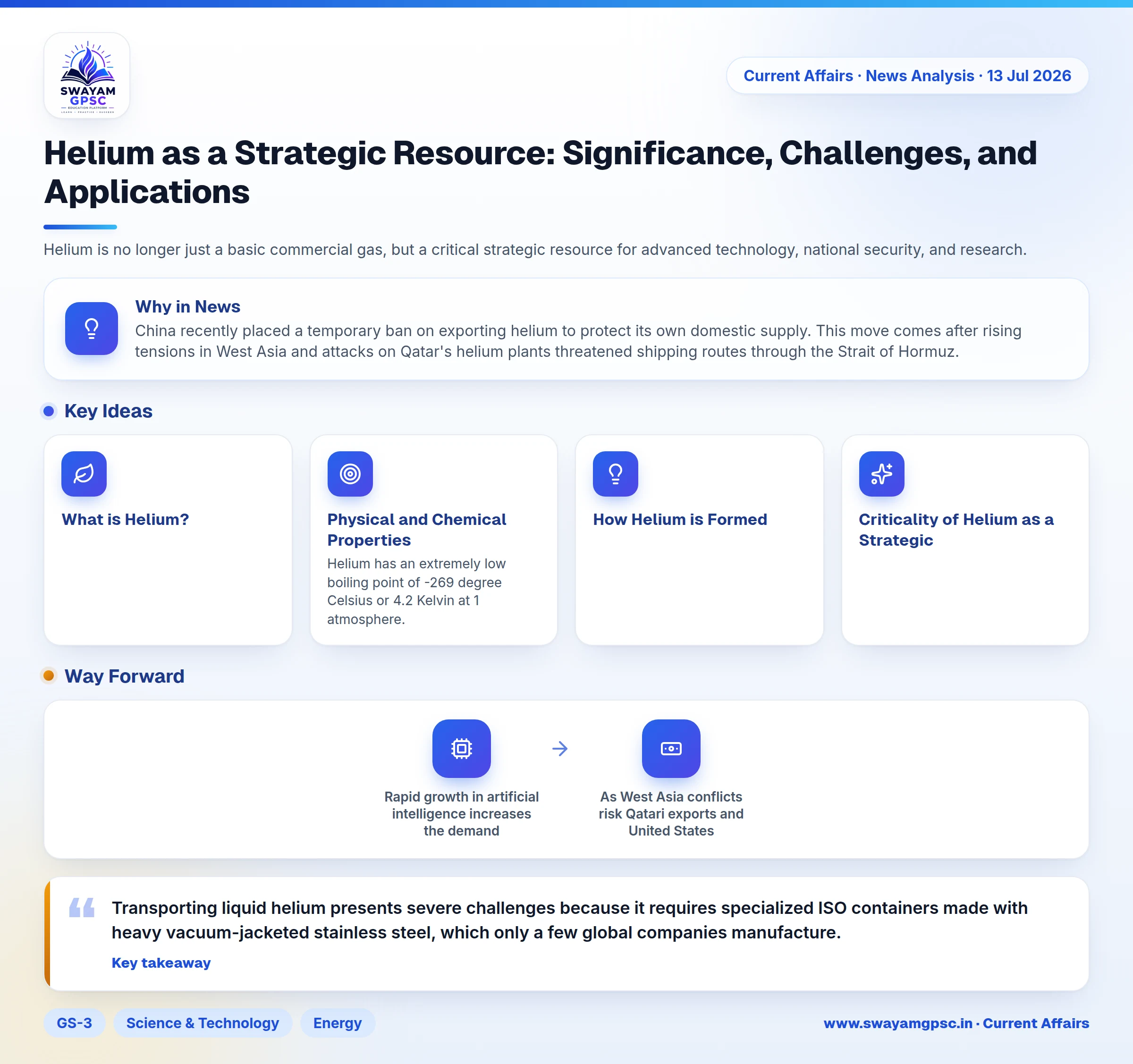
Helium as a Strategic Resource: Significance, Challenges, and Applications
#GS-3 #Science & Technology #Energy #Economy #Infrastructure #Current Events #International
Why in News
- China recently placed a temporary ban on exporting helium to protect its own domestic supply. This move comes after rising tensions in West Asia and attacks on Qatar's helium plants threatened shipping routes through the Strait of Hormuz.
What is Helium?
- Helium is no longer just a basic commercial gas, but a critical strategic resource for advanced technology, national security, and research. It is non-renewable and limited in supply, meaning humans cannot make it artificially or replace it in extremely cold environments.
Physical and Chemical Properties of Helium
- Helium has an extremely low boiling point of -269 degree Celsius or 4.2 Kelvin at 1 atmosphere. This property allows it to remain a liquid very close to absolute zero temperature.
- As a noble gas, helium shows extreme chemical inertness and does not react with other chemical substances. This quality offers a completely stable setting for sensitive manufacturing processes.
- Helium boasts high thermal conductivity, which allows it to absorb and spread heat faster than most other gases. Because of this feature, industries rely on it for fast and precise cooling.
- Helium features a tiny atomic radius with lightweight atoms that easily pass through microscopic cracks. Engineers use this property to detect tiny structural defects in high-tech equipment.
How Helium is Formed
- People cannot manufacture helium in factories, as it forms inside the Earth's crust over millions of years through the natural radioactive alpha decay of uranium and thorium.
- During this radioactive decay, emitted alpha particles collect surrounding electrons and turn into stable helium atoms.
- Over long periods, the created helium gas drifts upward and gets trapped in underground rock pockets along with natural gas reserves.
- Companies can profitably extract helium only when natural gas deposits contain at least 3% helium by volume, using cryogenic fractional distillation to separate it based on boiling points.
Criticality of Helium as a Strategic Resource
- Modern microchip production techniques like EUV lithography, plasma etching, and atomic layer deposition rely completely on liquid helium to manage heat and cool silicon wafers.
- Superconducting quantum computers require liquid helium to function properly, as their qubits stay stable only at temperatures close to absolute zero.
- Space agencies such as ISRO and NASA use pressurized helium gas to push liquid oxygen and liquid hydrogen fuels directly into rocket engines during flight.
- Hospital MRI machines use a closed-loop system of liquid helium to cool superconducting magnets, which helps maintain the magnetic field needed for medical scanning.
Key Challenges and Vulnerabilities
- Transporting liquid helium presents severe challenges because it requires specialized ISO containers made with heavy vacuum-jacketed stainless steel, which only a few global companies manufacture.
- Liquid helium carries a high risk of evaporating on its own due to its low boiling point, meaning it escapes into the atmosphere and leaves Earth's atmosphere forever once the holding time expires.
- Global helium production faces extreme supply concentration, with the United States controlling 43% and Qatar controlling 33% of the world's market.
- Key geopolitical bottlenecks create high market vulnerability, as conflicts in West Asia threaten to block helium shipments passing through the Strait of Hormuz.
Major Industrial Applications of Helium
- In silicon wafer manufacturing, helium provides a clean and inert environment to create high-purity optical fibers and cool down silicon during processing.
- Deep space rocketry relies on helium to clean out fuel lines and seal vital valves in liquid propellant stages during countdowns and launches.
- Helium acts as a safe and non-flammable gas alternative to hydrogen for filling weather tracking balloons and commercial airships.
- Technicians use helium for industrial leak detection in high-pressure pipelines, HVAC systems, and vacuum networks to pinpoint tiny cracks that other gases cannot pass through.
- Advanced arc welding, known as GTAW, uses helium as a shielding gas to prevent contamination when joining metals like aluminum and titanium.
Way Forward
- Rapid growth in artificial intelligence increases the demand for memory chips, making global technology companies highly vulnerable to localized helium supply disruptions.
- As West Asia conflicts risk Qatari exports and United States reserves shift to private ownership, India must build indigenous helium recovery facilities from domestic natural gas fields to safeguard its tech sector.