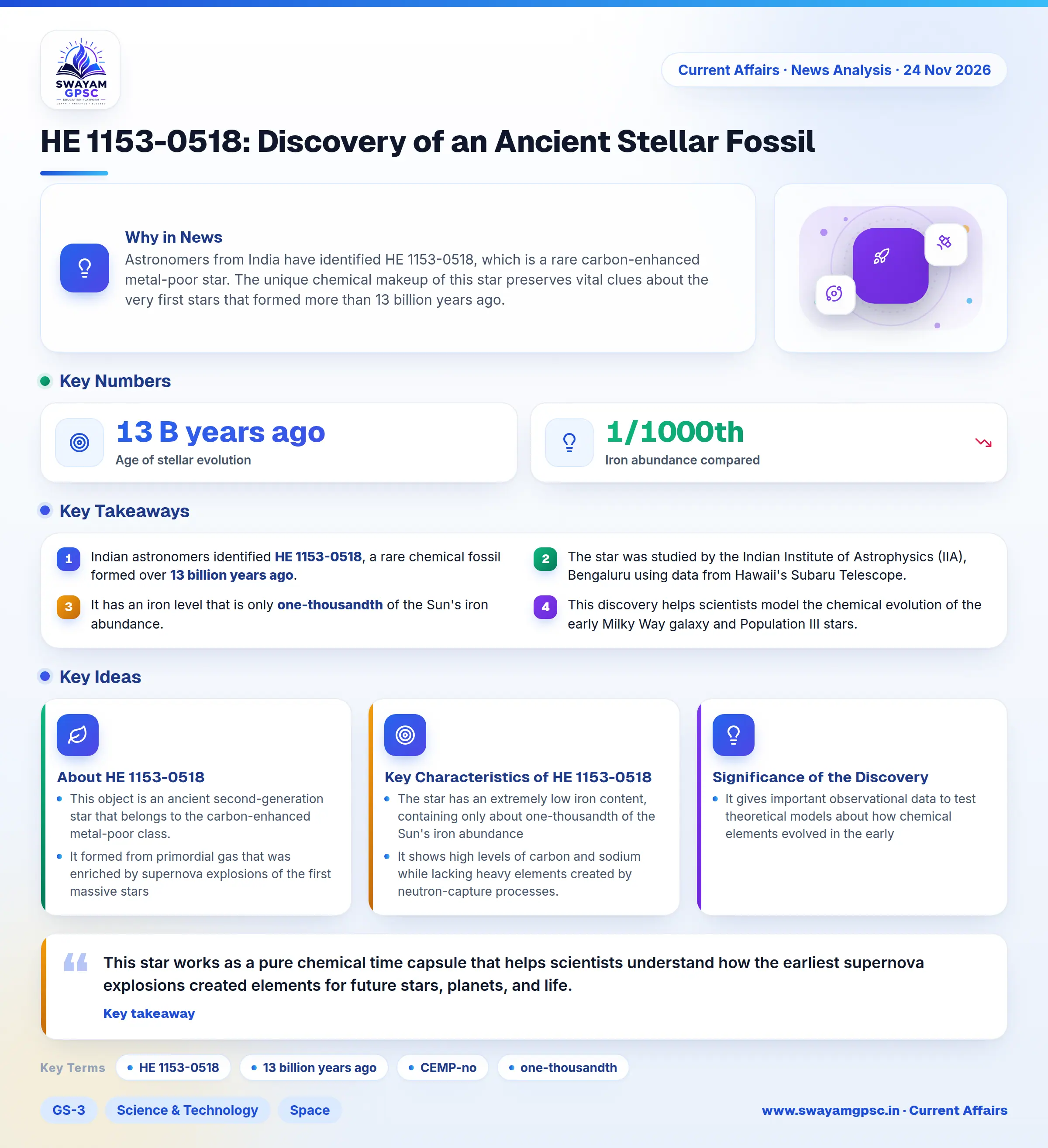
HE 1153-0518: Discovery of an Ancient Stellar Fossil
#GS-3 #Science & Technology #Space #HE 1153-0518 #CEMP-no star #Indian Institute of Astrophysics
Key takeaways
- Indian astronomers identified HE 1153-0518, a rare chemical fossil formed over 13 billion years ago.
- The star was studied by the Indian Institute of Astrophysics (IIA), Bengaluru using data from Hawaii's Subaru Telescope.
- It has an iron level that is only one-thousandth of the Sun's iron abundance.
- This discovery helps scientists model the chemical evolution of the early Milky Way galaxy and Population III stars.
Why in News
- Astronomers from India have identified HE 1153-0518, which is a rare carbon-enhanced metal-poor star.
- The unique chemical makeup of this star preserves vital clues about the very first stars that formed more than 13 billion years ago.
About HE 1153-0518
- This object is an ancient second-generation star that belongs to the carbon-enhanced metal-poor class.
- It formed from primordial gas that was enriched by supernova explosions of the first massive stars, known as Population III stars, shortly after the Big Bang.
- Researchers from the Indian Institute of Astrophysics (IIA), Bengaluru and Dakshin Kamrup College in Assam studied this star.
- The team analyzed high-resolution spectroscopic data gathered from the Subaru Telescope located in Hawaii.
Key Characteristics of HE 1153-0518
- The star has an extremely low iron content, containing only about one-thousandth of the Sun's iron abundance, which proves it formed during the earliest period of galaxy formation.
- It shows high levels of carbon and sodium while lacking heavy elements created by neutron-capture processes.
- The star has a low carbon isotopic ratio of carbon-12 to carbon-13, which shows that deep internal mixing took place inside it.
- It emits excess infrared radiation, which suggests that a layer of circumstellar dust might surround the star.
Significance of the Discovery
- This star works as a pure chemical time capsule that helps scientists understand how the earliest supernova explosions created elements for future stars, planets, and life.
- It gives important observational data to test theoretical models about how chemical elements evolved in the early Milky Way galaxy.