Gram Sabha Consent and Forest Clearance Rules
#GS-2 #GS-3 #Indian Polity & Constitution #Local Government #Governance & Social Justice #Good Governance #Current Events #National #Environment #Sustainable Development #Local Self Governance #Government Policies & Interventions
Key takeaways
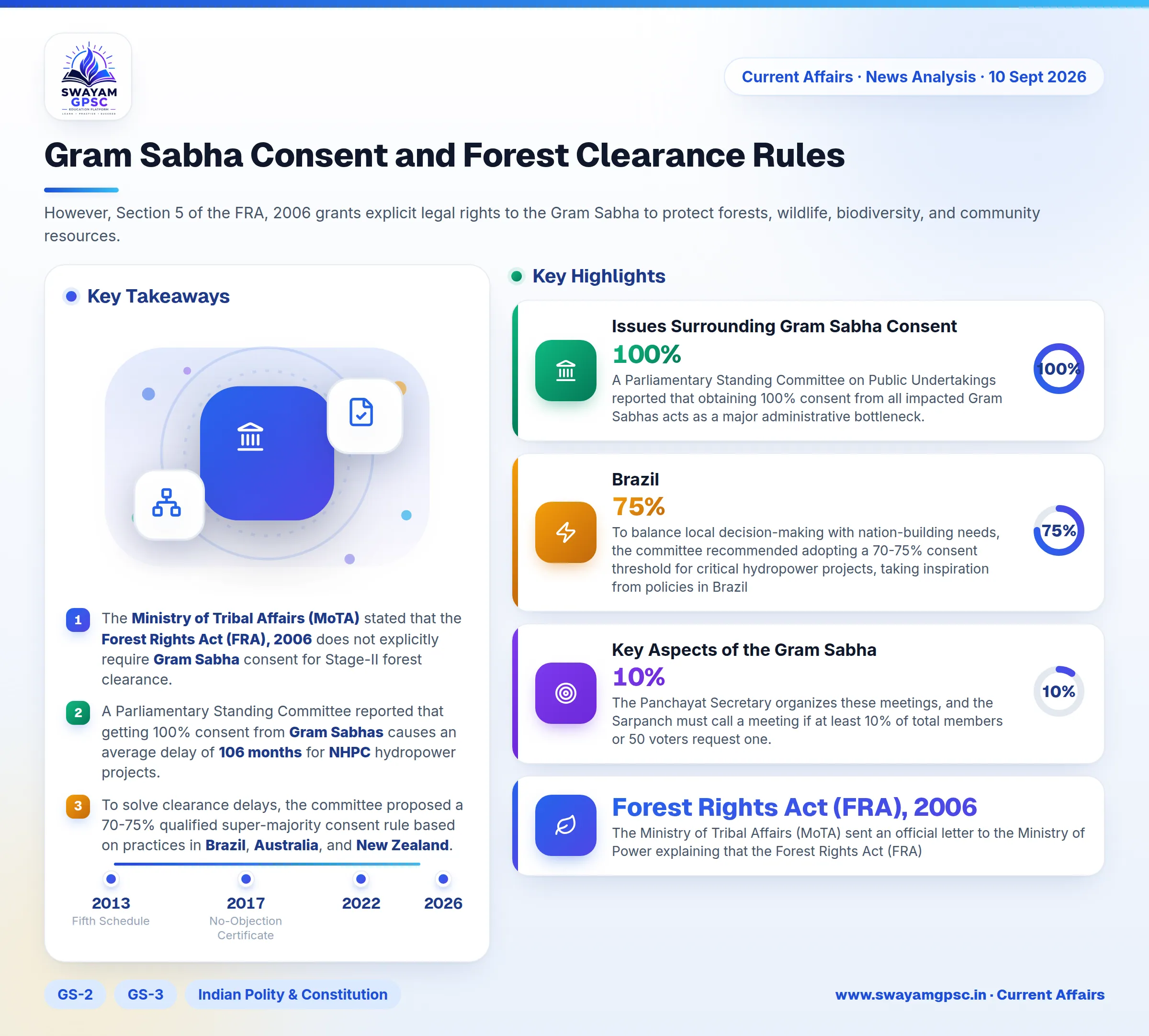
- The Ministry of Tribal Affairs (MoTA) stated that the Forest Rights Act (FRA), 2006 does not explicitly require Gram Sabha consent for Stage-II forest clearance.
- A Parliamentary Standing Committee reported that getting 100% consent from Gram Sabhas causes an average delay of 106 months for NHPC hydropower projects.
- To solve clearance delays, the committee proposed a 70-75% qualified super-majority consent rule based on practices in Brazil, Australia, and New Zealand.
- Legal experts highlight that weakening Gram Sabha consent violates the PESA Act, 1996 and the 2013 Niyamgiri Supreme Court judgment.
Why in News
- The Ministry of Tribal Affairs (MoTA) sent an official letter to the Ministry of Power explaining that the Forest Rights Act (FRA), 2006 contains no specific text requiring Gram Sabha consent for Stage-II forest clearance.
- The Ministry of Tribal Affairs also stated that this clearance process falls outside its mandate, which has triggered a fresh debate about protecting tribal rights and requiring Gram Sabha approval for public infrastructure projects.
Issues Surrounding Gram Sabha Consent
- Requiring Gram Sabha approval to divert forest land has become a main cause of delay for major infrastructure initiatives, especially hydroelectric dams managed by the National Hydroelectric Power Corporation (NHPC).
- A Parliamentary Standing Committee on Public Undertakings reported that obtaining 100% consent from all impacted Gram Sabhas acts as a major administrative bottleneck.
- Under-construction NHPC initiatives spend an average of 106 months obtaining forest clearances, whereas environmental clearances take only 7.2 months.
- For instance, the Teesta-IV Hydroelectric Project (HEP) remains stalled because 3 Gram Panchayats have withheld approval, even though 7 other Gram Panchayats gave their consent.
- To balance local decision-making with nation-building needs, the committee recommended adopting a 70-75% consent threshold for critical hydropower projects, taking inspiration from policies in Brazil, Australia, and New Zealand.
Legal Origin of Gram Sabha Consent
- The original text of the Forest Rights Act (FRA), 2006 does not include the exact phrase regarding Gram Sabha consent for diverting forest areas.
- However, Section 5 of the FRA, 2006 grants explicit legal rights to the Gram Sabha to protect forests, wildlife, biodiversity, and community resources.
- The requirement for local approval developed through executive rules created under the Forest (Conservation) Act, 1980 (FCA).
- Authorities must complete all rights recognition procedures under the FRA, 2006 before they can legally hand over forest lands for non-forest uses.
- Diverting forest land follows a two-step approval model: Stage-I gives basic in-principle permission, while Stage-II gives the final clearance.
- Earlier rules based on a 2009 circular and a 2017 amendment made it mandatory to settle all forest rights and receive a formal No-Objection Certificate (NOC) from Gram Sabhas before Stage-II clearance.
- The Forest (Conservation) Rules, 2022 removed this requirement, allowing central authorities to approve land transfers before settling local community rights.
- The Ministry of Tribal Affairs (MoTA) maintains that while it acts as the main central ministry for the FRA, 2006, actual execution on the ground rests with state governments and Union Territory authorities.
- The ministry took a similar legal stand during the Great Nicobar Island development project, where it asked to be removed as a respondent using the same arguments.
Key Aspects of the Gram Sabha
- The 73rd Constitutional Amendment Act, 1992 and Article 243(b) established the Gram Sabha as a constitutional body comprising every registered voter in a village.
- The Gram Sabha is a permanent body that underpins local self-governance without having separate elected representatives, and state laws define its powers.
- State rules require the Gram Sabha to convene at least 2 to 4 times every year, usually on Republic Day, Labour Day, Independence Day, and Gandhi Jayanti.
- The Panchayat Secretary organizes these meetings, and the Sarpanch must call a meeting if at least 10% of total members or 50 voters request one.
- A 2026 study by the Ministry of Panchayati Raj noted that public participation remains low because of daily job constraints, lack of awareness, and slow grievance mechanisms.
- The village Sarpanch chairs the meeting, and in their absence, the Up-Sarpanch or a member chosen by the present group leads the assembly.
- This body approves village development plans, establishes local priorities, and checks local budgets and spending before the Gram Panchayat carries out work.
- It manages village public infrastructure and local natural resources, while verifying individual and community forest claims.
- It keeps local administration accountable by conducting social audits, picking scheme beneficiaries, and resolving minor local disagreements.
Concerns Regarding MoTA Stance
- Legal scholars contend that the Ministry of Tribal Affairs (MoTA) cannot step away from its duty without leaving forest communities without central support.
- This stance goes against the constitutional protections in the Fifth Schedule, Sixth Schedule, and PESA Act, 1996, while ignoring the landmark 2013 Niyamgiri Supreme Court judgment.
- Lowering the required consent level from 100% to a 70-75% super-majority means smaller hamlets directly losing land could be easily outvoted by larger nearby villages.
- Skipping full informed consent increases the risk of forced displacement, which could spark widespread local opposition across forested tribal regions.
Way Forward
- India must create transparent, time-bound clearance processes that prevent infrastructure delays without removing the basic legal rights of tribal populations.
- Improving inter-ministerial dialogue and setting up strong grievance redressal systems will help reconcile industrial growth with tribal welfare.
- Safeguarding Gram Sabha decision-making is necessary to achieve inclusive, law-abiding, and sustainable governance across the nation.