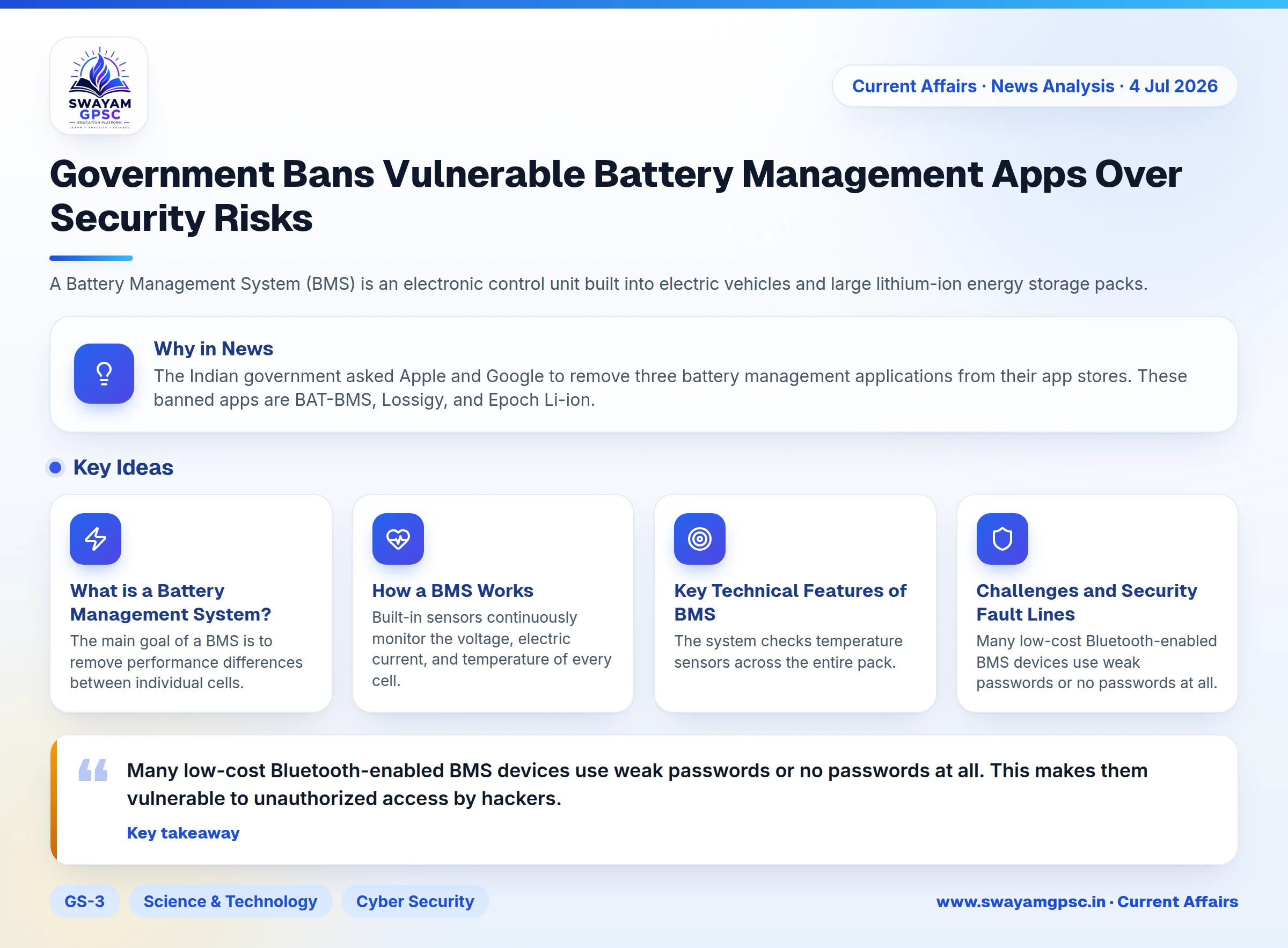
Government Bans Vulnerable Battery Management Apps Over Security Risks
#GS-3 #Science & Technology #Cyber Security #Energy #Current Events #National #Battery Management System #Electric Vehicles
Why in News
- The Indian government asked Apple and Google to remove three battery management applications from their app stores. These banned apps are BAT-BMS, Lossigy, and Epoch Li-ion.
- The government took this action because these apps posed serious cybersecurity threats and created safety risks for passengers.
What is a Battery Management System?
- A Battery Management System (BMS) is an electronic control unit built into electric vehicles and large lithium-ion energy storage packs. It serves as the main brain of the battery pack by monitoring physical and electrical conditions of every cell.
- The main goal of a BMS is to remove performance differences between individual cells. This helps all cells inside a large battery pack to charge and discharge at the same rate.
How a BMS Works
- Built-in sensors continuously monitor the voltage, electric current, and temperature of every cell. This helps the system calculate the real-time State of Charge (SoC) and State of Health (SoH).
- If some battery cells charge faster than others, the BMS turns on balancing circuits. It removes extra energy from stronger cells or sends it to weaker cells so the whole battery pack works as one balanced unit.
- If the system detects dangerous electrical limits, it uses electronic switches like MOSFETs or relays. These switches immediately shut down the circuit to protect the hardware and keep users safe.
Key Technical Features of BMS
- Modern BMS units include Bluetooth Low Energy (BLE) modules that connect wirelessly within a 15-meter distance.
- Technicians can use special mobile apps to check live diagnostic data, track charging cycles, and read system error logs.
- The system checks temperature sensors across the entire pack. If any cell gets too hot, the system reduces power output or turns on cooling systems to prevent fires.
- Advanced algorithms track remaining battery energy like a digital fuel gauge and monitor long-term battery degradation.
- The system constantly monitors electric current. If it detects a sudden power spike, it opens the main safety switch instantly to protect the motor and wiring.
Challenges and Security Fault Lines
- Many low-cost Bluetooth-enabled BMS devices use weak passwords or no passwords at all. This makes them vulnerable to unauthorized access by hackers.
- Default security settings allow any smartphone within 15 meters to connect through diagnostic apps. Unapproved users can then change battery settings and even disable the battery discharge function.
- Turning off the battery discharge circuit cuts power to the electric motor instantly. This brings the vehicle to a sudden stop and creates a major risk of road accidents and injuries.