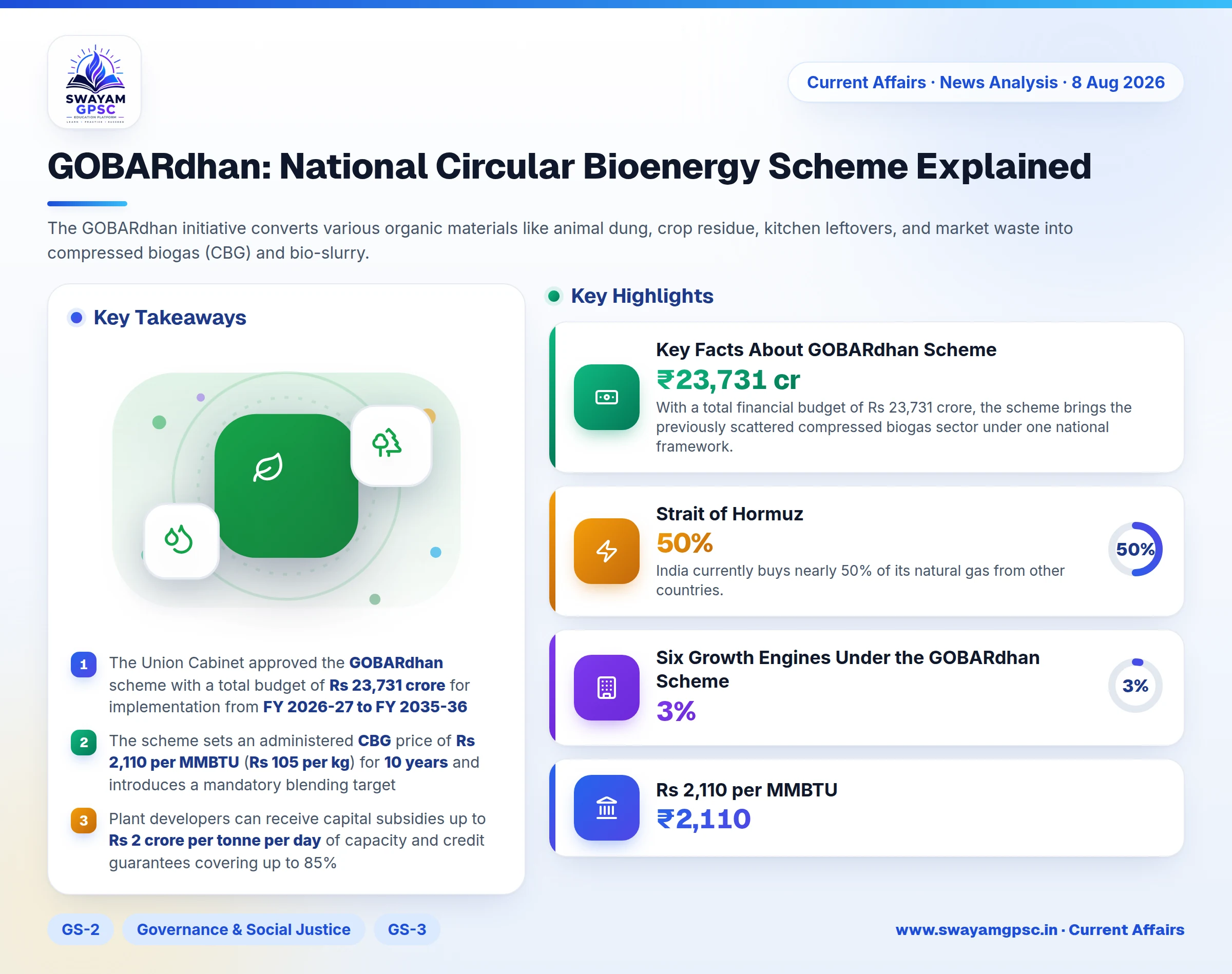
GOBARdhan: National Circular Bioenergy Scheme Explained
#GS-2 #Governance & Social Justice #GS-3 #Economy #Infrastructure #Science & Technology #Energy #Environment #Sustainable Development
Key takeaways
- The Union Cabinet approved the GOBARdhan scheme with a total budget of Rs 23,731 crore for implementation from FY 2026-27 to FY 2035-36 under the Ministry of Petroleum and Natural Gas.
- The scheme sets an administered CBG price of Rs 2,110 per MMBTU (Rs 105 per kg) for 10 years and introduces a mandatory blending target rising from 3% in FY 2026-27 to 5% by FY 2028-29.
- Plant developers can receive capital subsidies up to Rs 2 crore per tonne per day of capacity and credit guarantees covering up to 85% on project loans.
- The policy expects to generate over Rs 75,000 crore for India's economy, create 1.5 lakh jobs, and reduce 40 million tonnes of carbon dioxide emissions.
Why in News
- The Union Cabinet recently approved the GOBARdhan scheme, also known as the National Circular Bioenergy Scheme. This program turns organic waste into clean energy while creating economic growth in rural areas.
Key Facts About GOBARdhan Scheme
- The GOBARdhan initiative converts various organic materials like animal dung, crop residue, kitchen leftovers, and market waste into compressed biogas (CBG) and bio-slurry.
- The central government approved this scheme on 6th August 2026, setting its operational period from FY 2026-27 to FY 2035-36 under the Ministry of Petroleum and Natural Gas.
- With a total financial budget of Rs 23,731 crore, the scheme brings the previously scattered compressed biogas sector under one national framework.
- This program relies on six key growth engines that handle product purchasing, pricing, financial assistance, pipeline networks, loan guarantees, and overall ecosystem building.
- The government aims to expand domestic CBG production nearly 10 times, bring in private investment, and turn rural areas into clean energy hubs that boost national energy security.
- India currently buys nearly 50% of its natural gas from other countries. Supply risks near the Strait of Hormuz, which carries 55% to 60% of India's imported LNG, make local bioenergy production essential.
- Biogas producers must register on the GOBARdhan Unified Registration Portal to receive an official identification number and claim government benefits.
- By 6th August 2026, producers registered 1,908 plants on the platform, including 217 functional plants producing 0.4 MMSCMD of gas and 339 plants under active construction.
Six Growth Engines Under the GOBARdhan Scheme
- Under the guaranteed purchase system, City Gas Distribution companies must buy 3% CBG in FY 2026-27, 4% in FY 2027-28, and 5% from FY 2028-29 onward for transport and household gas supply, creating a reliable market for private investors.
- The policy establishes a fixed government price of Rs 2,110 per MMBTU or Rs 105 per kg of CBG for at least 10 years, giving plant owners guaranteed profits while keeping fuel affordable.
- New projects can get direct financial support of up to Rs 2 crore per tonne per day of production capacity, alongside grants for raw material collection, fertilizer processing, and plant expansions.
- The government funds dedicated supply pipelines that connect biogas plants directly to main gas grids and local distribution networks, lowering transport expenses.
- Small businesses and new entrepreneurs can access bank loans more easily because the government provides credit guarantees covering up to 85% of the borrowed amount.
- A dedicated challenge fund helps local districts assess raw material supplies, improve processing technology, train workers, and promote organic fertilizers.
Expected Outcomes of the GOBARdhan Scheme
- Guaranteed purchase rules, stable gas prices, and direct financial subsidies will make projects profitable and draw heavy private sector investment.
- The growth of the compressed biogas industry will add over Rs 75,000 crore to India's total economic output over the next decade.
- This sector will create more than 1.5 lakh jobs while helping farmers, local cooperatives, and village entrepreneurs earn extra income from raw material collection.
- Converting farm waste, animal dung, and city organic garbage into clean fuel keeps waste out of harmful open landfills.
- Replacing traditional fossil fuels with clean biogas will cut carbon emissions by more than 40 million tonnes.
- The scheme will produce roughly 250 million metric tonnes of natural fertilizer, boosting the use of Fermented Organic Manure and Liquid Fermented Organic Manure in farming.
Government Initiatives for Building CBG Ecosystem
- India built its bioenergy foundation through key programs like the SATAT initiative, the Market Development Assistance Scheme, the Biomass Aggregation Machinery Scheme, and the National Bioenergy Programme.
- Under the Biomass Aggregation Machinery (BAM) Scheme, which has a budget of Rs 564.75 crore, the Ministry approved 37 funding proposals worth Rs 248 crore by 16th March 2026 to help producers buy harvesting equipment.
- The Development of Pipeline Infrastructure (DPI) Scheme set aside Rs 994.5 crore between FY 2024-25 and FY 2028-29, sanctioning Rs 56.31 crore so far to build connection pipelines.
- The Market Development Assistance (MDA) Scheme gives plant operators Rs 1,500 per metric tonne to support the sale of organic fertilizers.
- By 4th March 2026, operators registered 120 CBG plants on the national fertilizer portal, signed 44 partnership agreements, and conducted 15,690 farmer awareness workshops over twelve months.
Way Forward
- The GOBARdhan scheme turns organic waste into clean energy and rural wealth through clear price guarantees, direct funding, pipeline links, and cheap loans. Expanding this compressed biogas network directly strengthens national energy security and advances the goals of Atmanirbhar Bharat and Viksit Bharat.
Frequently Asked Questions
- The acronym GOBARdhan stands for Galvanizing Organic Bio-Agro Resources Dhan.
- The central government first launched the GOBARdhan initiative on 30th April 2018 as part of the Swachh Bharat Mission Grameen.
- The CBG Obligation mandates gas companies to blend 3% bio-gas in FY 2026-27, 4% in FY 2027-28, and 5% from FY 2028-29 onward into commercial and home supplies.
- The Ministry of Petroleum and Natural Gas manages and supervises the new national framework.
- Compressed Biogas (CBG) is purified organic gas converted into clean fuel that easily connects to standard natural gas pipelines and vehicles.