The GOBARdhan Initiative for Circular Bioenergy
#GS-3 #Economy #Infrastructure #Agriculture #Environment #Sustainable Development #Current Events #National
Key takeaways
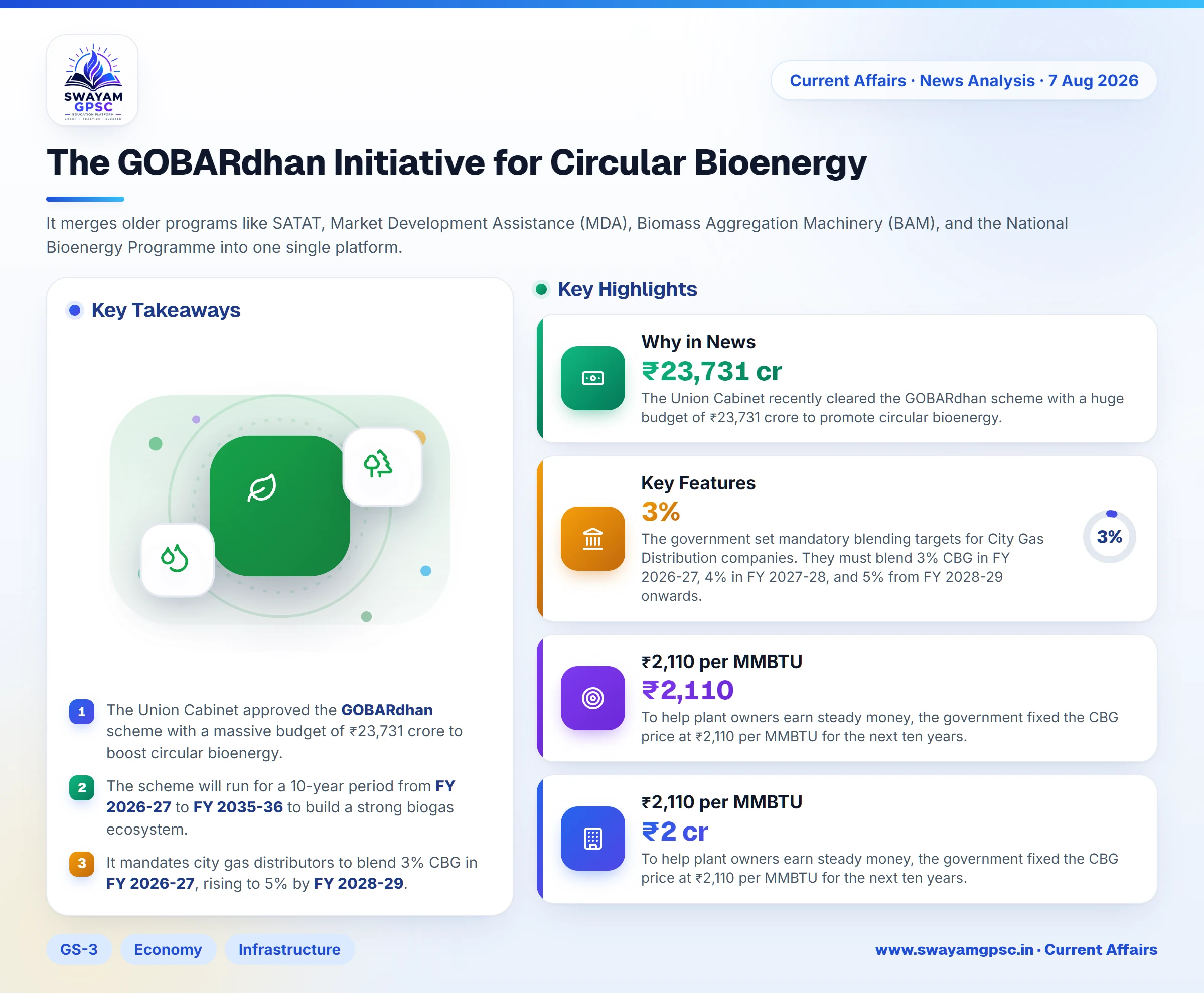
- The Union Cabinet approved the GOBARdhan scheme with a massive budget of ₹23,731 crore to boost circular bioenergy.
- The scheme will run for a 10-year period from FY 2026-27 to FY 2035-36 to build a strong biogas ecosystem.
- It mandates city gas distributors to blend 3% CBG in FY 2026-27, rising to 5% by FY 2028-29.
- The government set a stable administered price of ₹2,110 per MMBTU for CBG to help plant operators.
Why in News
- The Union Cabinet recently cleared the GOBARdhan scheme with a huge budget of ₹23,731 crore to promote circular bioenergy.
About the GOBARdhan Initiative
- This national framework brings the entire Compressed Biogas (CBG) sector together. It turns farm waste, cow dung, and city waste into clean fuel and high-quality organic fertilizers.
- The Ministry of Petroleum and Natural Gas (MoPNG) will manage this initiative across the country.
- The government will run this scheme over a 10-year period starting from FY 2026-27 to FY 2035-36.
- It merges older programs like SATAT, Market Development Assistance (MDA), Biomass Aggregation Machinery (BAM), and the National Bioenergy Programme into one single platform.
- The main goal is to make CBG a major part of India's green energy. This will boost local production, attract private money, support rural business, and cut down gas imports.
Key Features
- The government set mandatory blending targets for City Gas Distribution companies. They must blend 3% CBG in FY 2026-27, 4% in FY 2027-28, and 5% from FY 2028-29 onwards.
- To help plant owners earn steady money, the government fixed the CBG price at ₹2,110 per MMBTU for the next ten years.
- New and expanding projects can get financial help up to ₹2 crore per Ton Per Day (TPD) of capacity. This money also supports collecting raw materials and processing manure.
- The scheme funds new pipelines to connect local biogas plants directly with city gas networks and the national grid.
- A special credit guarantee system will help small businesses, cooperatives, and rural entrepreneurs get bank loans with lower risks.
- A dedicated fund will help districts map their waste resources, support new technologies, train workers, and improve organic manure quality.
Significance
- Producing more local biogas will reduce expensive LNG imports. This saves valuable foreign exchange and makes India more self-reliant in energy.
- Farmers can earn extra money by selling crop waste and cow dung. This also stops them from burning crop residue and helps produce rich organic fertilizer.