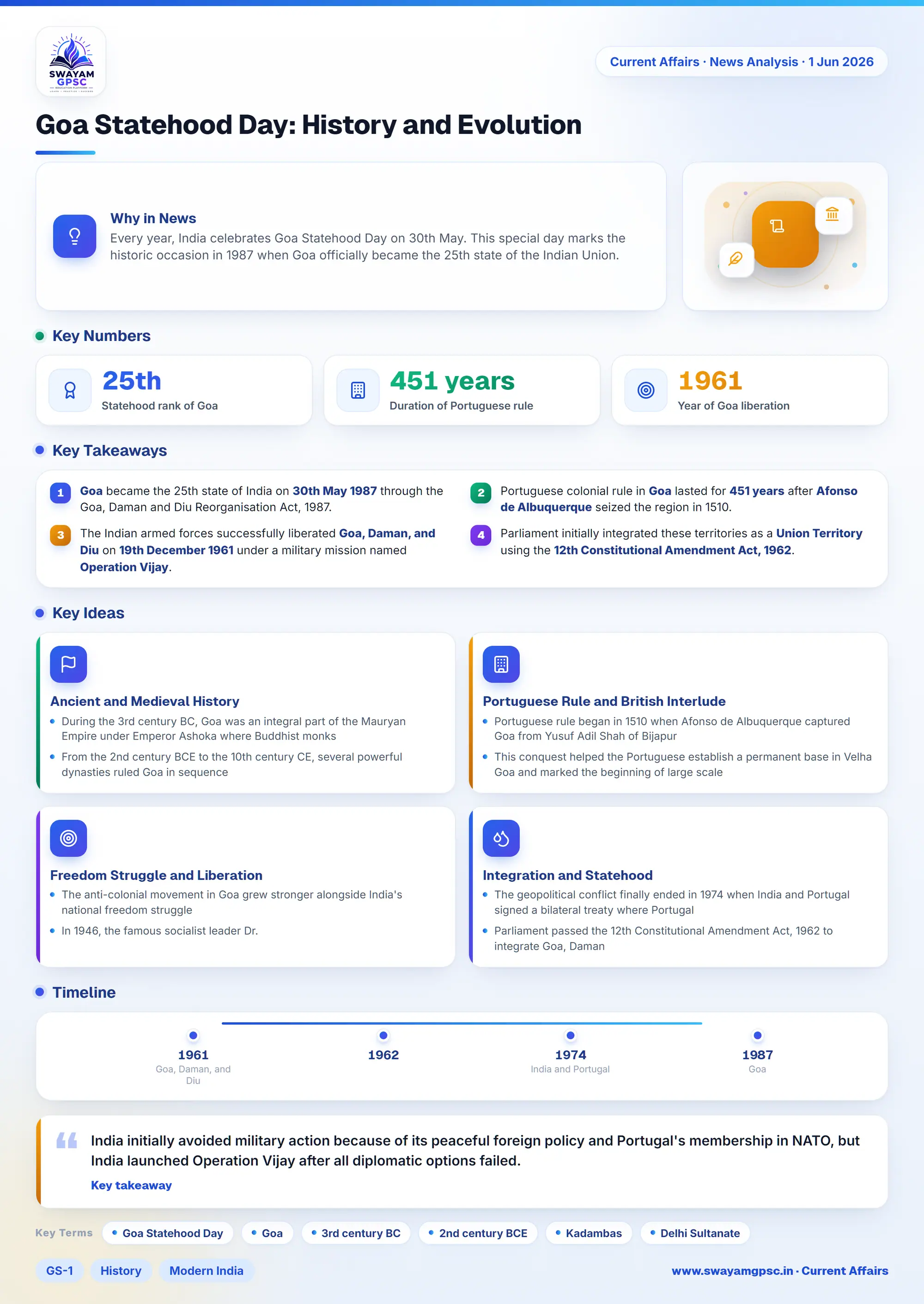
Goa Statehood Day: History and Evolution
#GS-1 #History #Modern India #Freedom Struggle #GS-2 #Current Events #National
Key takeaways
- Goa became the 25th state of India on 30th May 1987 through the Goa, Daman and Diu Reorganisation Act, 1987.
- Portuguese colonial rule in Goa lasted for 451 years after Afonso de Albuquerque seized the region in 1510.
- The Indian armed forces successfully liberated Goa, Daman, and Diu on 19th December 1961 under a military mission named Operation Vijay.
- Parliament initially integrated these territories as a Union Territory using the 12th Constitutional Amendment Act, 1962.
- Portugal formally recognized India's sovereignty over these enclaves by signing a bilateral treaty in 1974.
Why in News
- Every year, India celebrates Goa Statehood Day on 30th May.
- This special day marks the historic occasion in 1987 when Goa officially became the 25th state of the Indian Union.
Ancient and Medieval History
- During the 3rd century BC, Goa was an integral part of the Mauryan Empire under Emperor Ashoka where Buddhist monks laid the initial religious foundations of the region.
- From the 2nd century BCE to the 10th century CE, several powerful dynasties ruled Goa in sequence, including the Satavahanas, the Western Kshatrapas, the Bhojas, the Chalukyas of Badami, and the Rashtrakutas.
- Later, the Kadambas ruled as feudatories of the Chalukyas of Kalyani and actively supported and patronized Jainism across Goa.
- The region saw rapid changes in power during the later medieval period when the Delhi Sultanate took control in 1312, followed by Harihara I of the Vijayanagara Empire in 1370, the Bahmani sultans of Gulbarga in 1469, and finally the Adil Shahis of Bijapur.
Portuguese Rule and British Interlude
- Portuguese rule began in 1510 when Afonso de Albuquerque captured Goa from Yusuf Adil Shah of Bijapur, starting a colonial reign that lasted for 451 years.
- This conquest helped the Portuguese establish a permanent base in Velha Goa and marked the beginning of large scale conversions to Christianity in the region.
- The Portuguese administration officially shifted its colonial capital from Velha Goa to Panjim in the year 1843.
- During the Napoleonic Wars, the British temporarily occupied Goa from 1812 to 1815.
Freedom Struggle and Liberation
- The anti-colonial movement in Goa grew stronger alongside India's national freedom struggle, highlighted by Tristão de Bragança Cunha founding the Goa National Congress in 1928 during the Calcutta session of the Indian National Congress.
- In 1946, the famous socialist leader Dr. Ram Manohar Lohia led a historic rally in Goa which successfully energized the local struggle for civil liberties and complete integration with India.
- India initially avoided military action because of its peaceful foreign policy and Portugal's membership in NATO, but India launched Operation Vijay after all diplomatic options failed.
- The Indian armed forces successfully liberated Goa, Daman, and Diu from Portuguese rule on 19th December 1961.
Integration and Statehood
- The geopolitical conflict finally ended in 1974 when India and Portugal signed a bilateral treaty where Portugal officially recognized India's sovereignty over Goa, Daman and Diu, and Dadra & Nagar Haveli.
- Parliament passed the 12th Constitutional Amendment Act, 1962 to integrate Goa, Daman, and Diu as a Union Territory under the First Schedule of the Constitution.
- Finally, the Goa, Daman and Diu Reorganisation Act, 1987 granted full statehood to Goa on 30th May 1987, while Daman and Diu remained a separate Union Territory.